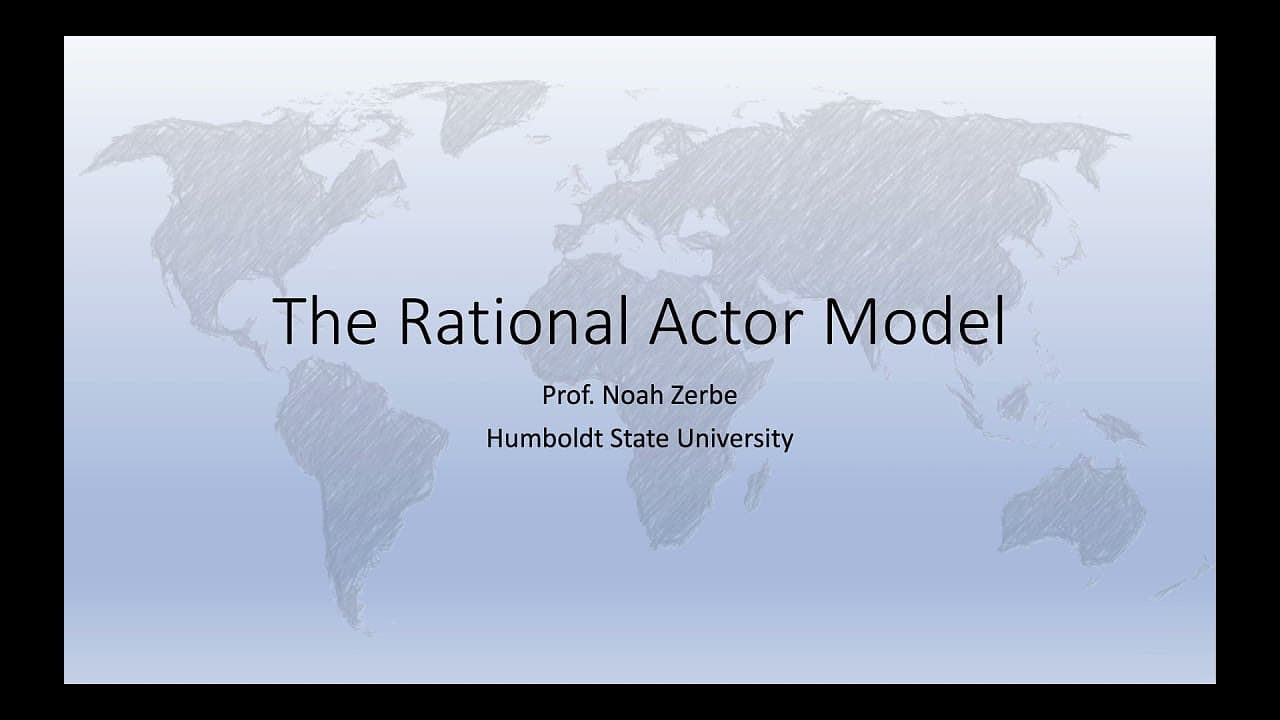
The Rational Actor Model of Foreign Policy Decision Making
TL;DR
The rational actor model assumes that decision makers in foreign policy make consistent, value-maximizing choices based on specific goals and constraints, but it has limitations.
Transcript
Hey everyone. Noah Zerbe here. This is one of a series of videos looking at decision making in foreign policy. In this video, we're going to break down the rational actor model. So let's start with the question of what makes an actor rational? That is, what do we mean by rationality? Graham Allison defines rationality as, "consistent, val... Read More
Key Insights
- 🧑🏭 The rational actor model assumes decision makers are rational, purposeful, and value-maximizing.
- 😫 It assumes a decision-making process of problem identification, goal-setting, information gathering, evaluation, selection, implementation, and evaluation.
- ✊ The model misses out on the context of decision making, such as conflicting power centers and contested preferences.
- 😀 Decision making is often characterized by incomplete or inaccurate information and can face implementation challenges.
Install to Summarize YouTube Videos and Get Transcripts
Explore YouTube Video Summarizer or Get YouTube Transcript Extractor
Questions & Answers
Q: What does the rational actor model assume about decision makers in foreign policy?
The rational actor model assumes that decision makers are rational, purposeful, and value-maximizing individuals who have clear goals and preferences.
Q: Does the rational actor model guarantee sound outcomes in decision making?
No, the rational actor model suggests that the decision-making process will lead to better decisions, but it does not guarantee better outcomes. Sound outcomes depend on various factors beyond rationality.
Q: Are states' preferences always unified and clearly specified, as assumed by the rational actor model?
No, in reality, states' preferences are often contested, and decision makers often operate based on competing interests and objectives.
Q: How does the rational actor model view the implementation of decisions?
The rational actor model assumes that implementation is relatively efficient, but in reality, implementation can be delayed, characterized by conflict and miscommunication due to bureaucratic and political processes.
Summary & Key Takeaways
-
The rational actor model assumes that decision makers in foreign policy act purposefully, have clear goals, rank their preferences, and maximize utility.
-
It is based on the assumptions that decision makers have a pyramid of authority, receive advice and information, and can coordinate the bureaucracy.
-
The model follows a decision-making process of problem identification, goal-setting, gathering information, evaluating alternatives, selecting the best option, implementation, and evaluation.
Read in Other Languages (beta)
Share This Summary 📚
Summarize YouTube Videos and Get Video Transcripts with 1-Click
Try YouTube Summary with ChatGPT & Claude or YouTube Transcript Generator
Explore More Summaries from Noah Zerbe 📚

Summarize YouTube Videos and Get Video Transcripts with 1-Click
Try YouTube Summary with ChatGPT & Claude or YouTube Transcript Generator