Why Mount Everest's height keeps changing
TL;DR
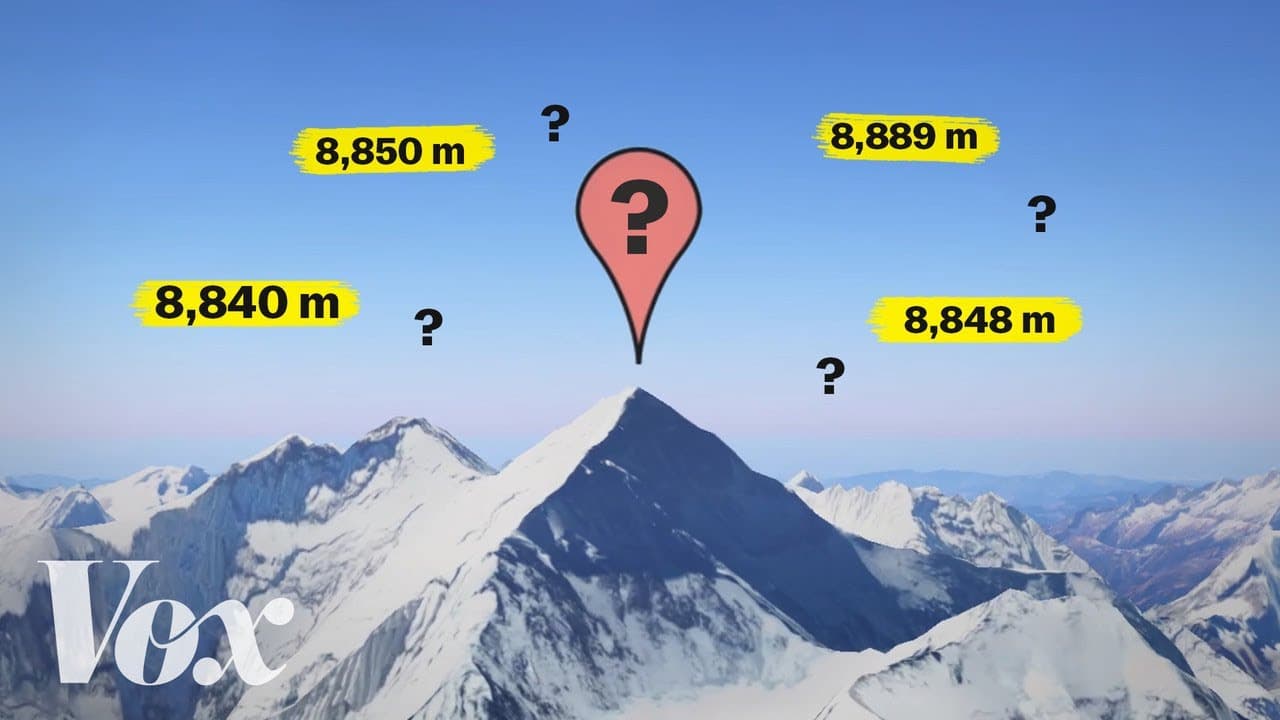
Mount Everest's height varies due to measurement methods and tectonic activity.
Transcript
These two men were the first to climb to the top of Mt. Everest. Edmund Hillary, from New Zealand, and Tenzing Norgay, a Sherpa from from Nepal and India, became global celebrities after reaching the summit, where Hillary snapped this photo of Norgay holding their national flags. Since then, many have followed in their footsteps, raising their own ... Read More
Key Insights
- Edmund Hillary and Tenzing Norgay were the first to summit Mount Everest in 1953, reaching a height of 8,840 meters. Since then, various expeditions have reported slightly different heights due to measurement techniques.
- The height of Mount Everest has been officially recorded at different values over time, with the most recent measurement in 2020 being 8,849 meters. This variation is due to changes in surveying technology and tectonic activity.
- The Great Trigonometrical Survey of India in the 19th century was the first to measure Everest's height, using a theodolite and trigonometry from over 100 miles away due to restrictions in Nepal.
- Sea level is crucial for measuring mountain heights, but it's not uniform globally due to tides, climate change, and Earth's gravitational variations, making precise measurements challenging.
- The collision of the Indian and Asian tectonic plates, which formed the Himalayas, continues to cause the range to rise approximately 5 millimeters annually, impacting Everest's height.
- The 2015 earthquake in Nepal prompted a re-evaluation of Everest's height, leading to a collaborative measurement effort by Nepalese and Chinese surveyors using modern GPS technology.
- Nepal's 2020 measurement was significant as it marked the first time the country independently measured Everest's height, reflecting national pride and technological advancement.
- Different measurement methods could make other mountains appear taller than Everest, such as Chimborazo in Ecuador or Mauna Kea in Hawaii, depending on the reference point used.
Install to Summarize YouTube Videos and Get Transcripts
Explore YouTube Video Summarizer or Get YouTube Transcript Extractor
Questions & Answers
Q: Why do the recorded heights of Mount Everest vary?
The recorded heights of Mount Everest vary due to differences in measurement techniques over time, including the tools and methods used. Early measurements relied on trigonometry and distant calculations, while modern methods use GPS technology and account for sea level variations and tectonic activity. These factors, along with natural changes like tectonic shifts, contribute to the variation in recorded heights.
Q: What was the significance of the 2020 measurement of Mount Everest?
The 2020 measurement of Mount Everest was significant because it marked the first time Nepal independently measured the mountain's height, reflecting national pride and technological advancement. The joint announcement with China, declaring the height as 8,849 meters, highlighted improved surveying techniques and international collaboration in accurately determining the world's tallest mountain's height.
Q: How did early surveyors measure Mount Everest's height?
Early surveyors measured Mount Everest's height using the Great Trigonometrical Survey of India, which involved trigonometry and a theodolite to calculate the height from over 100 miles away due to political restrictions in Nepal. This method required estimating sea level and measuring angles between points, providing an initial height of 8,840 meters in 1855.
Q: What role does sea level play in measuring mountain heights?
Sea level serves as the baseline for measuring mountain heights, but it's not uniform globally due to tides, climate change, and Earth's gravitational variations. These fluctuations make precise measurements challenging, as surveyors must account for the geoid, an irregular shape representing Earth's true sea level, to accurately determine a mountain's height.
Q: How do tectonic shifts affect Mount Everest's height?
Tectonic shifts affect Mount Everest's height by causing the Himalayas to rise approximately 5 millimeters annually due to the ongoing collision between the Indian and Asian tectonic plates. This geological activity can alter the mountain's height over time, necessitating periodic re-measurements to account for these natural changes.
Q: What technology is used in modern measurements of Mount Everest?
Modern measurements of Mount Everest use GPS technology, which provides accurate height readings by calculating the time it takes for satellite signals to reach a receiver. However, these measurements must be adjusted for Earth's ellipsoid and geoid to establish local sea level, ensuring precise height determination despite natural and technological challenges.
Q: What challenges do surveyors face when measuring Mount Everest?
Surveyors face challenges when measuring Mount Everest due to the need to accurately determine sea level, which varies globally due to tides, climate change, and gravitational differences. Additionally, the mountain's remote location and extreme altitude complicate data collection, requiring advanced technology and international collaboration to achieve precise measurements.
Q: How could other mountains be considered taller than Everest?
Other mountains could be considered taller than Everest depending on the measurement method. For example, if measured from Earth's center, Mount Chimborazo in Ecuador would be taller due to its equatorial location. Similarly, Mauna Kea in Hawaii, when measured from its base on the ocean floor, exceeds Everest's height, highlighting the impact of reference points on perceived elevation.
Summary & Key Takeaways
-
Mount Everest's height has been recorded differently over the years due to advancements in measurement technology and tectonic shifts. The most recent measurement in 2020, conducted jointly by Nepal and China, recorded the height as 8,849 meters, reflecting both natural changes and improved surveying techniques.
-
The Great Trigonometrical Survey of the 19th century first measured Everest's height from afar due to political restrictions, using trigonometry and a theodolite. Modern measurements incorporate GPS technology and account for Earth's gravitational variations, providing more precise results despite ongoing tectonic activity.
-
Nepal's independent measurement of Everest in 2020 was a milestone, showcasing national capability and pride. The measurement considered complex factors like sea level variation and tectonic activity, highlighting the challenges and significance of accurately determining the world's tallest mountain's height.
Read in Other Languages (beta)
Share This Summary 📚
Summarize YouTube Videos and Get Video Transcripts with 1-Click
Try YouTube Summary with ChatGPT & Claude or YouTube Transcript Generator
Explore More Summaries from Vox 📚




Summarize YouTube Videos and Get Video Transcripts with 1-Click
Try YouTube Summary with ChatGPT & Claude or YouTube Transcript Generator