Geithner plan 5 | Money, banking and central banks | Finance & Capital Markets | Khan Academy
TL;DR
The Geithner Plan offers a put option with a $25.50 strike price, providing a subsidy to private investors, but the actual benefit goes to insolvent banks, rather than the investors.
Transcript
In the last video I constructed a scenario where we get all of the upside in an investment and our downside was limited to essentially 15% of our investment. Or in that case it was $25.50. I think I made a slide math error. I kept saying $24.50. It was really $25.50. And I also apologize, I realize I had my sound settings a little off. But hopefull... Read More
Key Insights
- 📽️ The Geithner Plan offers a put option with a $25.50 strike price, providing a subsidy to private investors participating in the project.
- 🤪 The actual benefit of the subsidy goes to insolvent banks selling the toxic assets, rather than the private investors.
- 🥺 The bid prices in the market indicate that investors are not willing to pay the magic number required for the plan to be successful, leading to potential scenarios where banks create hedge funds to buy the assets themselves.
- ❓ The subsidy offered in the Geithner Plan can be theoretically valued using option pricing models, estimating it to be around $15 to $20 for the put option.
Install to Summarize YouTube Videos and Get Transcripts
Explore YouTube Video Summarizer or Get YouTube Transcript Extractor
Questions & Answers
Q: How does the Geithner Plan limit the downside for investors?
By allowing investors to put $25.50 aside and risk only $4.50, the downside is limited to the capital invested. Even if the security's value drops below $25.50, investors still have the cash they put aside.
Q: Who benefits from the Geithner Plan's subsidy?
The subsidy ultimately benefits the banks selling the toxic assets, as they can sell for their desired price, ensuring they don't have to sell below their actual value.
Q: What is the value of the put option offered in the Geithner Plan?
Calculations using an option calculator estimate the put option's theoretical price to be around $15 to $20 for a security with a $30 value, 30% volatility, and a 30% yield.
Q: Why would rational investors be unwilling to pay the full price for the security plus the option?
Even if investors would pay up to $45 or $50 for the full value, this would primarily benefit the banks selling the assets, as the investors would be paying for the option. Thus, the private investors would gain little value from the arrangement.
Summary & Key Takeaways
-
The Geithner Plan allows investors to put $25.50 aside and risk only $4.50 to participate in the project, leveraging the Fed's funds to buy twice as many securities.
-
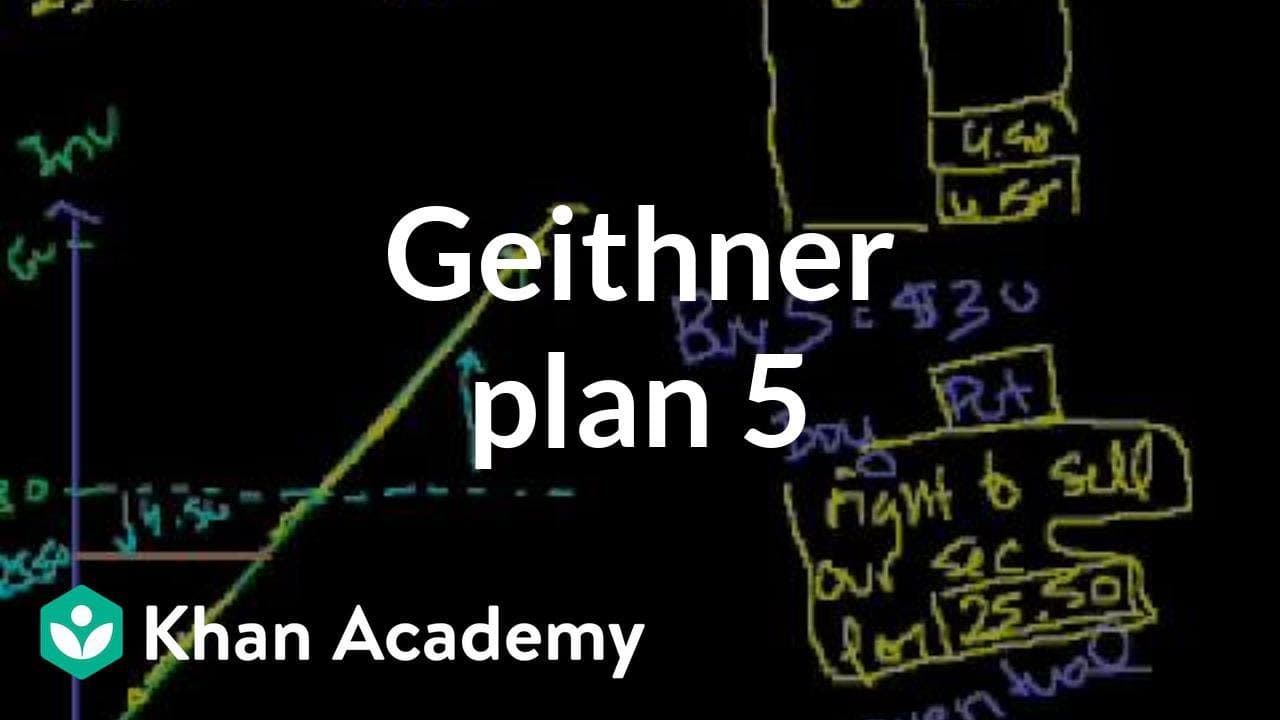
The payoff diagram shows that investors can capture all the upside of the security while limiting their downside to $4.50.
-
Comparing the Geithner Plan to conventional securities, a put option on the security with a $25.50 strike price offers the same payoff, indicating that the Geithner Plan is essentially providing a put option to investors.
Read in Other Languages (beta)
Share This Summary 📚
Summarize YouTube Videos and Get Video Transcripts with 1-Click
Try YouTube Summary with ChatGPT & Claude or YouTube Transcript Generator
Explore More Summaries from Khan Academy 📚



Summarize YouTube Videos and Get Video Transcripts with 1-Click
Try YouTube Summary with ChatGPT & Claude or YouTube Transcript Generator