Nature and Classification of Load Torques - Electrical Drives - Drives and control
TL;DR
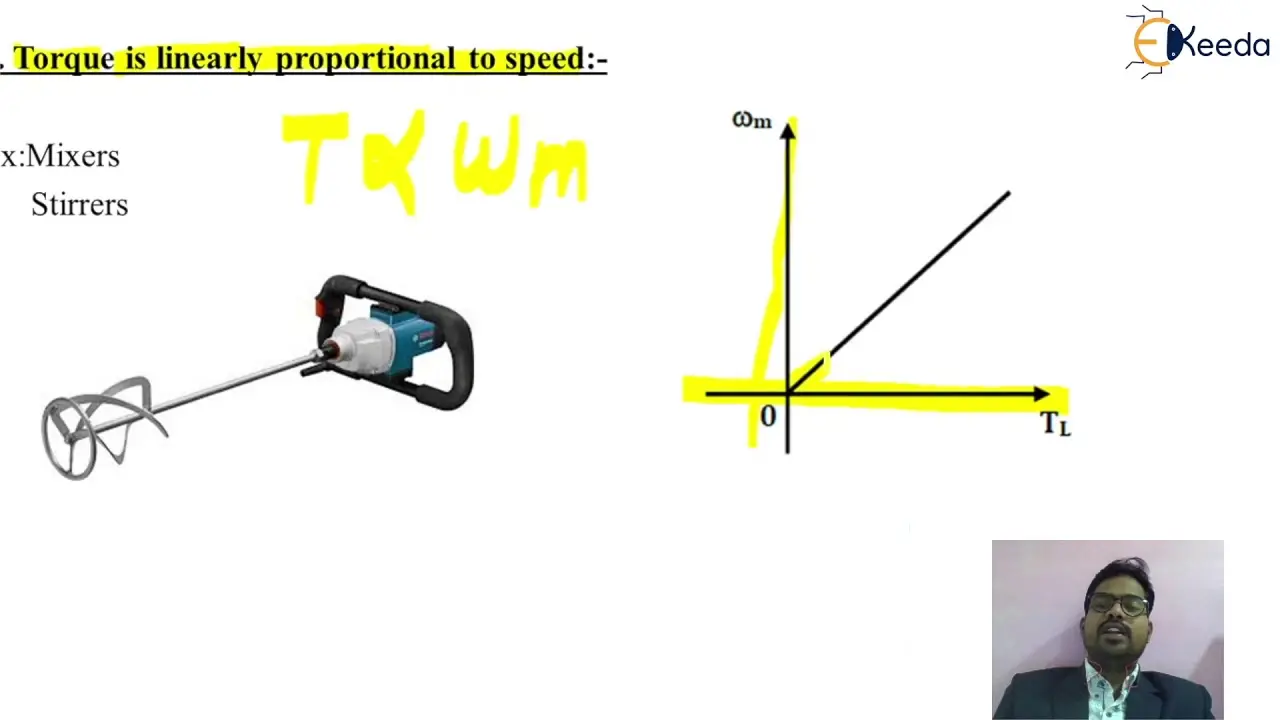
This video explains the different natures of load torque, including constant torque, torque as a function of speed, and torque inversely proportional to speed.
Transcript
friends in this video we are detailing study what are the different natures of the lotus and what are the different classification of low torque so let's begin so friends let's we will start to understand what do you mean by the nature of the rotor so for the understanding of the load torque you should know the basic fundamental concept of what do ... Read More
Key Insights
- 🧑🦼 Load torque is the opposing force to motor torque in an electrical drive system.
- 🧑🦼 The nature of load torque depends on the motor's application and can be constant or vary with speed.
- 🧑🦼 Active load torque has the potential to drive the motor, while passive load torque opposes the motion.
- 🐎 Load torque can be classified as constant, a function of speed, or inversely proportional to speed.
- 💦 Different applications require specific types of load torque to perform work effectively.
- 🎰 Constant torque is common in machines like shaping machines, cutting machines, and grinders.
- 🚤 Torque as a function of speed is found in pumps, compressors, industrial fans, and ship propellers.
Install to Summarize YouTube Videos and Get Transcripts
Explore YouTube Video Summarizer or Get YouTube Transcript Extractor
Questions & Answers
Q: What is load torque?
Load torque refers to the opposing force to motor torque in an electrical drive system. It determines the required torque to overcome the load and perform the desired work.
Q: How are the natures of load torque differentiated?
Load torque can be constant, independent of speed, or vary as a function of speed. It can be directly proportional to the square of speed, linearly proportional to speed, or inversely proportional to speed.
Q: What does it mean for load torque to be active?
Active load torque is a type of torque that has the potential to drive the motor under equilibrium conditions. Examples include the torque due to forces of gravity, tension in elastic bodies, compression, and torsion.
Q: What is the nature of passive load torque?
Passive load torque always opposes the motion and changes its sign when the rotation of the drive changes. Examples include torque due to friction, cutting, windage, and the working principle of lathe machines.
Summary & Key Takeaways
-
Load torque refers to the opposing force to the motor torque in an electrical drive system, and its nature depends on the motor's application.
-
The nature of load torque can be constant, independent of speed, or vary as a function of speed, either linearly or proportional to the square of speed.
-
Load torque can also be classified as either active, with the potential to drive the motor, or passive, opposing the motion of the motor.
Read in Other Languages (beta)
Share This Summary 📚
Summarize YouTube Videos and Get Video Transcripts with 1-Click
Try YouTube Summary with ChatGPT & Claude or YouTube Transcript Generator
Explore More Summaries from Ekeeda 📚

Summarize YouTube Videos and Get Video Transcripts with 1-Click
Try YouTube Summary with ChatGPT & Claude or YouTube Transcript Generator