Māori (The REAL Language of New Zealand)
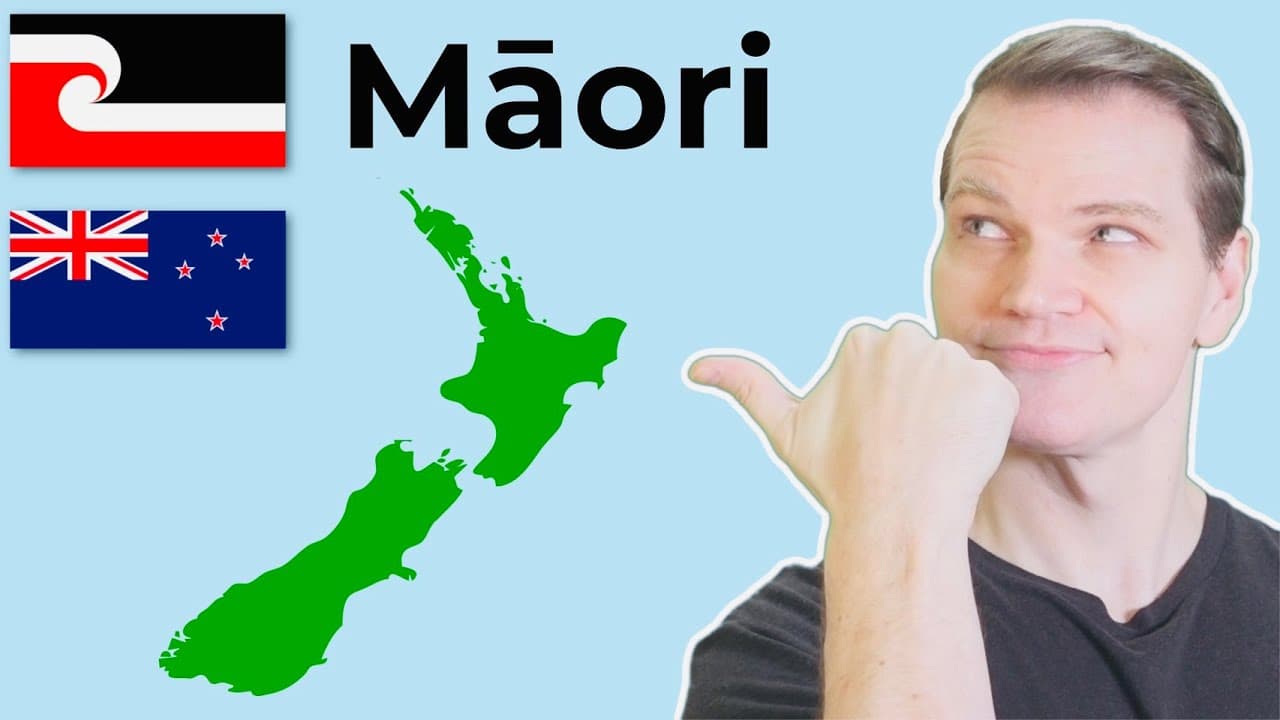
TL;DR
The Māori language is an official yet endangered language in New Zealand.
Transcript
when you think of english-speaking countries one of the countries that comes to mind might be new zealand new zealand is indeed an english-speaking country but there's another official language there one that was there long before the arrival of english speakers that language is maori or the maori language maori is an eastern polynesian language wh... Read More
Key Insights
- Māori is an Eastern Polynesian language and part of the Austronesian family, closely related to Hawaiian and Tahitian.
- Māori became an official language of New Zealand in 1987, but only a small percentage of the population speaks it fluently.
- The decline of Māori began with European settlement in the late 1700s, leading to English dominance and Māori language suppression.
- Efforts to revitalize Māori began in the 1980s, with increasing interest and initiatives continuing into the present.
- Māori pronunciation is straightforward, with only 15 letters in its alphabet, including unique consonant digraphs.
- The Māori language uses a predicate-subject word order, and verbs are not conjugated for tense, person, or number.
- Possessive forms in Māori depend on the nature of possession, with distinctions between voluntary and involuntary ownership.
- The New Zealand government aims to increase Māori speakers significantly by 2040, supported by educational programs.
Install to Summarize YouTube Videos and Get Transcripts
Explore YouTube Video Summarizer or Get YouTube Transcript Extractor
Questions & Answers
Q: What is the historical significance of the Māori language in New Zealand?
The Māori language holds historical significance as the indigenous language of New Zealand, spoken by the Māori people long before European colonization. It was the predominant language until the late 1700s when European settlers introduced English, leading to a decline in Māori speakers. Efforts to revive the language have been ongoing since the 1980s.
Q: How does Māori pronunciation differ from English?
Māori pronunciation is simpler than English, featuring only 15 letters in its alphabet, including eight consonants and five vowels. Unique to Māori are two consonant digraphs, 'ng' and 'wh,' with specific sounds. The language is phonetic, meaning it is written as it sounds, and it lacks consonant clusters, often inserting vowels to break them up.
Q: What are some key grammatical features of the Māori language?
Māori grammar includes a predicate-subject word order, unlike English's subject-predicate order. Verbs are not conjugated for tense, person, or number; instead, particles indicate tense and aspect. Possessives depend on the nature of possession, with distinctions between voluntary and involuntary ownership, and pronouns differentiate between inclusive and exclusive plural forms.
Q: What are the current efforts to revitalize the Māori language?
Current efforts to revitalize Māori include government initiatives aiming for one million speakers by 2040 and educational programs like kohangareo, immersion schools, and bilingual schools. These initiatives focus on increasing fluency and promoting Māori culture. The New Zealand Prime Minister supports these efforts, raising her daughter to be bilingual in English and Māori.
Q: How does Māori handle verb conjugation and tense?
Māori does not conjugate verbs for person, number, or tense. Instead, it uses verbal particles to indicate time, aspect, or mood. These particles precede the verb, such as 'i' for past tense, 'e' for present continuous, and 'ka' for non-past, covering both present and future actions. This system simplifies verb usage compared to languages like English.
Q: What role does the Māori language play in New Zealand's education system?
The Māori language plays a growing role in New Zealand's education system, with programs like kohangareo (language nests) for early childhood immersion, Māori immersion schools, and bilingual schools. These programs aim to increase the number of fluent Māori speakers, though currently, only a minority of Māori students participate, highlighting the need for expanded enrollment.
Q: How does the Māori language distinguish between possession types?
Māori distinguishes between possession types using 'a' and 'o' class forms. 'A' class possessives indicate voluntary possession or dominance, like a parent over a child. 'O' class possessives indicate involuntary possession or subordination, like a child possessing a parent. This distinction reflects the nature of the relationship between the possessor and the possessed.
Q: What challenges does the Māori language face in terms of survival?
The Māori language faces challenges in survival due to its status as an endangered language, with only a small percentage of New Zealanders speaking it fluently. Efforts to revitalize it depend on increased enrollment in educational programs and societal support. The language's survival is crucial for preserving New Zealand's cultural heritage and indigenous identity.
Summary & Key Takeaways
-
Māori is an Eastern Polynesian language, officially recognized in New Zealand since 1987, though spoken by a minority. Efforts to revitalize it include educational programs and government initiatives. The language features a simple phonetic alphabet and unique grammatical structures, such as predicate-first word order and non-conjugated verbs.
-
Historically, the Māori language was predominant in New Zealand until European colonization led to its decline. English became dominant, especially after policies enforced English-only education. Revival efforts gained traction in the late 20th century, aiming to preserve and promote Māori as part of New Zealand's cultural heritage.
-
Māori grammar includes unique features like a small alphabet, specific possessive forms, and distinct word order. The language lacks a verb 'to be,' and verbs are not conjugated, using particles to indicate tense and aspect instead. Pronouns include distinctions for inclusivity and exclusivity in plural forms.
Read in Other Languages (beta)
Share This Summary 📚
Summarize YouTube Videos and Get Video Transcripts with 1-Click
Try YouTube Summary with ChatGPT & Claude or YouTube Transcript Generator
Explore More Summaries from Langfocus 📚
Summarize YouTube Videos and Get Video Transcripts with 1-Click
Try YouTube Summary with ChatGPT & Claude or YouTube Transcript Generator