Stanford CS109 Probability for Computer Scientists I Combinatorics I 2022 I Lecture 2
TL;DR
This content discusses the concepts of counting and choosing, specifically focusing on permutations and combinations. It provides insights into the step rule of counting and the or rule of counting, as well as the derivation of the formula for combinations.
Transcript
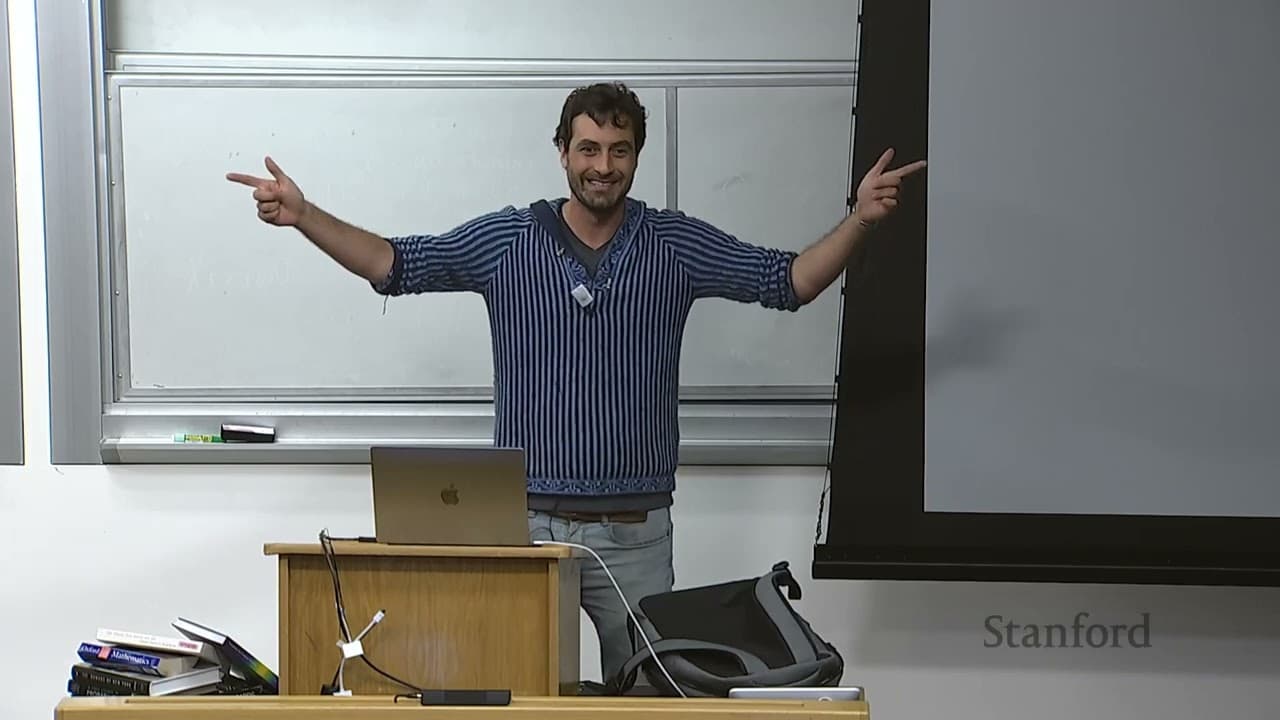
and thanks for being so patient but boy do we have a fun fun fun class for you today we get to talk about serious counting before we jump into that though there are a couple quick announcements uh the most important announcement is that problem set one goes out today um it's got 12 problems and there's actually uh or sorry 11 problems and there's a... Read More
Key Insights
- 😀 The problem set app offers immediate feedback and allows for simulations and coding tasks.
- 👶 Python review sessions are available for students who are new to Python or need a refresher.
- 😑 LaTeX is a useful language for writing mathematical expressions and creating visually appealing problem solutions.
- 💝 The late policy offers flexibility but encourages students to manage their time effectively.
- 👨💻 The honor code is discussed to emphasize academic integrity.
- 🖐️ Permutations and combinations play a significant role in counting and choosing scenarios.
- 📏 The step rule of counting and the or rule of counting provide a foundation for solving counting problems.
Install to Summarize YouTube Videos and Get Transcripts
Explore YouTube Video Summarizer or Get YouTube Transcript Extractor
Questions & Answers
Q: How does the problem set app work and what benefits does it offer?
The problem set app allows students to obtain immediate feedback on their problem-solving process. It provides a platform for writing explanations and checking answers, ensuring that students understand the underlying mathematics. The app enables simulations and coding tasks, enhancing the learning experience for probability topics.
Q: Is programming in Python a prerequisite for the course?
While prior programming experience in Python is ideal, it is not mandatory. Previous experience in a different programming language is acceptable. Additionally, the course offers optional Python review sessions to familiarize students with probability-specific concepts in Python.
Q: What is LaTeX, and why is it useful in CS109?
LaTeX is a markup language used for writing mathematical expressions with beautifully-rendered symbols. In CS109, LaTeX is introduced as a tool for effectively communicating complex mathematical ideas. While using LaTeX is not a requirement, it is encouraged as it enhances the appearance of problem solutions.
Q: What is the purpose of the section signups, and how do they work?
The section signups allow students to select their preferred section times. It is not a first-come-first-serve basis, but rather a matching process based on student preferences. The goal is to accommodate student schedules and create a conducive learning environment.
Summary & Key Takeaways
-
The content introduces the problem set app, which allows students to receive immediate feedback on problem-solving and learn Python for probability.
-
It explains the concept of permutations, which involves counting the number of unique orderings of distinct objects.
-
The content discusses the importance of LaTeX as a language for writing mathematical expressions and provides resources for learning it.
-
It covers the honor code and late policy, emphasizing the importance of understanding academic integrity and the flexibility of due dates.
Read in Other Languages (beta)
Share This Summary 📚
Summarize YouTube Videos and Get Video Transcripts with 1-Click
Try YouTube Summary with ChatGPT & Claude or YouTube Transcript Generator
Explore More Summaries from Stanford Online 📚
Summarize YouTube Videos and Get Video Transcripts with 1-Click
Try YouTube Summary with ChatGPT & Claude or YouTube Transcript Generator