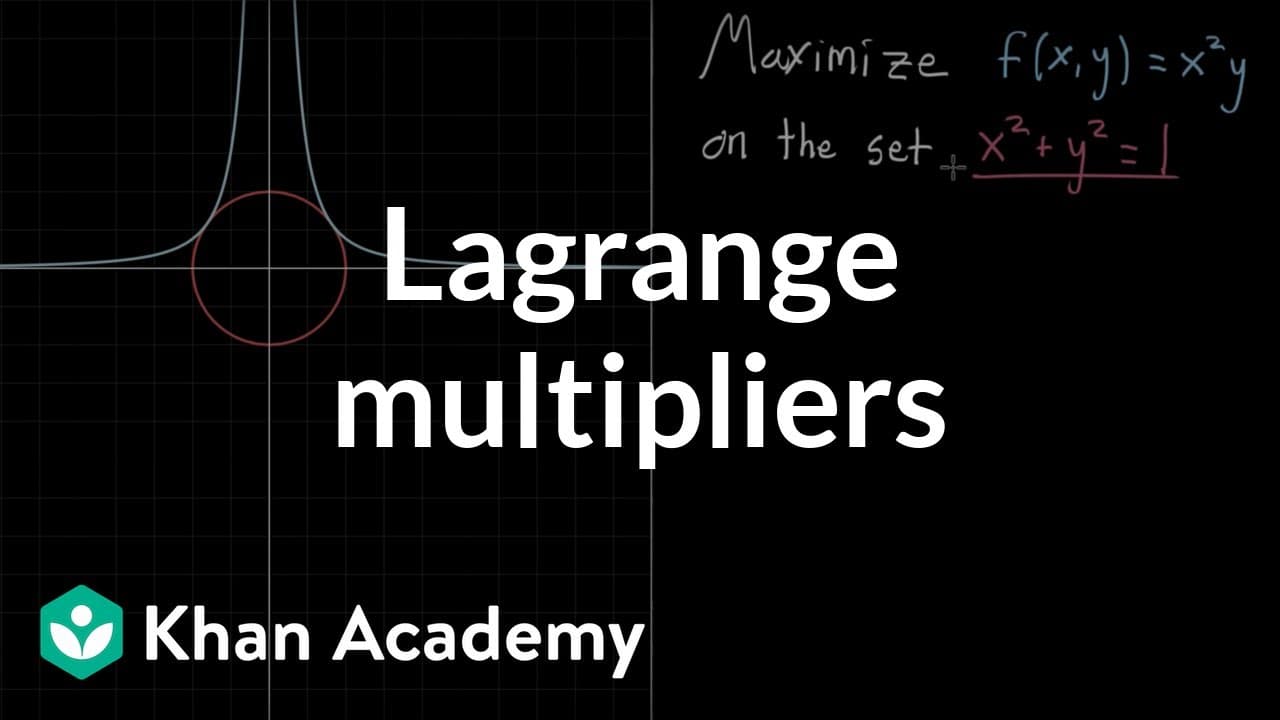
Finishing the intro lagrange multiplier example
TL;DR
The video explains the Lagrange Multiplier technique for solving constrained optimization problems, providing an example and step-by-step explanation.
Transcript
- [Instructor] So in the last two videos we were talking about this constrained optimization problem where we want to maximize a certain function on a certain set, the set of all points x, y where x squared plus y squared equals one. And we ended up working out through some nice, geometrical reasoning that we need to solve this system of equations.... Read More
Key Insights
- 😥 The Lagrange Multiplier technique helps solve constrained optimization problems by finding points of tangency.
- 😫 Solving a system of equations using the Lagrange Multiplier technique involves finding the gradients and setting them proportional.
- ✅ Checking for the possibility of variables being zero is necessary to eliminate invalid solutions.
Install to Summarize YouTube Videos and Get Transcripts
Explore YouTube Video Summarizer or Get YouTube Transcript Extractor
Questions & Answers
Q: What is the purpose of the Lagrange Multiplier technique in constrained optimization?
The Lagrange Multiplier technique is used to find the maximum or minimum values of a function while satisfying a set of constraints. It helps identify points of tangency between the contour lines.
Q: How do you solve a system of equations using the Lagrange Multiplier technique?
To solve a system of equations, you start by finding the gradients of the function to maximize and the constraint function. Then you set the gradients proportional to each other and solve for the variables involved.
Q: Why is it important to check for the possibility of x or y being zero in the solution?
Checking for the possibility of x or y being zero is crucial because when dividing by a variable, it is assumed that the variable is not equal to zero. If x or y is zero, it would lead to an invalid solution.
Q: How can you determine the maximum value of the function using the Lagrange Multiplier technique?
By plugging the values of x and y that satisfy the constraints into the function, you can evaluate the function at those points. The maximum value is the greatest output obtained.
Summary & Key Takeaways
-
The video discusses a constrained optimization problem and demonstrates how to maximize a function on a set of points.
-
The solution involves solving a system of equations, where the method is to find the gradient of the constrained function and set it proportional to the gradient of the function to maximize.
-
By finding the values of x and y that satisfy the constraints, the video concludes with the maximum values of the function.
Read in Other Languages (beta)
Share This Summary 📚
Summarize YouTube Videos and Get Video Transcripts with 1-Click
Try YouTube Summary with ChatGPT & Claude or YouTube Transcript Generator
Explore More Summaries from Khan Academy 📚



Summarize YouTube Videos and Get Video Transcripts with 1-Click
Try YouTube Summary with ChatGPT & Claude or YouTube Transcript Generator