Fundamental Theorem of Calculus Part 1
TL;DR
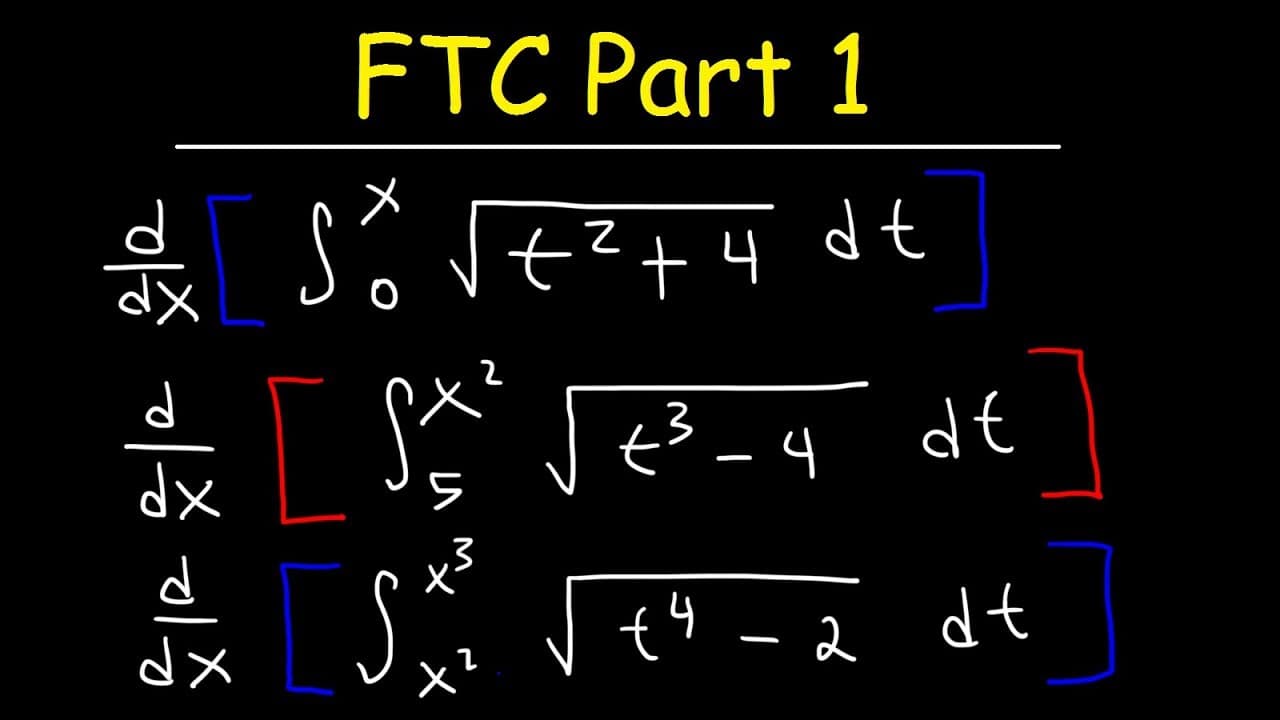
The fundamental theorem of calculus states that if g(x) is the definite integral of f(t) from a to x, then the derivative of g(x) is equal to f(x).
Transcript
in this video we're going to talk about the first part of the fundamental theorem of calculus so if g of x is equal to the definite integral of f of t from a to x then g prime of x is going to equal f of x so if g is the antiderivative of f then the derivative of g will equal f the derivative of the antiderivative will give you the original functio... Read More
Key Insights
- ❓ The first part of the fundamental theorem of calculus explains the relationship between derivatives and integrals.
- 🔠 The antiderivative, denoted as capital F, is the function that, when differentiated, gives back the original function.
- 🍧 By utilizing the fundamental theorem of calculus, it is possible to find derivatives of integrals without having to perform the integration operation.
- ❓ The first part of the fundamental theorem of calculus is sometimes referred to as the second part, but the principle remains the same regardless of the terminology.
- 0️⃣ The derivative of a constant is always zero.
- 😑 The presence of different variables or expressions within the integral can affect the result when applying the fundamental theorem of calculus.
- 📏 The chain rule is useful when differentiating functions within an integral.
Install to Summarize YouTube Videos and Get Transcripts
Explore YouTube Video Summarizer or Get YouTube Transcript Extractor
Questions & Answers
Q: What is the first part of the fundamental theorem of calculus?
The first part states that if g(x) is the definite integral of f(t) from a to x, then g'(x) = f(x).
Q: What is the antiderivative?
The antiderivative, denoted by capital F, is the inverse operation of differentiation and represents all the possible functions whose derivative is equal to the original function.
Q: Can the first part of the fundamental theorem of calculus be expressed differently?
Yes, it can also be stated as the derivative of the integral of f(t) from a to x is equal to f(x). In some cases, the variable may not be replaced with x, but the principle remains the same.
Q: How can the derivative of an integral be found without integrating?
By using the fundamental theorem of calculus, you can find the derivative of an integral by evaluating the original function at x.
Summary & Key Takeaways
-
The first part of the fundamental theorem of calculus states that the derivative of the integral of a function from a to x is equal to the original function evaluated at x.
-
The antiderivative of a function is denoted by capital F, and the derivative of the antiderivative gives the original function.
-
By using the fundamental theorem of calculus, it is possible to find derivatives of integrals without having to integrate and then differentiate.
Read in Other Languages (beta)
Share This Summary 📚
Summarize YouTube Videos and Get Video Transcripts with 1-Click
Try YouTube Summary with ChatGPT & Claude or YouTube Transcript Generator
Explore More Summaries from The Organic Chemistry Tutor 📚



Summarize YouTube Videos and Get Video Transcripts with 1-Click
Try YouTube Summary with ChatGPT & Claude or YouTube Transcript Generator