Visualizing Fourier expansion of square wave
TL;DR
Fourier series can represent a square wave as an infinite series of sines and cosines, with coefficients calculated based on the wave's characteristics.
Transcript
- [Voiceover] So we started with a square wave that had a period of two pi, then we said, hmm, can we represent it as an infinite series of weighted sines and cosines, and then working from that idea, we were actually able to find expressions for the coefficients, for a sub zero and a sub n when n does not equal zero, and the b sub ns. And evaluati... Read More
Key Insights
- 👋 Fourier series can represent complex waveforms, such as a square wave, as combinations of simpler trigonometric functions.
- ⚾ The coefficients in the Fourier series are derived based on the characteristics of the waveform, such as its period and symmetry.
- 💳 The a sub zero coefficient represents the average value or DC component of the waveform.
- 💳 The a sub n coefficients represent the contribution of cosine terms, while the b sub n coefficients represent the contribution of sine terms.
- ❓ The presence or absence of certain coefficients depends on the harmonic structure of the waveform.
- 🍉 Adding more terms in the Fourier series improves the accuracy of approximating the original waveform.
- 🆘 Visualizing the Fourier series representation of a waveform can help understand how the series converges towards the actual shape.
Install to Summarize YouTube Videos and Get Transcripts
Explore YouTube Video Summarizer or Get YouTube Transcript Extractor
Questions & Answers
Q: How is a square wave represented using Fourier series?
A square wave can be represented using Fourier series by combining weighted sines and cosines. The coefficients, a sub zero, a sub n, and b sub n, are calculated to determine the contribution of each term in the series.
Q: Why are the a sub ns all zero for n not equal to zero?
The a sub ns are all zero for n not equal to zero because the square wave only contains odd harmonics. Since the a sub ns represent the contributions of cosine terms, and a cosine function is out of phase with the square wave, they are not present in the series.
Q: How does the addition of more terms in the series impact the approximation of the square wave?
Adding more terms in the series improves the approximation of the square wave. Each term contributes a sine function with a frequency corresponding to the harmonic. As more terms are added, the approximation becomes closer to the shape of the square wave.
Q: Can the Fourier series expansion of the square wave be visualized?
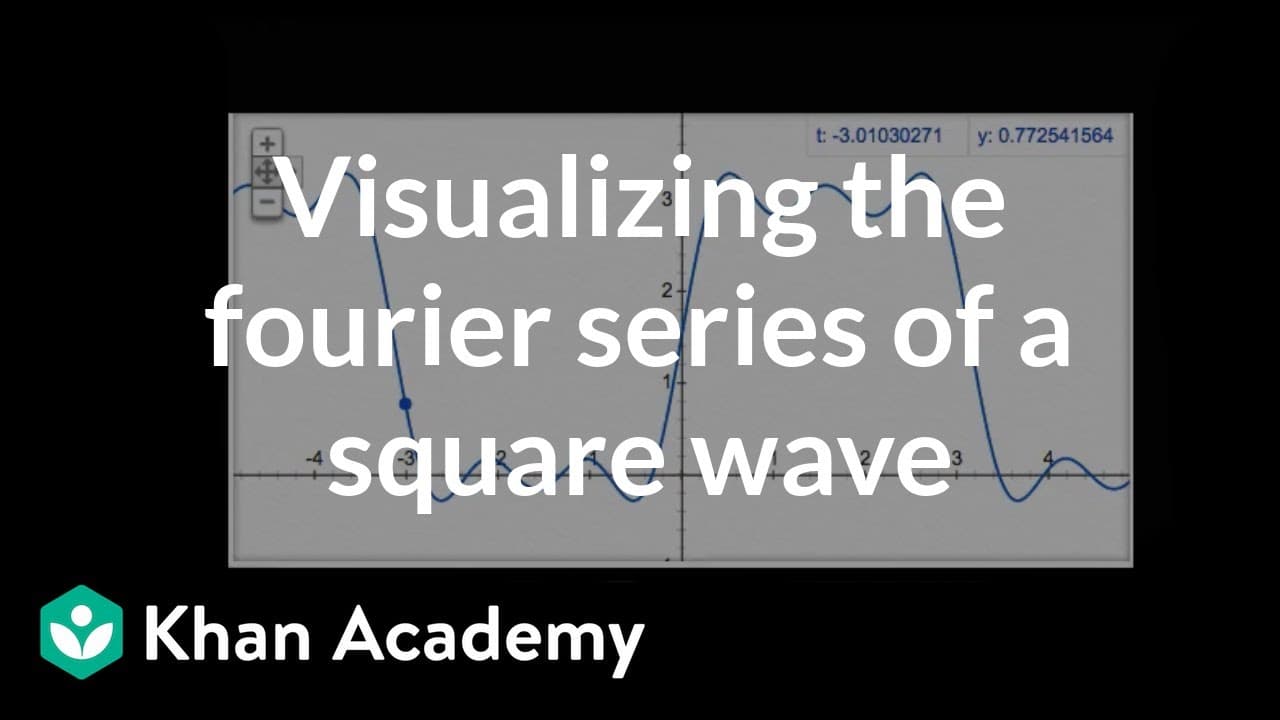
Yes, by inputting the expressions into graphing software like Google, the Fourier series representation of the square wave can be graphed. The graph shows how the series approximation progressively resembles the square wave as more terms are included.
Summary & Key Takeaways
-
The video explores representing a square wave through Fourier series, which represents it as a combination of weighted sines and cosines.
-
The coefficients, a sub zero, a sub n, and b sub n, are determined for the square wave, with a sub n being zero for any n other than zero and b sub n being zero for even n and six over n pi for odd n.
-
By expanding the Fourier series, the video shows how the square wave can be approximated with increasing accuracy by adding more terms.
Read in Other Languages (beta)
Share This Summary 📚
Summarize YouTube Videos and Get Video Transcripts with 1-Click
Try YouTube Summary with ChatGPT & Claude or YouTube Transcript Generator
Explore More Summaries from Khan Academy 📚



Summarize YouTube Videos and Get Video Transcripts with 1-Click
Try YouTube Summary with ChatGPT & Claude or YouTube Transcript Generator