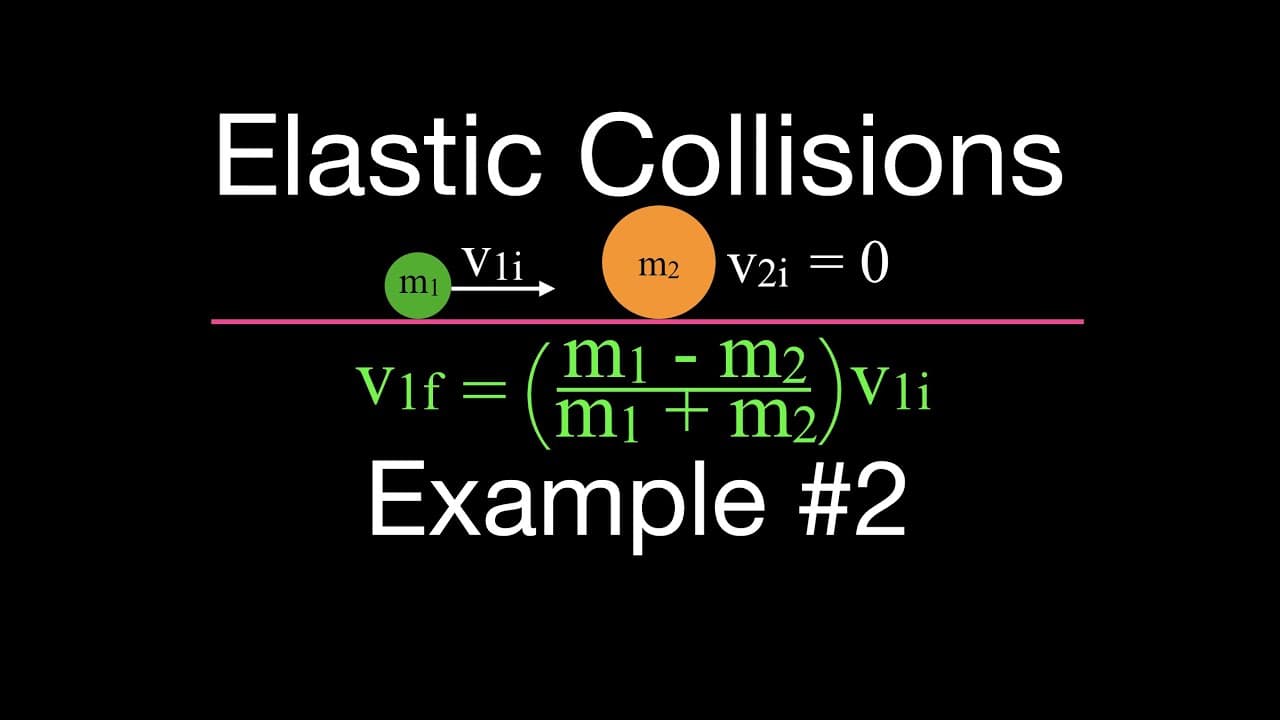
Momentum (12 of 16) Elastic Collisions, Example 2
TL;DR
Calculating the final velocities of two balls in an elastic collision scenario using equations.
Transcript
okay today's video is entitled elastic collisions example number two and this is the second example we're going to go over for elastic collisions if our problem is we have a ball that has a mass of 0.35 kilograms and the ball is moving with a velocity of 2.0 meters per second and it collides with a second ball that is stationary which means it's no... Read More
Key Insights
- 💥 Elastic collisions involve the conservation of kinetic energy and momentum.
- 💥 Understanding the mass and velocity of objects before a collision is crucial for calculating final velocities.
- 💥 Equations are used to determine the final velocities of objects in elastic collisions.
- 💥 Negative velocities can indicate a change in direction post-collision.
- 💥 Visual representation, like drawing diagrams, can aid in understanding elastic collision scenarios.
- 🆘 Sharing knowledge and helping others understand physics concepts is encouraged.
- 🈸 Thorough understanding and application of mathematical procedures are essential in physics problem-solving.
Install to Summarize YouTube Videos and Get Transcripts
Explore YouTube Video Summarizer or Get YouTube Transcript Extractor
Questions & Answers
Q: What is the scenario presented in the video regarding elastic collisions?
The video discusses an example of an elastic collision between two balls, one moving with a velocity and the other stationary.
Q: How are the final velocities of the two balls calculated in an elastic collision?
The final velocities are calculated using equations that involve the masses and initial velocities of the balls before the collision.
Q: What happens to the moving ball's velocity after the elastic collision?
The moving ball bounces off with a negative velocity, indicating it moves in the opposite direction after the collision.
Q: How does the concept of a perfectly elastic collision apply to the scenario described?
In a perfectly elastic collision, kinetic energy is conserved, and the final velocities of the colliding objects can be calculated using specific equations.
Summary & Key Takeaways
-
Two balls, one moving and one stationary, undergo an elastic collision.
-
Using equations and mass and velocity values, final velocities are calculated.
-
The moving ball bounces back with a negative velocity, while the stationary ball moves off with a positive velocity.
Read in Other Languages (beta)
Share This Summary 📚
Summarize YouTube Videos and Get Video Transcripts with 1-Click
Try YouTube Summary with ChatGPT & Claude or YouTube Transcript Generator
Explore More Summaries from Step by Step Science 📚

Summarize YouTube Videos and Get Video Transcripts with 1-Click
Try YouTube Summary with ChatGPT & Claude or YouTube Transcript Generator