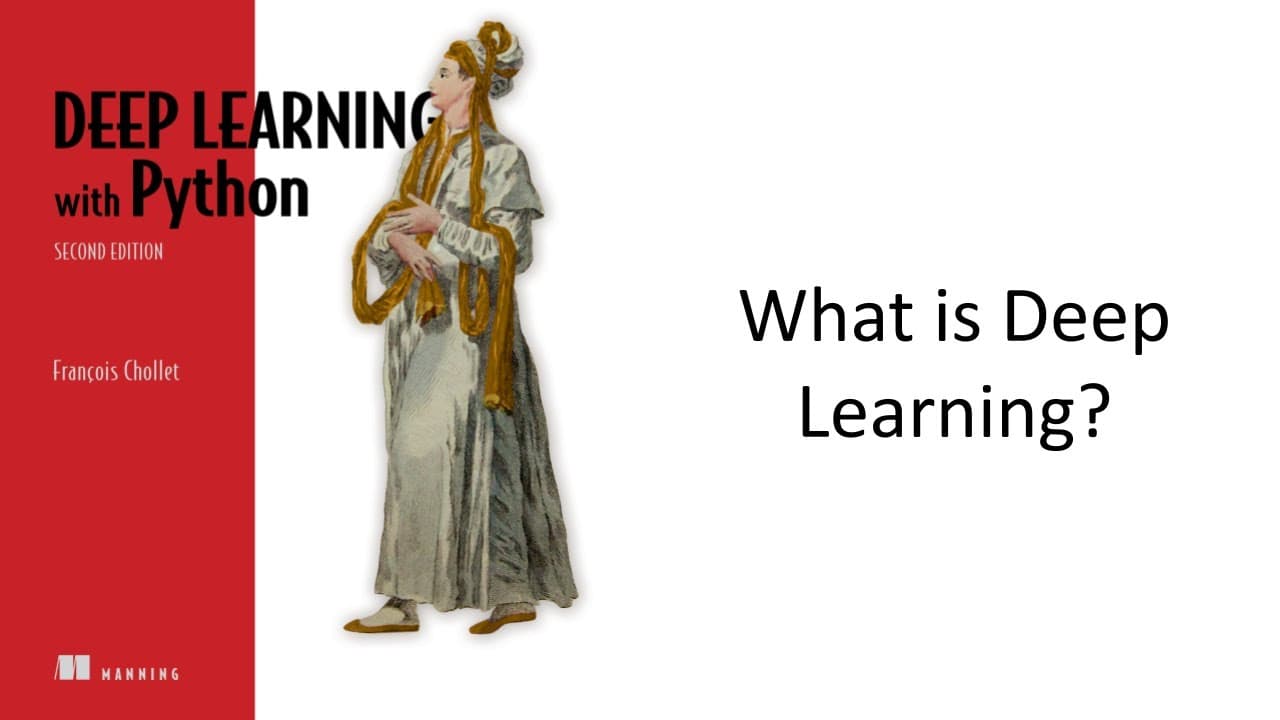
What is deep learning?
TL;DR
This video provides an overview of AI, machine learning, and deep learning, explaining their definitions, differences, and the role of representations and neural networks in deep learning.
Transcript
hello everyone and welcome to the first video in the python deep learning series in which we will be following the book by francois chole which is deep learning with python second edition this book is written for keras so that's what we will be learning we will be starting from the very first chapter that is what is deep learning so enjoy the video... Read More
Key Insights
- 🍂 Deep learning is a subset of machine learning, which falls under the field of artificial intelligence.
- 📏 Symbolic AI relies on handcrafted rules, while machine learning algorithms learn rules from data.
- 🌸 Machine learning requires input data, expected outputs, and a measure of performance, usually calculated using a loss function.
- 🏋️ Neural networks learn meaningful representations through layered transformations and parameterized weights.
Install to Summarize YouTube Videos and Get Transcripts
Explore YouTube Video Summarizer or Get YouTube Transcript Extractor
Questions & Answers
Q: What is the difference between symbolic AI and machine learning?
Symbolic AI involves creating explicit rules for logical problems, while machine learning algorithms learn rules from data. Symbolic AI is suitable for well-defined problems like chess, while machine learning is used for more complex tasks like image classification.
Q: How do machine learning algorithms use input data, expected outputs, and performance measurement?
Machine learning algorithms require input data, which is associated with expected outputs or labels. The algorithm's performance is measured by comparing its output to the true labels. This measurement guides the algorithm's learning process.
Q: What is the role of representations in machine learning?
Representations in machine learning refer to the transformation of data into meaningful outputs. Different representations, such as RGB or HSB for images, can make certain tasks easier. Machine learning models aim to find appropriate representations for the given task.
Q: How do neural networks learn successive layers of increasingly meaningful representations?
Neural networks are stacked layers that transform input data through parameterized weights. Each layer distills information, leading to increasingly meaningful representations. Learning in deep learning involves finding the right values for these weights.
Summary & Key Takeaways
-
The video introduces the book "Deep Learning with Python" and explains the importance of starting with the basics of deep learning.
-
It defines artificial intelligence as the automation of intellectual tasks and explains that machine learning and deep learning are subsets of AI.
-
The video compares symbolic AI to machine learning, discussing how machine learning algorithms learn rules instead of relying on handcrafted ones.
-
It explains the three ingredients of machine learning: input data, expected outputs, and a way to measure the algorithm's performance.
Read in Other Languages (beta)
Share This Summary 📚
Summarize YouTube Videos and Get Video Transcripts with 1-Click
Try YouTube Summary with ChatGPT & Claude or YouTube Transcript Generator
Explore More Summaries from Abhishek Thakur 📚




Summarize YouTube Videos and Get Video Transcripts with 1-Click
Try YouTube Summary with ChatGPT & Claude or YouTube Transcript Generator