The Nuclear-Powered Clocks of the Future
TL;DR
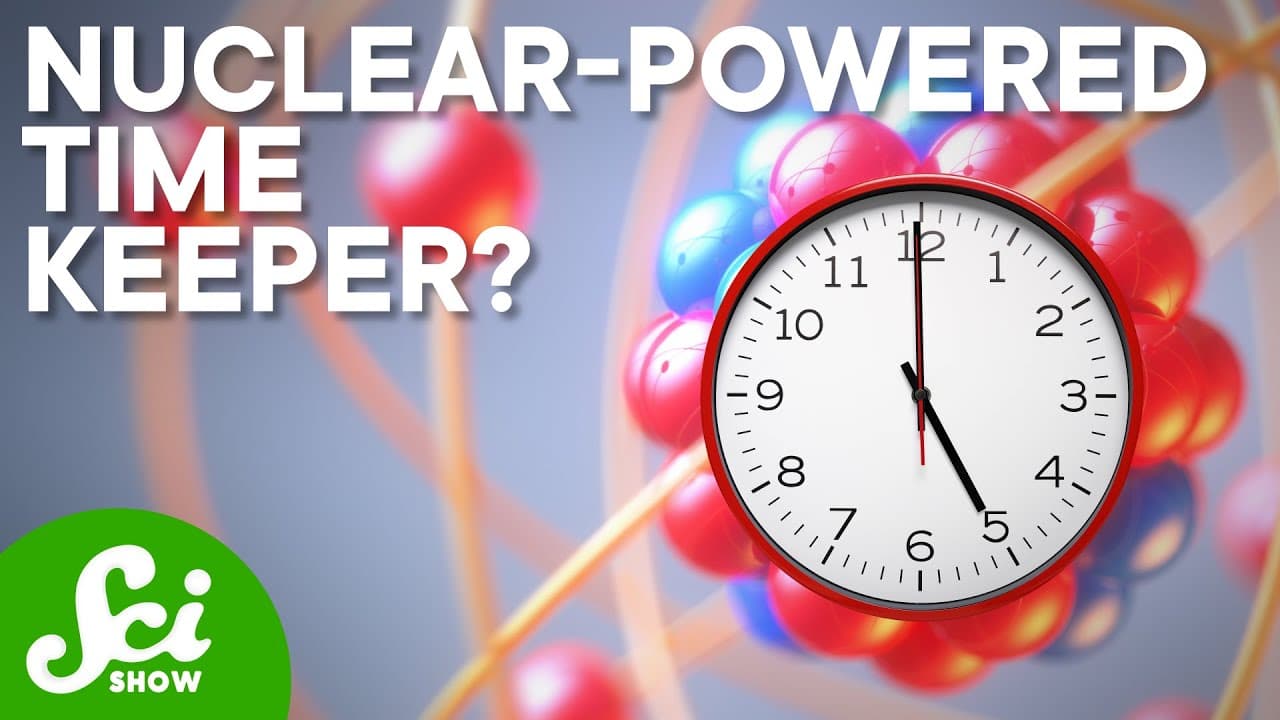
Scientists are researching nuclear clocks as a potential way to achieve even more precise timekeeping compared to atomic clocks, with potential applications in GPS, monitoring tectonic plates, studying dark matter, and investigating changes in the laws of physics over time.
Transcript
thanks to glenoud for supporting this scishow video you can get a hundred dollar sixty day credit on a new lenote account at lenode.com scishow what is the best way to measure the passage of time for me I got the old one Mississippi two Mississippi trick that might help you out in a pinch but there's a lot of Science and Technology out there that n... Read More
Key Insights
- 🙂 Atomic clocks, which rely on the precise ticking of light waves, are already highly accurate and reliable.
- 👨🔬 Scientists are researching nuclear clocks as a potential way to achieve even more accurate timekeeping.
- 🫀 Nuclear clocks utilize the energy levels of an atom's nucleus and offer certain advantages in stability.
- 🙂 The energy levels in a nucleus require more advanced technology, as they are on a larger scale and need gamma rays instead of laser light to excite the nuclei.
- 🪡 Thorium-229 contains a nuclear energy gap that could potentially be used in nuclear clocks, but further research is needed to determine the exact frequency needed.
- 👨🔬 Breakthrough experiments with actinium-229 have narrowed down the options for future research, providing valuable insights.
- 🍽️ Nuclear clocks could have practical applications in precision technologies such as GPS and monitoring tectonic plate movements.
Install to Summarize YouTube Videos and Get Transcripts
Explore YouTube Video Summarizer or Get YouTube Transcript Extractor
Questions & Answers
Q: How do atomic clocks work?
Atomic clocks rely on the precise ticking of light waves in atoms, which can be measured to mark the passage of time. These clocks are so accurate that they can be used in space and remain accurate to the nanosecond.
Q: How do nuclear clocks differ from atomic clocks?
Nuclear clocks utilize the energy levels of an atom's nucleus instead of the energy levels of its electrons like atomic clocks. This offers potential advantages in stability but presents challenges related to energy levels and the need for more advanced technology.
Q: What is the importance of thorium-229 in nuclear clocks?
Thorium-229 contains a known nuclear energy gap that scientists believe could be used to create a nuclear clock. However, the exact energy and frequency needed are not yet known, but breakthrough experiments with actinium-229 have provided valuable data for further research.
Q: What are the potential applications of nuclear clocks?
Nuclear clocks could have applications in more precise GPS technology, monitoring tectonic plate movements to predict volcanic eruptions, studying dark matter, and investigating changes in the laws of physics over time.
Summary & Key Takeaways
-
Atomic clocks, which rely on the precise ticking of light waves in atoms, are already incredibly accurate and reliable.
-
Scientists are now exploring the potential of nuclear clocks, which utilize the energy levels of an atom's nucleus, offering potential advantages in stability, but with challenges related to energy levels and the need for more advanced technology.
-
Breakthrough experiments with actinium-229 and thorium-229 have narrowed down the options for future research, opening up possibilities for more precise monitoring and potentially uncovering changes in the laws of physics over time.
Read in Other Languages (beta)
Share This Summary 📚
Summarize YouTube Videos and Get Video Transcripts with 1-Click
Try YouTube Summary with ChatGPT & Claude or YouTube Transcript Generator
Explore More Summaries from SciShow 📚






Summarize YouTube Videos and Get Video Transcripts with 1-Click
Try YouTube Summary with ChatGPT & Claude or YouTube Transcript Generator