Launching and landing on different elevations | Two-dimensional motion | Physics | Khan Academy
TL;DR
Solving a complicated two-dimensional projectile motion problem, involving launching a projectile off a platform at an angle and calculating its horizontal and vertical components.
Transcript
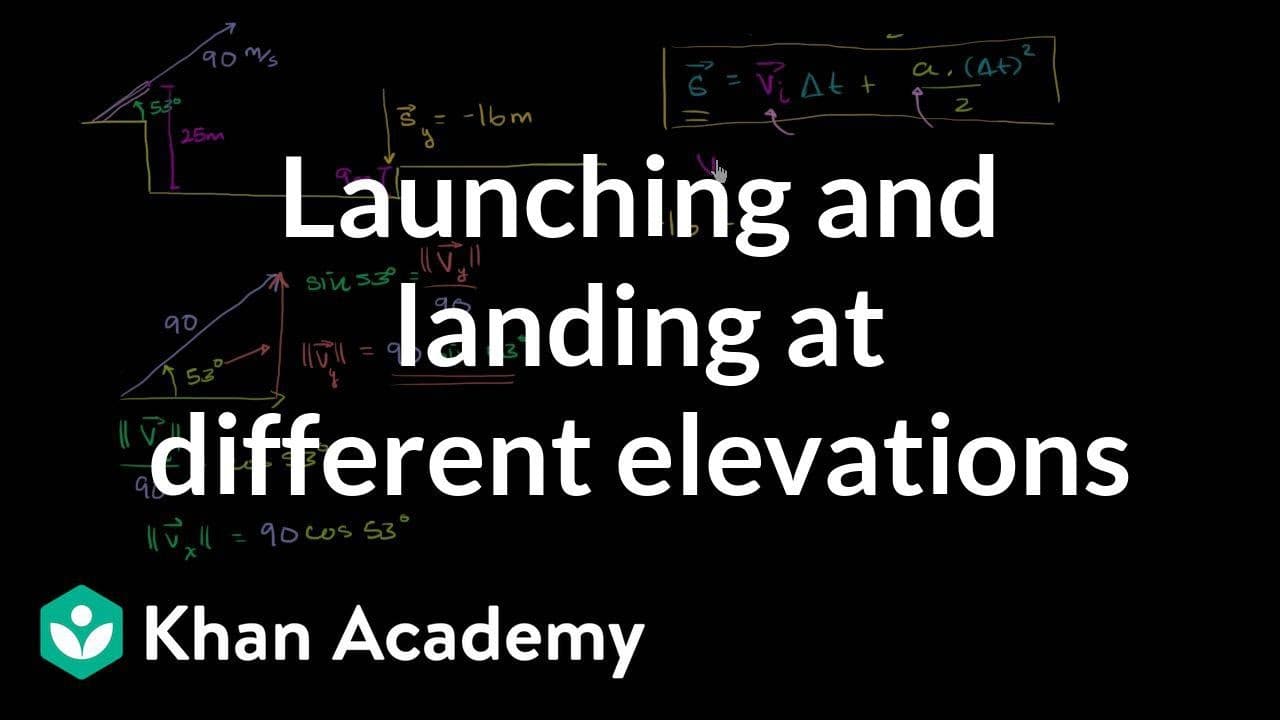
Let's do a slightly more complicated two-dimensional projectile motion problem now. So in this situation, I am going to launch the projectile off of a platform. And then it is going to land on another platform. And I'm going to fire the projectile at an angle. Let me draw this a little bit better. So I'm going to fire the projectile at an angle of-... Read More
Key Insights
- 🚥 The problem involves launching a projectile at an angle and calculating its horizontal and vertical components.
- 🏝️ The heights from which the projectile is launched and lands affect the calculations.
- ✈️ The time of flight is determined by solving a quadratic equation.
Install to Summarize YouTube Videos and Get Transcripts
Explore YouTube Video Summarizer or Get YouTube Transcript Extractor
Questions & Answers
Q: What is the angle at which the projectile is launched?
The projectile is launched at an angle of 53 degrees.
Q: What is the initial velocity of the projectile?
The initial velocity of the projectile is 90 meters per second.
Q: What are the heights from which the projectile is launched and lands?
The projectile is launched from a height of 25 meters and lands at a height of 9 meters.
Q: How is the time of flight calculated?
The time of flight is calculated using the formula for displacement in the vertical direction, by setting the displacement to be -16 meters and solving for the time.
Q: What is the horizontal displacement of the projectile?
The horizontal displacement of the projectile is 806 meters, calculated by multiplying the time of flight by the horizontal component of the velocity.
Summary & Key Takeaways
-
The problem involves launching a projectile at a 53-degree angle from a cannon with a velocity of 90 meters per second.
-
The projectile is launched from a height of 25 meters and lands at a height of 9 meters.
-
The solution involves dividing the velocity vector into horizontal and vertical components, using the vertical component to calculate the time of flight, and using the horizontal component to calculate the horizontal displacement.
Read in Other Languages (beta)
Share This Summary 📚
Summarize YouTube Videos and Get Video Transcripts with 1-Click
Try YouTube Summary with ChatGPT & Claude or YouTube Transcript Generator
Explore More Summaries from Khan Academy 📚



Summarize YouTube Videos and Get Video Transcripts with 1-Click
Try YouTube Summary with ChatGPT & Claude or YouTube Transcript Generator