Stanford ENGR108: Introduction to Applied Linear Algebra | 2020 | Lecture 14-VMLS k means app.
TL;DR
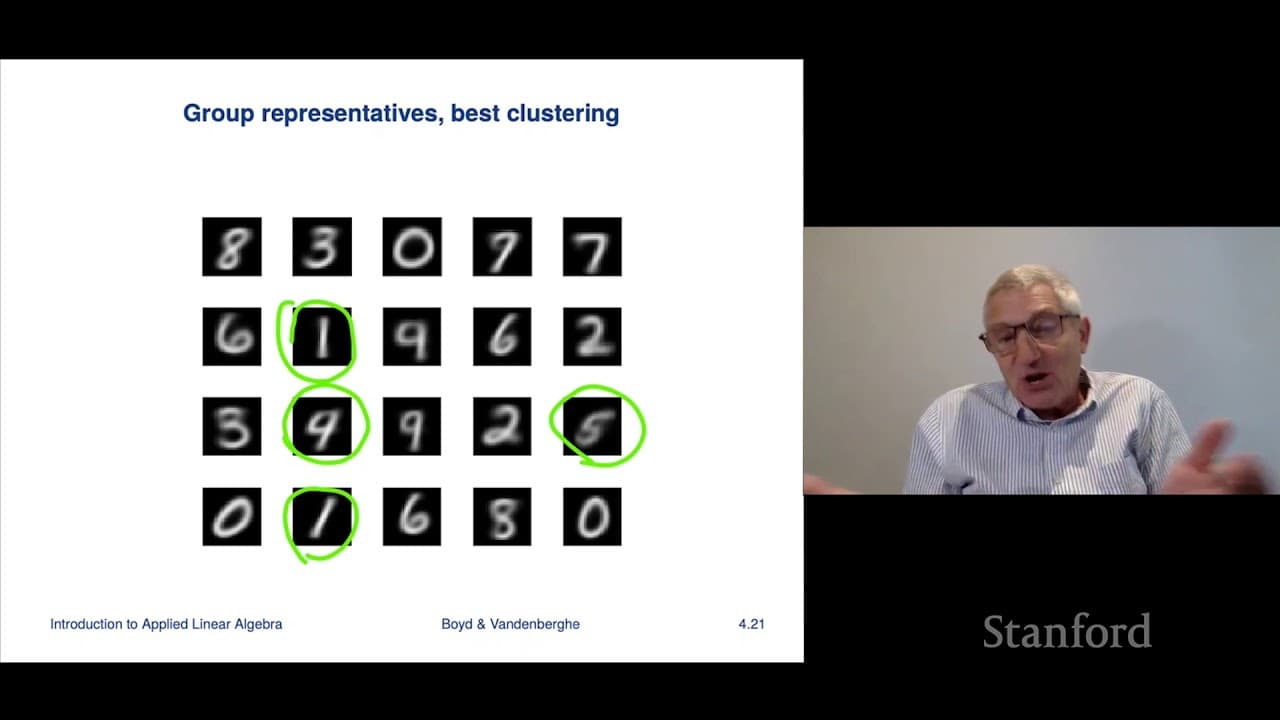
The K-means algorithm is applied to a handwritten digits dataset and a collection of Wikipedia articles, showcasing its ability to cluster and discover patterns in data without any knowledge of the underlying meaning of the features.
Transcript
we're not going to look at some real applications of the k-means algorithm and by real application i simply mean looking at some real data and this is just to give you a rough idea of what it can do and a couple of times i'll i'll give some editorial content about like basically how amazing it is it's what i'll say very simple so we'll see how that... Read More
Key Insights
- 👌 The K-means algorithm can effectively cluster handwritten digit images without any prior knowledge of what the digits represent.
- 🔑 Clustering based on word counts can reveal meaningful topics in a collection of Wikipedia articles, despite the algorithm's lack of understanding of the words' meanings.
- 👌 The simplicity of the K-means algorithm highlights the potential of unsophisticated approaches in achieving significant data analysis outcomes.
- 🧡 The algorithm's ability to discover patterns and clusters in diverse datasets showcases its versatility and wide range of applications.
- 👌 It is important to note that the K-means algorithm is a heuristic method that may not always find the optimal clustering solution.
- 👥 The algorithm's ability to group similar instances together suggests its potential for tasks such as image recognition and text analysis.
- ⬛ Unsupervised learning algorithms like K-means can efficiently process and analyze large amounts of data without the need for manual labeling.
Install to Summarize YouTube Videos and Get Transcripts
Explore YouTube Video Summarizer or Get YouTube Transcript Extractor
Questions & Answers
Q: How does the K-means algorithm work with the handwritten digits dataset?
The algorithm treats each image as a vector of pixel intensities and applies clustering to group similar images together. It iteratively assigns each image to the cluster with the closest centroid and updates the centroids based on the assigned images.
Q: Can the K-means algorithm correctly identify the handwritten digits in the dataset?
While the algorithm does not have any knowledge of what the digits represent, it can discover clusters that predominantly contain images of certain digits. Although there may be some overlap between clusters, the algorithm generally groups similar digits together.
Q: How does the K-means algorithm cluster the Wikipedia articles based on word counts?
The algorithm represents each article as a vector of word frequencies and clusters them based on these vectors. It does not consider the meaning of the words or the order in which they appear, demonstrating a "bag of words" approach to topic discovery.
Q: Can the K-means algorithm be used to automate the classification of new Wikipedia pages?
Yes, the algorithm can assign new Wikipedia pages to the closest cluster representative based on their word counts. This provides a simple and automated way to classify new pages into predefined topic clusters.
Summary & Key Takeaways
-
The K-means algorithm is used to cluster a dataset of handwritten digits, demonstrating its ability to group similar images together.
-
Another application involves clustering Wikipedia articles based on word counts, showing that the algorithm can reveal meaningful topic clusters without understanding the words' meanings.
-
Despite its simplicity and lack of contextual knowledge, the K-means algorithm successfully discovers patterns and clusters in diverse datasets.
Read in Other Languages (beta)
Share This Summary 📚
Summarize YouTube Videos and Get Video Transcripts with 1-Click
Try YouTube Summary with ChatGPT & Claude or YouTube Transcript Generator
Explore More Summaries from Stanford Online 📚
Summarize YouTube Videos and Get Video Transcripts with 1-Click
Try YouTube Summary with ChatGPT & Claude or YouTube Transcript Generator