Infix to Postfix Conversion Algorithm Part 1 | Data Structure Using C
TL;DR
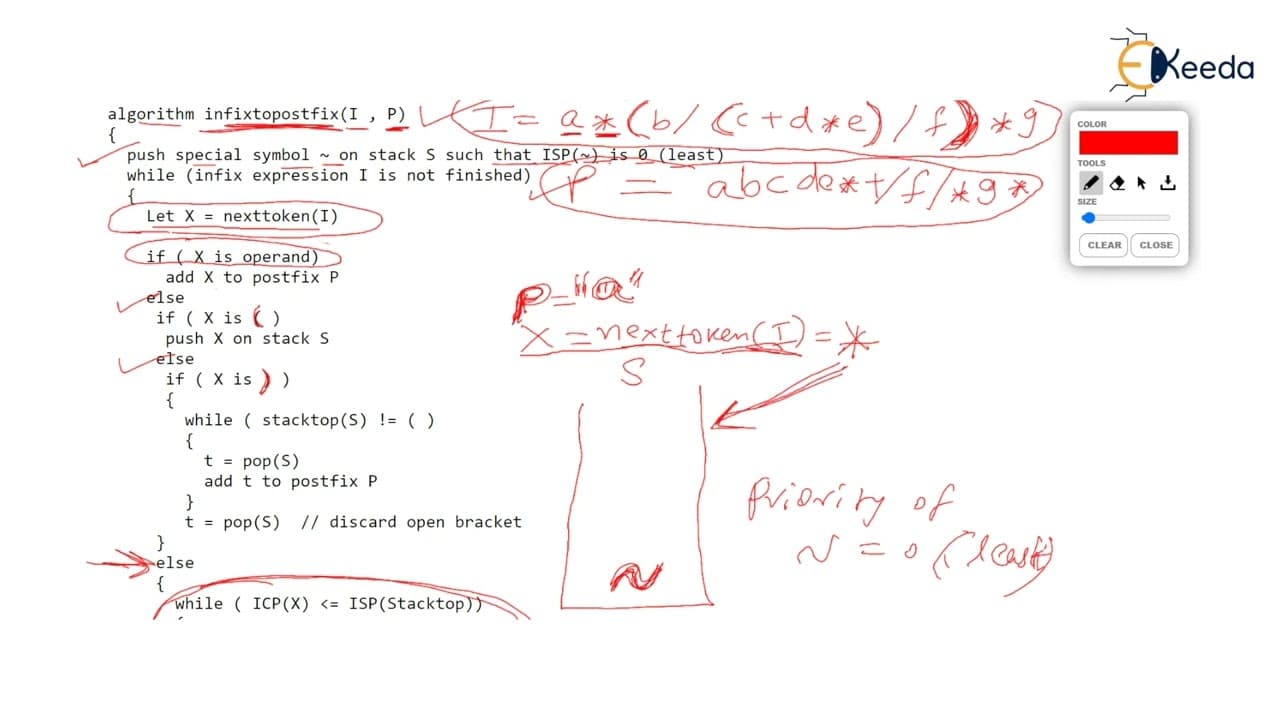
This video explains the algorithm to convert infix expressions to postfix expressions using a stack and operator priorities.
Transcript
hello dear students i am samir velankar i welcome all of you to this another video on expression evaluation in this video we will be seeing how to convert infix expression to postfix expression well you already know that in the very first video of this series we saw how to convert any infix to postfix but we will be learning computer algorithm to c... Read More
Key Insights
- 😑 The algorithm converts infix expressions to postfix expressions using a stack and operator priorities.
- 🤬 A special symbol like tilde is added to the stack to facilitate correct operator placement.
- 🍵 The algorithm handles brackets by solving them first and converting any operators within them to postfix.
- 📲 Incoming priorities and in-stack priorities are used to determine operator placement on the stack.
Install to Summarize YouTube Videos and Get Transcripts
Explore YouTube Video Summarizer or Get YouTube Transcript Extractor
Questions & Answers
Q: What is the purpose of converting infix expressions to postfix expressions?
Converting infix expressions to postfix expressions allows for simpler evaluation and calculation in computer algorithms.
Q: How does the algorithm handle different operators in the infix expression?
The algorithm uses a stack to store operators, with priority rules to determine which operator goes on top of the stack.
Q: Why is a special symbol like tilde added to the stack in this algorithm?
The tilde symbol is added as a placeholder and has the lowest priority. It helps ensure the algorithm runs smoothly and handles all operators correctly.
Q: What is the role of the stack in the infix to postfix conversion algorithm?
The stack is used to store operators and open brackets in the infix expression. It helps determine the order of operations and ensures correct postfix conversion.
Q: How does the algorithm handle brackets in the infix expression?
The algorithm treats brackets as operators and solves them first. Any operators within the brackets are converted to postfix before continuing with the rest of the expression.
Q: Can you explain the concept of incoming priority and in-stack priority?
Incoming priority refers to the priority of the incoming operator from the infix expression. In-stack priority refers to the priority of the topmost operator in the stack. These priorities are compared to determine operator placement on the stack.
Q: What happens after the infix expression is fully scanned and converted to postfix?
Any remaining operators in the stack are popped and added to the postfix expression. The postfix expression is then considered the final result.
Q: What are the benefits of using postfix expressions in algorithms?
Postfix expressions are easier and more efficient to evaluate and calculate. They eliminate the need for parentheses and have a fixed order of operations.
Summary & Key Takeaways
-
The video introduces the concept of converting infix expressions to postfix expressions using an algorithm.
-
It explains how the algorithm uses a stack and operator priorities to convert the expressions.
-
The video provides step-by-step instructions on how to convert an example infix expression to postfix.
Read in Other Languages (beta)
Share This Summary 📚
Summarize YouTube Videos and Get Video Transcripts with 1-Click
Try YouTube Summary with ChatGPT & Claude or YouTube Transcript Generator
Explore More Summaries from Ekeeda 📚





Summarize YouTube Videos and Get Video Transcripts with 1-Click
Try YouTube Summary with ChatGPT & Claude or YouTube Transcript Generator