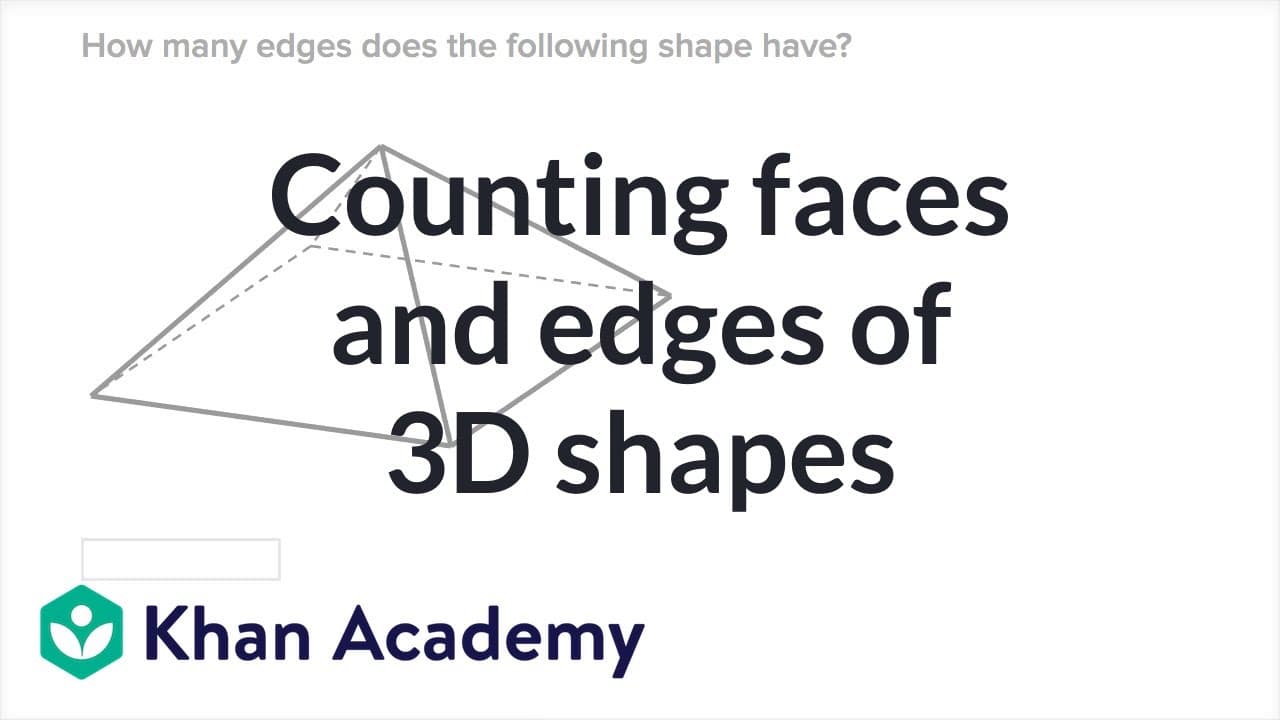
Counting faces and edges of 3D shapes
TL;DR
This video explains how to count the faces and edges of shapes using examples and visual demonstrations.
Transcript
- [Instructor] How many faces does the following shape have? Pause this video and see if you can figure that out. All right, I'm assuming you paused and I'll see if we can work through it together. And I'm gonna actually try to color the faces. So we have this face over, whoops. Let me do it in this other tool. So you have this face over here in th... Read More
Key Insights
- 😀 Transparent faces can be counted by mirroring them, allowing for a more accurate count of the shape's faces.
- 🫥 An edge is where two faces meet, and counting edges involves identifying the line segments connecting the faces.
- 😀 Color-coding the faces and edges helps avoid errors and ensures that each element is accurately counted.
- 😀 The same shape can have different numbers of faces and edges, as demonstrated in the example.
- 😀 Counting both faces and edges can help in understanding the overall structure and geometry of a shape.
- 🦻 Visualization and coloring techniques can aid in comprehending complex shapes and their components.
- 😀 Identifying transparent faces is essential in determining the number of faces a shape has.
Install to Summarize YouTube Videos and Get Transcripts
Explore YouTube Video Summarizer or Get YouTube Transcript Extractor
Questions & Answers
Q: How can you determine the number of faces in a shape?
To find the number of faces, you need to identify transparent faces and count the visible ones. Mirroring the transparent faces helps in visualizing all the faces. In the example, the shape had five faces.
Q: What is an edge in geometry?
An edge is a line segment where two faces of a shape meet. By counting the number of edges, you can determine how many lines connect the faces. In the given example, the shape had eight edges.
Q: Can you count both faces and edges of a shape at the same time?
Though the video primarily focuses on counting edges and faces separately, you can find both simultaneously. By examining the example shape, it was determined that it had three faces and eight edges.
Q: Why is color-coding helpful when counting faces and edges?
Color-coding can help visually distinguish the faces and edges within a shape, ensuring accurate counting. By using different colors for each face or edge, you can prevent mistakes such as double-counting or missing elements.
Summary & Key Takeaways
-
The video demonstrates how to count the faces of a shape by identifying transparent faces, mirroring them, and counting the visible sides. In the example, a shape was found to have five faces.
-
It also explains how to count edges by identifying where two faces meet. The example showed that a shape had eight edges.
-
Additionally, the video briefly mentions that the same shape has three faces and one square base.
Read in Other Languages (beta)
Share This Summary 📚
Summarize YouTube Videos and Get Video Transcripts with 1-Click
Try YouTube Summary with ChatGPT & Claude or YouTube Transcript Generator
Explore More Summaries from Khan Academy 📚



Summarize YouTube Videos and Get Video Transcripts with 1-Click
Try YouTube Summary with ChatGPT & Claude or YouTube Transcript Generator