Problems On Pumping Lemma Part 2
TL;DR
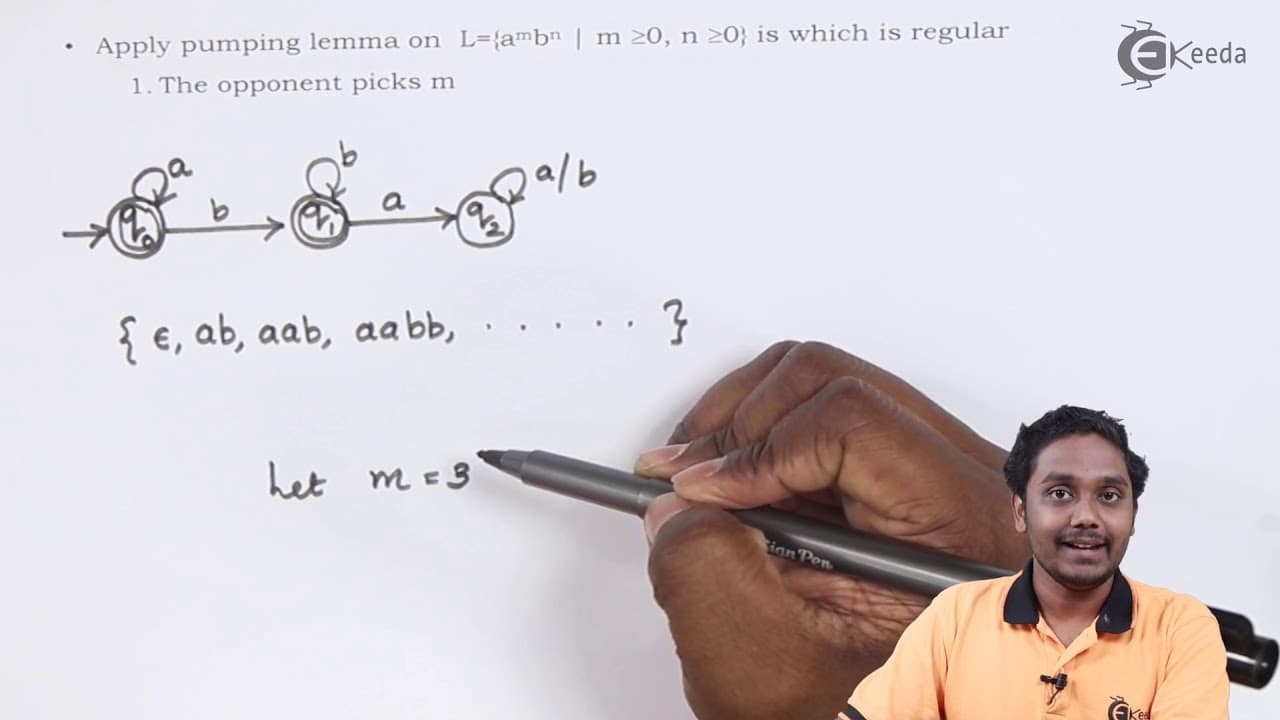
The video explains the application of pumping lemma to prove whether a language is regular or not.
Transcript
click the bell icon to get latest videos from equator hello friends in the previous video we have seen an example in which we were trying to prove that a particular language is not regular in that we were trying to prove the thing informally that means we don't have a mathematical base to prove that the given language was not regular before that we... Read More
Key Insights
- ⛽ The pumping lemma is a tool to prove that certain languages are not regular, but passing the pumping lemma does not guarantee regularity.
- ❓ A regular language can be recognized by a finite automaton.
- ⛽ Selecting appropriate values for the pumping lemma and applying it can help determine whether a language is regular or non-regular.
Install to Summarize YouTube Videos and Get Transcripts
Explore YouTube Video Summarizer or Get YouTube Transcript Extractor
Questions & Answers
Q: What is the purpose of the pumping lemma in language theory?
The pumping lemma is used as a tool to prove that certain languages are not regular. It helps identify patterns that cannot be handled by regular expressions or finite automata.
Q: How is the pumping lemma applied to prove a language is not regular?
To apply the pumping lemma, one must select a specific string from the language, split it into sub-strings, and pump one of the sub-strings to generate multiple combinations. If any of these combinations do not follow the pattern of the language, then the language is not regular.
Q: Does passing the pumping lemma guarantee that a language is regular?
No, passing the pumping lemma does not guarantee that a language is regular. It only means that the selected language satisfies the conditions of the lemma. Regularity needs to be proven through other methods.
Q: How can non-regular languages be identified using the pumping lemma?
By selecting specific strings and applying the pumping lemma, if it is impossible to generate valid combinations that follow the language's pattern, then the language is considered non-regular.
Summary & Key Takeaways
-
The video introduces the concept of pumping lemma and its use in proving a language is not regular.
-
It illustrates an example of a regular language and shows how a finite automaton can accept strings following a specific pattern.
-
The video then applies the pumping lemma to the regular language and demonstrates that it satisfies the lemma, indicating it is indeed regular.
Read in Other Languages (beta)
Share This Summary 📚
Summarize YouTube Videos and Get Video Transcripts with 1-Click
Try YouTube Summary with ChatGPT & Claude or YouTube Transcript Generator
Explore More Summaries from Ekeeda 📚

Summarize YouTube Videos and Get Video Transcripts with 1-Click
Try YouTube Summary with ChatGPT & Claude or YouTube Transcript Generator