Mutual Inductance & Solenoids - Physics
TL;DR
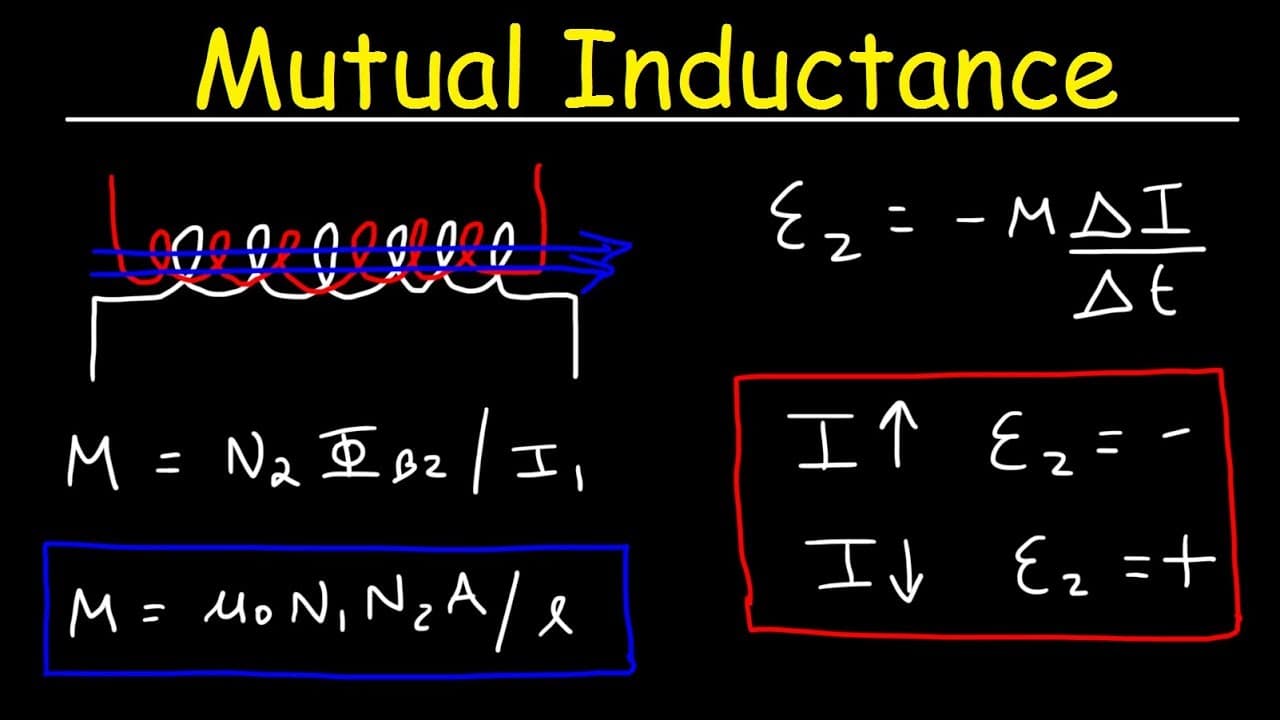
This video covers practice problems related to mutual inductance, with an explanation of how changing currents in one coil can induce an electromagnetic force (EMF) in another coil.
Transcript
in this video we're going to go over some practice problems associated with mutual inductance the concept of mutual inductance is relevant when two coils of wire are placed next to each other so if we have a current flowing through one of the wires let's call this coil one it's going to create a magnetic field and if the current is changing you're ... Read More
Key Insights
- 🥇 Mutual inductance occurs when two coils of wire are placed near each other, and changing currents induce EMF in each other.
- ☠️ The magnitude of induced EMF depends on the rate of change of current and the mutual inductance of each coil.
- 👮 The induced EMF opposes the change in current that caused it, following Lenz's law.
- ⌛ In practice problems, mutual inductance and induced EMF can be calculated using the given values of current, time, and other parameters.
- 🧭 The magnetic flux passing through a coil depends on the magnetic field and the coil's area.
- ↩️ In a solenoid and a coil scenario, the mutual inductance can be calculated by multiplying the number of turns, the magnetic permeability, and the area of the solenoid.
- 💱 The mutual inductance can also be used to calculate the induced EMF when the current is changing or constant in one coil.
Install to Summarize YouTube Videos and Get Transcripts
Explore YouTube Video Summarizer or Get YouTube Transcript Extractor
Questions & Answers
Q: What is mutual inductance, and how does it relate to changing currents in coils?
Mutual inductance refers to the phenomenon where a changing current in one coil induces an EMF in another coil. This is caused by the magnetic field created by the current in the first coil interacting with the second coil.
Q: What factors affect the magnitude of induced EMF in the second coil?
The magnitude of induced EMF depends on the rate of change of current in the first coil and the mutual inductance between the two coils. A faster change in current or a higher mutual inductance will result in a larger induced EMF.
Q: Can the induced EMF in the second coil be negative?
Yes, the induced EMF in the second coil can be negative. If the current in the first coil is increasing, the induced EMF will be negative and oppose the current change. If the current is decreasing, the induced EMF will be positive and support the current change.
Q: How can we calculate mutual inductance in a given scenario?
Mutual inductance can be calculated using the formula M = (EMF induced in the second coil) / (Change in current in the first coil / Change in time). The units of mutual inductance are henries.
Summary & Key Takeaways
-
Mutual inductance occurs when two coils of wire are placed near each other, and a changing current in one coil induces an EMF in the other coil.
-
The induced EMF depends on the rate of change of current and the mutual inductance of each coil.
-
Practice problems in the video involve calculating mutual inductance and induced EMF in different scenarios.
Read in Other Languages (beta)
Share This Summary 📚
Summarize YouTube Videos and Get Video Transcripts with 1-Click
Try YouTube Summary with ChatGPT & Claude or YouTube Transcript Generator
Explore More Summaries from The Organic Chemistry Tutor 📚



Summarize YouTube Videos and Get Video Transcripts with 1-Click
Try YouTube Summary with ChatGPT & Claude or YouTube Transcript Generator