Numerical On Design of Gear Pump - Design of Pump - Design of Mechanical Systems
TL;DR
This video provides a detailed analysis of the design procedure for a gear pump, covering various components and considerations such as motor power, coupling selection, gear design, casing design, and piping unit design.
Transcript
now in this video we will see the design procedure of a gear pump now if you check the question the question is like this design a gear pump with the following specification now the discharge is given 40 liters per minute and the pressure is given 50 bars so only this much information is given to us in this numerical and the other information if it... Read More
Key Insights
- 🇦🇪 The design procedure for a gear pump involves careful consideration of various components such as the driving unit, transmission unit, pump unit, casing, and piping.
- ✊ Motor power is calculated based on discharge and pressure specifications, considering factors such as mechanical and volumetric efficiencies.
- 😴 The selection of a suitable coupling, such as a flexible bush pin coupling, is essential for transmitting power efficiently in the transmission unit.
- ⚙️ Gear profiles, gear quality, and module calculations play a crucial role in the pump unit design, ensuring proper gear functionality and uniform discharge.
- 🦷 The casing design should prioritize pressure resistance, leak prevention, and precision machining to maintain proper clearance between gear teeth and the casing.
Install to Summarize YouTube Videos and Get Transcripts
Explore YouTube Video Summarizer or Get YouTube Transcript Extractor
Questions & Answers
Q: What is the first step in the design procedure for a gear pump?
The design procedure starts with the driving unit, where motor power calculations are performed based on discharge and pressure specifications. A motor with a capacity of 5.5 kW and 960 rpm is selected.
Q: How are gear profiles and gear quality determined in the pump unit design?
In the pump unit design, involute gear profiles and a pressure angle of 20 degrees are commonly used. The gear quality is assumed to be precision cut, with parameters such as x1 = x2 = 0 and f0 = 1.
Q: What factors should be considered in the casing design for a gear pump?
The casing design should take into account high pressure resistance, leak prevention, and precision machining of the inner surface to maintain proper clearance between gear teeth and the casing.
Q: How are pipe velocities determined in the gear pump design?
The pipe velocities are determined based on the range of velocities suitable for the suction and delivery sides of the pump. In this design, a velocity of 1-1.5 m/s is used for the suction side and 1.5-3 m/s for the delivery side.
Summary & Key Takeaways
-
The video explains the design procedure for a gear pump, starting with the driving unit, which includes motor power calculations based on discharge and pressure specifications. A standard motor of 5.5 kW and 960 rpm is selected.
-
The video then moves on to the transmission unit, discussing the selection of a flexible bush pin coupling based on power ratings and speed requirements.
-
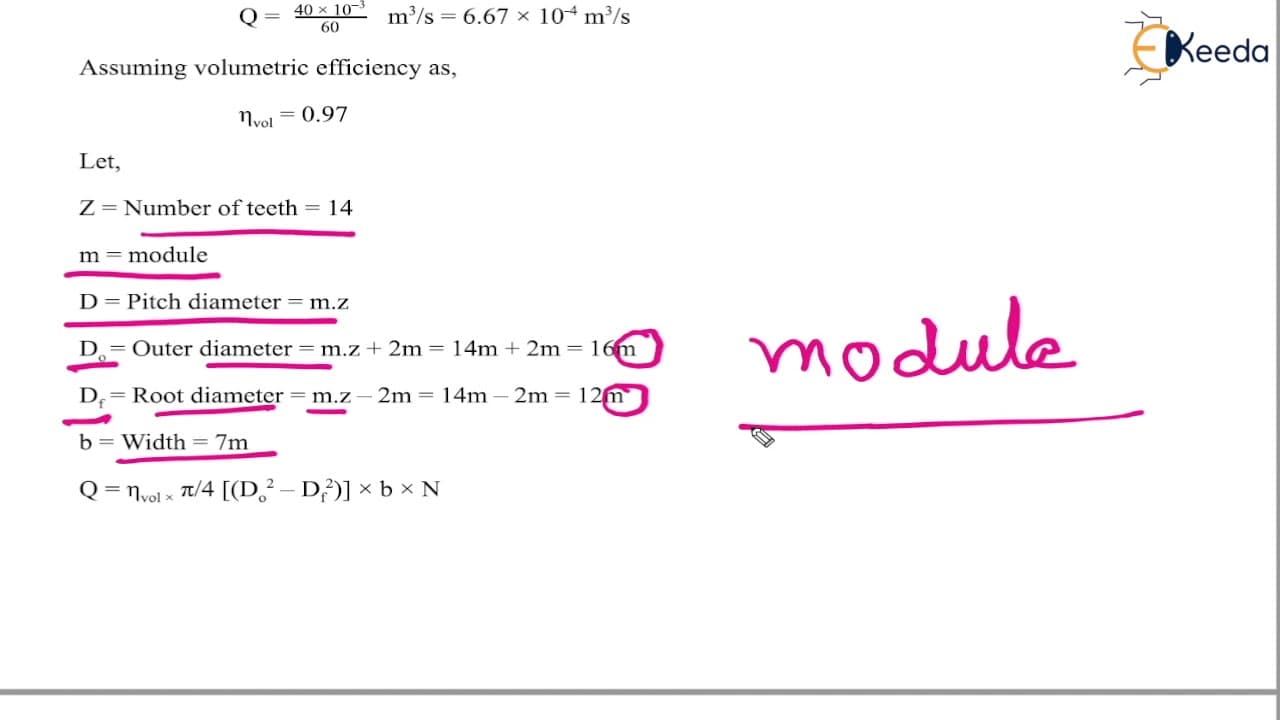
The pump unit design is covered, including the selection of gear profiles, gear quality, module calculations, and gear dimensions.
-
The casing design is explained, emphasizing the choice of material and considerations for pressure resistance and leak prevention.
-
Finally, the video briefly touches on the piping unit design, highlighting the importance of suitable pipe material and velocity calculations for the suction and delivery sides.
Read in Other Languages (beta)
Share This Summary 📚
Summarize YouTube Videos and Get Video Transcripts with 1-Click
Try YouTube Summary with ChatGPT & Claude or YouTube Transcript Generator
Explore More Summaries from Ekeeda 📚






Summarize YouTube Videos and Get Video Transcripts with 1-Click
Try YouTube Summary with ChatGPT & Claude or YouTube Transcript Generator