How Does Sabi's Brain-Reading Beanie Work?
TL;DR
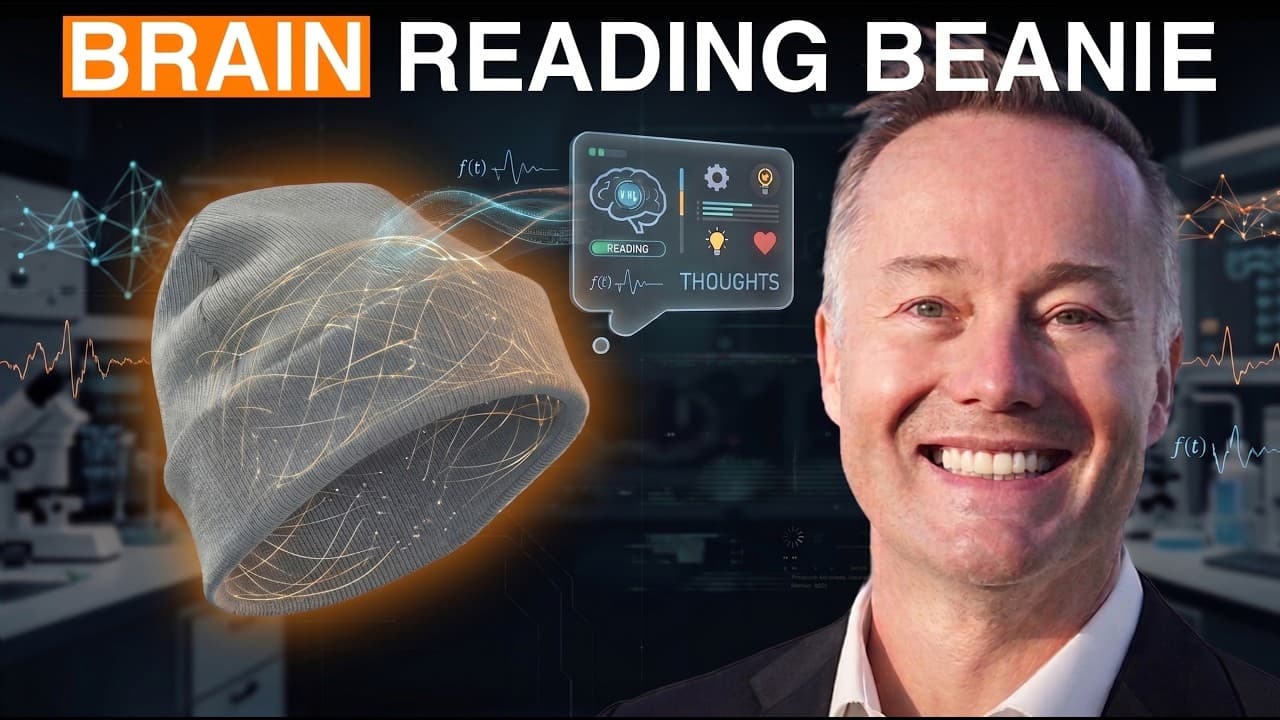
Sabi has developed a beanie equipped with 100,000 sensors that can read brain activity and translate thoughts into text without invasive surgery. The technology uses non-invasive sensors and deep learning models to interpret electrical activity in the brain. Despite skepticism, the founders claim it could revolutionize brain-computer interfaces by offering a non-invasive alternative to current methods.
Transcript
You're staking your entire reputations on a cap that allows me to dictate my words. It does not work. There's no way to put a beanie on and then have it do transcription. Come on. >> It is real. You You would not believe the amount of engineering and effort that has gone into it to make it work. But it does work. >> This doesn't work. I'm calling C... Read More
Key Insights
- Sabi's beanie uses 100,000 sensors to read brain activity non-invasively.
- The beanie translates thoughts into text using deep learning models.
- Sabi aims to provide a non-invasive alternative to brain-computer interfaces.
- The technology relies on analyzing electrical activity from outside the skull.
- Sabi's founders have backgrounds in math, electronics, and deep learning.
- The product is backed by significant investment, including from Venod Khosla.
- Sabi aims to launch a functional version of the beanie by the end of the year.
- The beanie's current limitation is a transcription speed of 30 words per minute.
Install to Summarize YouTube Videos and Get Transcripts
Explore YouTube Video Summarizer or Get YouTube Transcript Extractor
Questions & Answers
Q: How does Sabi's brain-reading beanie work?
Sabi's beanie uses 100,000 sensors to detect electrical activity in the brain and deep learning models to translate these signals into text. This non-invasive brain-computer interface offers an alternative to traditional methods that require invasive surgery. The technology interprets neural activity from outside the skull, akin to how satellites analyze terrain through the atmosphere.
Q: What makes Sabi's beanie different from other brain-computer interfaces?
Sabi's beanie is non-invasive, meaning it doesn't require surgery to implant sensors into the brain. Instead, it uses a cap with 100,000 sensors to read electrical activity from the scalp. This approach, combined with deep learning models, allows it to translate thoughts into text without the need for invasive procedures, setting it apart from traditional brain-computer interfaces.
Q: What are the limitations of Sabi's brain-reading technology?
Currently, Sabi's beanie can transcribe thoughts at a speed of 30 words per minute. Additionally, users need to think words slowly and deliberately for accurate transcription. While the technology is promising, these limitations highlight the challenges in achieving real-time, seamless brain-to-text translation, which Sabi aims to improve in future iterations.
Q: Who are the founders of Sabi and what is their background?
Sabi was founded by Rahul Chabra and Atmib Banerjee, who have backgrounds in math, electronics, and deep learning. Rahul interned at Stanford and worked on autonomous drones and early versions of LSTM models, while Atmib was a deep learning lead at a satellite company. Their expertise in bio-signals and deep learning has been instrumental in developing Sabi's brain-reading beanie.
Q: What is the potential impact of Sabi's beanie on technology?
Sabi's beanie could revolutionize brain-computer interfaces by providing a non-invasive method for reading and translating brain activity into text. This technology has the potential to change how we interact with computers and devices, enabling seamless thought-to-text communication without the need for invasive surgery, which could have far-reaching implications in various fields.
Q: What challenges does Sabi face in bringing their beanie to market?
Sabi faces challenges in improving the transcription speed and accuracy of their brain-reading beanie. The current limitation of 30 words per minute and the need for deliberate thought highlight the technological hurdles in achieving real-time, seamless brain-to-text communication. Additionally, gaining consumer trust and proving the technology's efficacy are crucial for successful market entry.
Q: How is Sabi funded and who are its notable investors?
Sabi has raised significant investment to develop its brain-reading beanie, with notable backing from Venod Khosla, a prominent venture capitalist known for supporting innovative technologies. This financial support indicates confidence in Sabi's potential to revolutionize brain-computer interfaces and underscores the importance of continued development and refinement of their technology.
Q: When is Sabi's beanie expected to be available to consumers?
Sabi aims to launch a functional version of their brain-reading beanie by the end of the year. The company is working on refining the technology to improve transcription speed and accuracy, with the goal of providing a non-invasive, user-friendly brain-computer interface that can be used in everyday settings, potentially transforming how we interact with technology.
Summary & Key Takeaways
-
Sabi has developed a beanie with 100,000 sensors that can read brain activity and translate thoughts into text without invasive surgery. This non-invasive brain-computer interface uses deep learning models to interpret electrical signals, offering a groundbreaking alternative to traditional methods. Despite skepticism about its feasibility, the founders claim the technology is real and revolutionary.
-
The beanie works by analyzing electrical activity from the brain through the skull, similar to how satellites interpret terrain through the atmosphere. Sabi's founders, with backgrounds in math, electronics, and deep learning, have engineered this innovative product, which is backed by significant investment, including from Venod Khosla.
-
Sabi aims to launch a functional version of the beanie by the end of the year, with a current transcription capability of 30 words per minute. The company envisions a future where users can think freely, and their thoughts are transcribed in real time, potentially transforming how we interact with technology.
Read in Other Languages (beta)
Share This Summary 📚
Summarize YouTube Videos and Get Video Transcripts with 1-Click
Try YouTube Summary with ChatGPT & Claude or YouTube Transcript Generator
Explore More Summaries from This Week in Startups 📚






Summarize YouTube Videos and Get Video Transcripts with 1-Click
Try YouTube Summary with ChatGPT & Claude or YouTube Transcript Generator