Finding missing side length when given perimeter | Math | 3rd grade | Khan Academy
TL;DR
Find the length of missing sides in shapes by using the perimeter and known side lengths.
Transcript
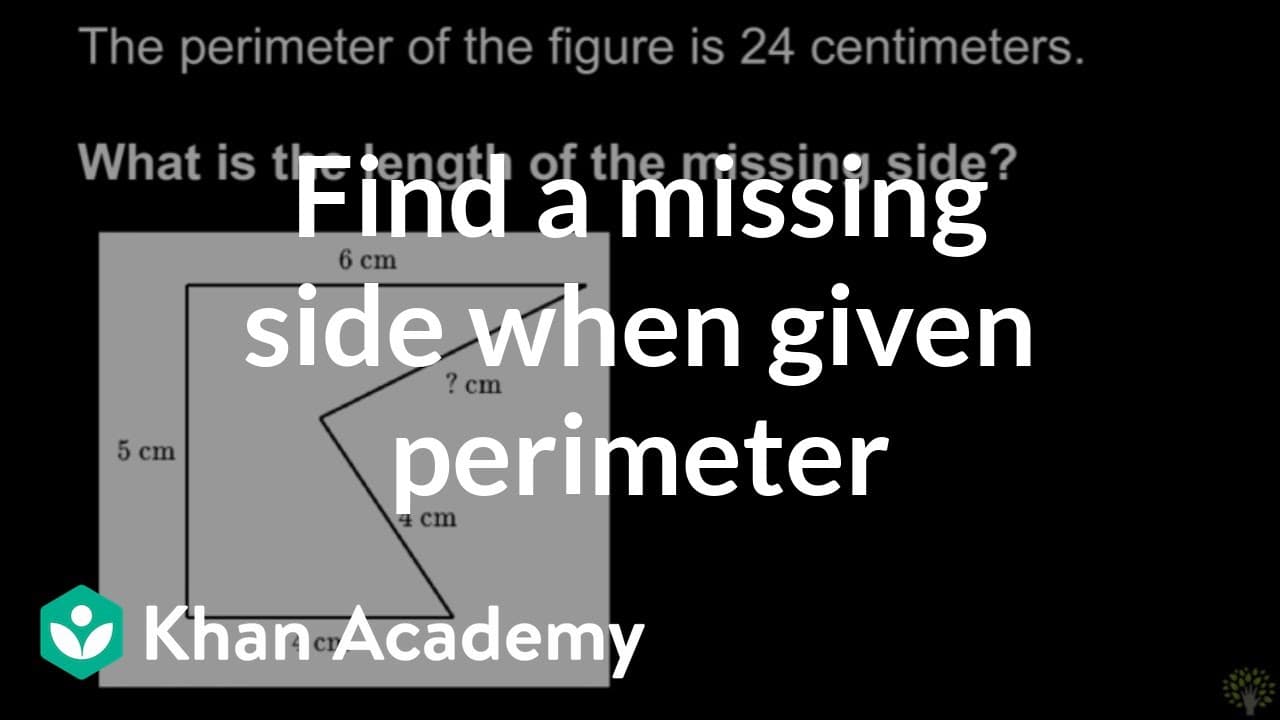
- [Voiceover] The perimeter of the figure is 24 centimeters. What is the length of the missing side? So we're told this figure down here has a perimeter of 24 centimeters. The perimeter is 24 centimeters. So what that tells us is that the distance around the entire outside is 24 centimeters. But what we want to know is what is the length of the mis... Read More
Key Insights
- 💠 The perimeter of a shape is the total distance around the outside.
- 😫 To find the length of a missing side, add up the known side lengths and the missing side, and set it equal to the given perimeter.
- 🙃 In a rectangle, opposite sides are equal in length.
- 🟰 Symmetry and equal sharing can help determine missing side lengths.
- 😒 To solve for a missing side length, use basic addition and subtraction skills.
- 🤒 Perimeter is measured in units of length, such as centimeters or meters.
- 🍹 The sum of the known side lengths must match the given perimeter for the missing side length to be correct.
Install to Summarize YouTube Videos and Get Transcripts
Explore YouTube Video Summarizer or Get YouTube Transcript Extractor
Questions & Answers
Q: How can we find the length of a missing side in a shape with a given perimeter?
To find the length of the missing side, add up the known side lengths and the missing side. Set this total equal to the given perimeter and solve for the missing side length.
Q: In the first example, why did the known side lengths add up to 19 cm?
The known side lengths in the first example were 6 cm, 5 cm, 4 cm, and 4 cm. When these lengths were added together, the sum was 19 cm.
Q: Why did the missing side length need to be 5 cm in the first example?
In order for the total perimeter to be 24 cm, the missing side length had to be 5 cm. When added to the known side lengths, it resulted in a total distance of 24 cm.
Q: How did the second example illustrate the concept of opposite sides being equal in a rectangle?
In the second example, when one side of the rectangle was known to be 11 meters, it automatically meant that the opposite side was also 11 meters. This is a characteristic of rectangles.
Summary & Key Takeaways
-
The perimeter of a figure is given as 24 cm, and the length of the missing side is to be determined. By adding up the known side lengths and the missing side, the total distance is found to be 24 cm, and thus the missing side length is 5 cm.
-
In another example, the perimeter of a rectangle is given as 32 meters, and one side is known to be 11 meters. By adding the known side lengths and the missing side, the missing side length is found to be 5 meters.
Read in Other Languages (beta)
Share This Summary 📚
Summarize YouTube Videos and Get Video Transcripts with 1-Click
Try YouTube Summary with ChatGPT & Claude or YouTube Transcript Generator
Explore More Summaries from Khan Academy 📚



Summarize YouTube Videos and Get Video Transcripts with 1-Click
Try YouTube Summary with ChatGPT & Claude or YouTube Transcript Generator