Type 1 Basic Problems 12,13 - Laplace Transform - Engineering Mathematics 3
TL;DR
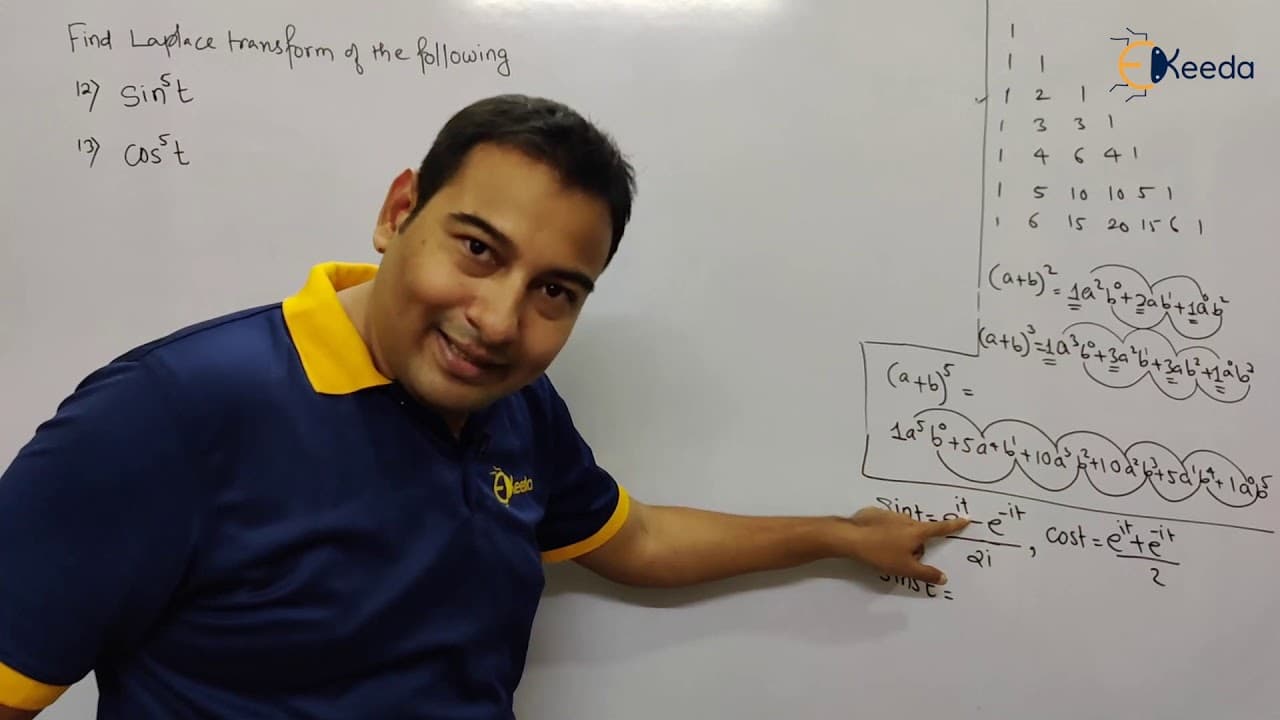
This video explains how to solve Laplace transform problems involving sine and cosine using Pascal's triangle.
Transcript
hello friends in this video we'll be discussing laplace transform type number one basic problems problem number 12 and 13. welcome back friends let's move on let's go ahead till now we are done with 11 problem now we are moving to the next problem 12 and 13. if you remember till now we are done with cos quality now we are moving ahead and now we'll... Read More
Key Insights
- 😑 Pascal's triangle is a useful tool for expanding expressions in Laplace transform problems involving sine and cosine functions.
- 💁 The formulas for sine and cosine functions are essential to convert them into exponential form for simplification.
- ✋ By using Pascal's triangle, problems involving higher powers of sine and cosine can be solved efficiently.
- 😑 Understanding the pattern and coefficients in Pascal's triangle is crucial for correctly expanding the expressions.
- 🔺 Practice and familiarity with Pascal's triangle can greatly simplify and streamline the process of solving Laplace transform problems.
Install to Summarize YouTube Videos and Get Transcripts
Explore YouTube Video Summarizer or Get YouTube Transcript Extractor
Questions & Answers
Q: What is the purpose of using Pascal's triangle in Laplace transform problems?
Pascal's triangle is used to simplify calculations and expand expressions in problems involving higher powers of sine and cosine functions. It provides a systematic way to determine the coefficients of the expanded expressions.
Q: Why is it necessary to use Pascal's triangle for problems involving 5 or higher powers of sine and cosine?
Pascal's triangle is necessary for problems with powers of sine and cosine greater than 4 because it allows us to easily determine the coefficients of the expanded expressions. Without Pascal's triangle, the calculations would be more complex and time-consuming.
Q: What are the formulas for sine and cosine functions in Laplace transform problems?
The formula for sine function is e^(it) - e^(-it) / (2i), and the formula for cosine function is e^(it) + e^(-it) / 2. These formulas are used to convert the sine and cosine functions into exponential form for further simplifications.
Q: How does Pascal's triangle help in expanding expressions involving sine and cosine functions?
Pascal's triangle provides the coefficients for expanding expressions involving sine and cosine functions. The coefficients follow a pattern where each line represents the coefficients of (a + b) raised to a certain power. By using the coefficients from Pascal's triangle, the expressions can be expanded easily.
Summary & Key Takeaways
-
The video discusses Laplace transform problems 12 and 13, focusing on solving problems involving sine and cosine functions using Pascal's triangle.
-
Pascal's triangle is introduced as a tool for simplifying the calculations and expanding the expressions.
-
The video explains the formulas for sine and cosine functions and provides step-by-step instructions for using Pascal's triangle to solve the problems.
Read in Other Languages (beta)
Share This Summary 📚
Summarize YouTube Videos and Get Video Transcripts with 1-Click
Try YouTube Summary with ChatGPT & Claude or YouTube Transcript Generator
Explore More Summaries from Ekeeda 📚






Summarize YouTube Videos and Get Video Transcripts with 1-Click
Try YouTube Summary with ChatGPT & Claude or YouTube Transcript Generator