Two Dimension and Pointer |Data Structure Using C
TL;DR
This video explains the relationship between two-dimensional arrays and pointers in C programming.
Transcript
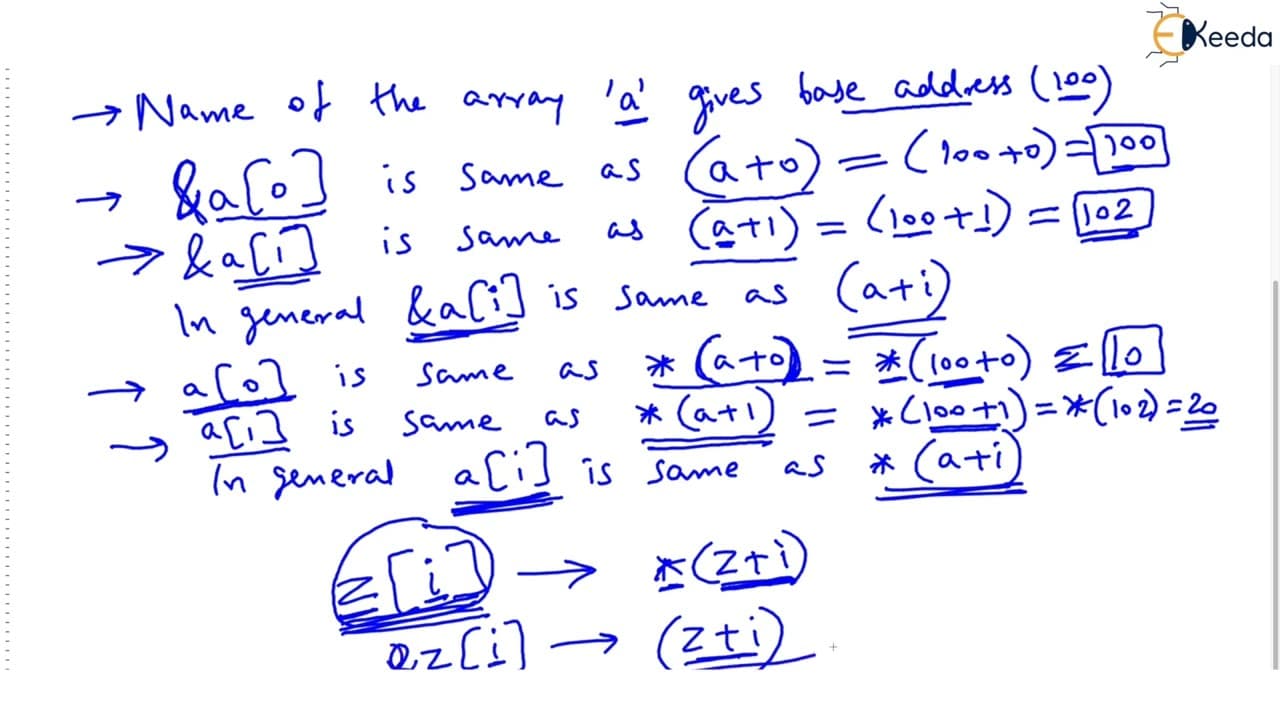
hello dear students in this video we will see what is the relation between two dimensional array and pointer now as you see i have declared a two dimensional array of four rows and two columns and i've drawn some diagrams but what i want all of you to do first is that just please revise the concept of one dimensional array that we saw in the earlie... Read More
Key Insights
- 🏪 One-dimensional arrays store elements in consecutive memory locations.
- ⚾ The name of an array with a single subscript gives the base address of the array.
- 🫰 Accessing elements in a one-dimensional array can be done using both the address operator and adding an index to the base address.
- 🏪 Two-dimensional arrays are stored as a sequence of bytes in memory.
- 🤨 Each row in a two-dimensional array is stored consecutively, followed by the next row.
- ⚾ Accessing base addresses and values of elements in a two-dimensional array can be done using pointer notation.
- 😃 The notation "a[i][j]" is equivalent to "*(a + i + j)" and can be used to access specific elements in a two-dimensional array.
Install to Summarize YouTube Videos and Get Transcripts
Explore YouTube Video Summarizer or Get YouTube Transcript Extractor
Questions & Answers
Q: How are the elements in a one-dimensional array stored in memory?
The elements in a one-dimensional array are stored in consecutive memory locations as a sequence of bytes. The address of each element can be accessed using the address operator (&) or by adding an index to the base address of the array.
Q: What is the difference between using the address operator and adding an index to the base address to access an element's address?
There is no practical difference between using the address operator and adding an index to the base address. Both methods will give the same address of the element. Using the address operator is more explicit, while adding an index is a shorthand notation.
Q: How are two-dimensional arrays stored in memory?
Two-dimensional arrays are stored as a sequence of bytes in memory. The elements of each row are stored consecutively, and the rows are also stored consecutively in memory.
Q: How can we access the base address of a specific row in a two-dimensional array?
To access the base address of a specific row in a two-dimensional array, we can use pointer notation by adding the row index to the base address of the array.
Summary & Key Takeaways
-
The video first revises the concept of one-dimensional arrays and explains how each element in the array is stored in memory.
-
It then explains the notational conventions for accessing the address and value of elements in a one-dimensional array.
-
The video then introduces two-dimensional arrays and discusses how they are represented in memory as a sequence of bytes.
-
It explains how to access the base address and values of elements in a two-dimensional array using pointer notation.
-
The video concludes with a demonstration of accessing specific elements in a two-dimensional array using pointers.
Read in Other Languages (beta)
Share This Summary 📚
Summarize YouTube Videos and Get Video Transcripts with 1-Click
Try YouTube Summary with ChatGPT & Claude or YouTube Transcript Generator
Explore More Summaries from Ekeeda 📚






Summarize YouTube Videos and Get Video Transcripts with 1-Click
Try YouTube Summary with ChatGPT & Claude or YouTube Transcript Generator