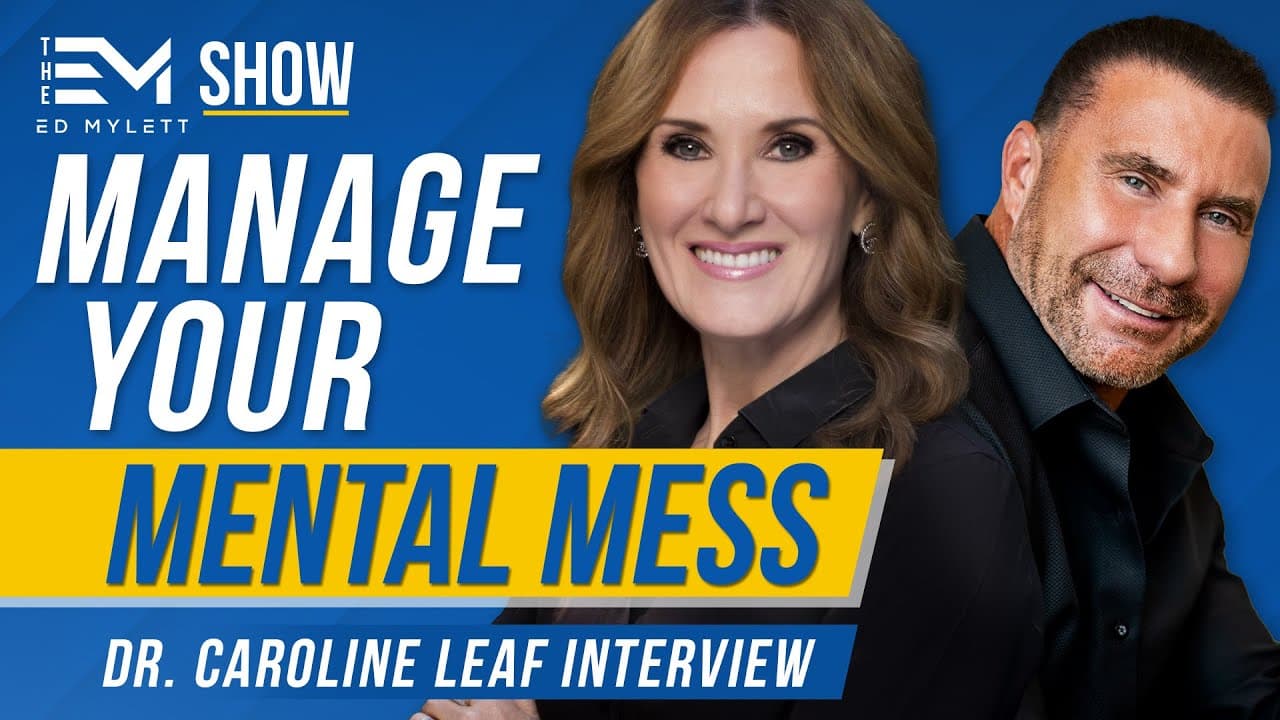
HEAL YOUR MIND and CONTROL Your BRAIN! - Interview w/ Dr. Caroline Leaf
TL;DR
Dr. Caroline Leaf discusses managing mental mess for a healthier mind.
Transcript
if we're human we are going to experience messes and there's no shame in that the sooner we get rid of the shame and guilt and condemnation around being messy and the sooner we as leaders talk about the mind more authentically we more the more we give people that follow us a permission to talk about mind only three percent of leaders are talking ab... Read More
Key Insights
- Dr. Caroline Leaf emphasizes the importance of accepting human messiness and removing shame to better manage mental health.
- Only three percent of leaders discuss mental health, contributing to stigma and the illusion of perfection.
- Thoughts are built through thinking, feeling, and choosing, which are constant processes shaping our brain.
- The brain is not wired for toxic thoughts, which can trigger immune responses similar to fighting a virus.
- Self-regulation and mind management can improve mental efficiency by 81% and enhance overall health.
- The Neurocycle is a five-step process for mind management: gather awareness, reflect, write, recheck, and active reach.
- Dr. Leaf discusses the interplay between spirituality and science, suggesting they are two sides of the same coin.
- Identity is shaped by experiences and can be affected by external factors like trauma, but self-regulation can help navigate these influences.
Install to Summarize YouTube Videos and Get Transcripts
Explore YouTube Video Summarizer or Get YouTube Transcript Extractor
Questions & Answers
Q: What is the primary message Dr. Caroline Leaf conveys about mental health?
Dr. Caroline Leaf emphasizes the acceptance of human messiness and the removal of shame and guilt associated with mental health issues. She stresses the importance of leaders discussing mental health more openly to reduce stigma and enable people to address their mental challenges without fear of judgment.
Q: How does Dr. Leaf describe the process of forming thoughts?
Dr. Leaf explains that thoughts are formed through a continuous cycle of thinking, feeling, and choosing. This process begins from the moment we wake up and continues throughout the day, affecting our brain's structure. Thoughts are real physical entities in the brain, represented by tree-like structures that store information and emotions.
Q: What is the Neurocycle, and how does it benefit mental health?
The Neurocycle is a five-step process for managing the mind, consisting of gathering awareness, reflecting, writing, rechecking, and active reach. This method helps individuals self-regulate their thoughts and emotions, improving mental efficiency by 81% and enhancing overall health by reducing inflammation and improving cellular function.
Q: What does Dr. Leaf say about the relationship between mind and brain?
Dr. Leaf explains that the mind and brain are separate but inseparable entities. The mind is an external force that keeps the brain and body functioning. While the brain is a physical structure, the mind is responsible for driving thoughts and emotions, impacting the brain's health and structure.
Q: How does Dr. Leaf view the connection between spirituality and science?
Dr. Leaf views spirituality and science as two sides of the same coin, with spirituality providing the narrative and science explaining how things work. She believes that understanding the intricacies of the brain and mind can enhance one's appreciation for a higher power and improve one's ability to serve others and live a fulfilling life.
Q: What is the impact of cognitive dissonance on mental health?
Cognitive dissonance occurs when an individual holds conflicting thoughts, leading to mental stress and confusion. Dr. Leaf suggests that cognitive dissonance is a normal part of human experience, and it can be managed by using the Neurocycle to explore and reconcile these conflicting thoughts, ultimately leading to improved mental clarity and well-being.
Q: How does identity influence mental health according to Dr. Leaf?
Dr. Leaf explains that identity is heavily influenced by one's experiences and environment. Traumatic experiences can shape negative self-perceptions, leading to mental health challenges. However, by practicing self-regulation and mind management, individuals can navigate these influences, access their wise mind, and reshape their identity in a healthier way.
Q: What practical advice does Dr. Leaf offer for improving brain health?
Dr. Leaf recommends incorporating the Neurocycle into daily life as a primary method for mind management. Additionally, she suggests practices like deep breathing exercises to prepare the brain for optimal functioning. These techniques help balance the brain's hemispheres, reduce impulsivity, and enhance creative and introspective abilities.
Summary & Key Takeaways
-
Dr. Caroline Leaf discusses the natural messiness of human thoughts and the importance of removing shame to improve mental health. She highlights the low percentage of leaders who talk about mental health, which contributes to stigma.
-
Thoughts are constructed through a continuous process of thinking, feeling, and choosing, affecting the brain's structure. Toxic thoughts are not natural for the brain and can trigger immune responses similar to fighting viruses.
-
Dr. Leaf introduces the Neurocycle, a five-step mind management technique, and explains the relationship between mind and brain. She also explores the connection between spirituality and science, viewing them as complementary.
Read in Other Languages (beta)
Share This Summary 📚
Summarize YouTube Videos and Get Video Transcripts with 1-Click
Try YouTube Summary with ChatGPT & Claude or YouTube Transcript Generator
Explore More Summaries from Ed Mylett 📚





Summarize YouTube Videos and Get Video Transcripts with 1-Click
Try YouTube Summary with ChatGPT & Claude or YouTube Transcript Generator