Put vs. short and leverage | Finance & Capital Markets | Khan Academy
TL;DR
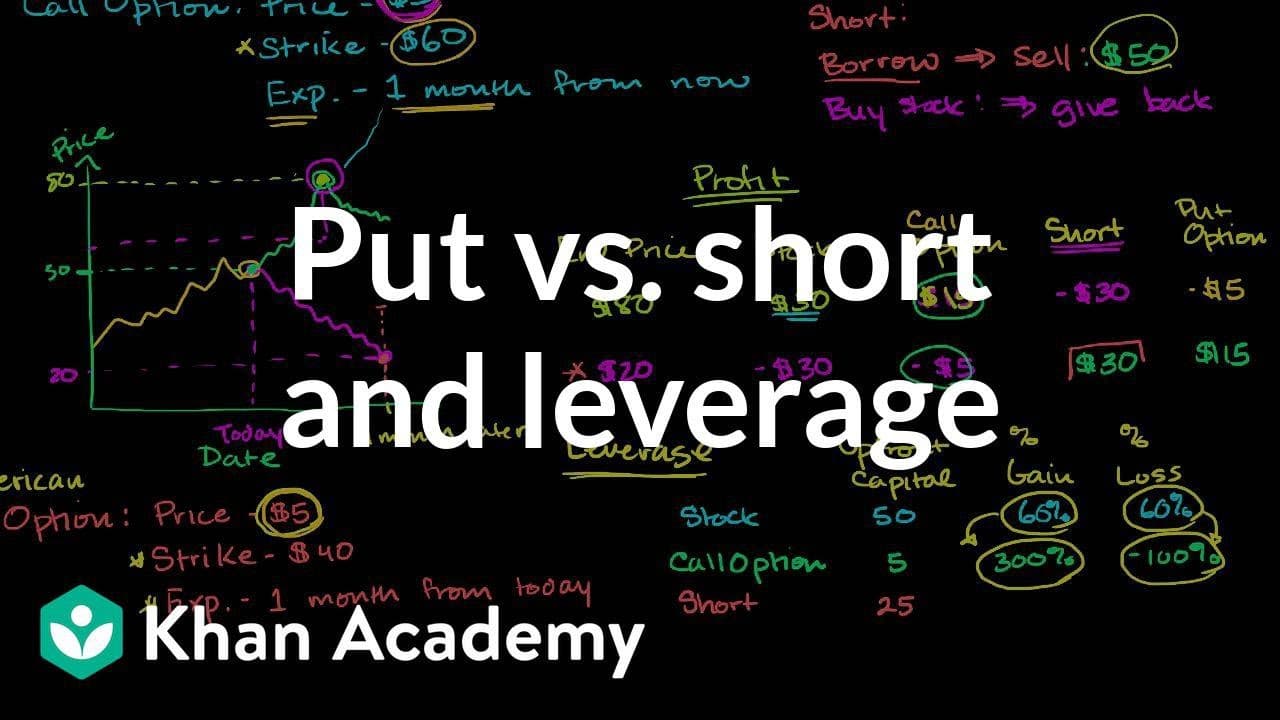
Put options offer higher leverage and potential gains compared to shorting stocks.
Transcript
Let's think about how put options can give us leverage on a downside, or I should say, on a bet that the stock will go down relative to shorting. This one's a little bit more complicated, because shorting is a little bit less intuitive. But if you were to short a stock, in order to short it, you might say hey, I don't have to put any money up front... Read More
Key Insights
- 😘 Shorting stocks requires upfront capital, while put options have lower upfront investment requirements.
- 🍰 Shorting profits when the stock price declines, while put options offer gains in both downward and upward movements.
- 👋 The best-case scenario in shorting is a stock value of zero, resulting in maximum profit. Put options have a defined maximum profit potential.
Install to Summarize YouTube Videos and Get Transcripts
Explore YouTube Video Summarizer or Get YouTube Transcript Extractor
Questions & Answers
Q: How does shorting a stock work, and what is the upfront capital requirement?
Shorting a stock involves borrowing and selling it with the expectation that its price will fall. However, upfront capital is required, usually at least 50% of the value of the short.
Q: What happens when the stock goes down in a shorting scenario?
When the stock decreases in price, shorting becomes profitable. You can buy back the stock at a lower price, return it to the lender, and keep the difference as profit.
Q: What is the best-case scenario in shorting a stock?
The ideal scenario is when the stock goes to zero, allowing you to buy it back for nothing, resulting in a 100% profit based on the upfront capital invested.
Q: How do put options differ from shorting in terms of upfront investment and potential gains?
Put options require less upfront investment, usually only a fraction of the stock's value. In case the stock decreases, the potential gains can be higher compared to shorting.
Summary & Key Takeaways
-
Shorting a stock requires upfront capital and carries the risk of the stock moving against you.
-
With shorting, if the stock goes down, you make a profit, while if it goes up, you incur a loss.
-
Put options allow for lower upfront investment and provide a higher potential return when stocks decline.
Read in Other Languages (beta)
Share This Summary 📚
Summarize YouTube Videos and Get Video Transcripts with 1-Click
Try YouTube Summary with ChatGPT & Claude or YouTube Transcript Generator
Explore More Summaries from Khan Academy 📚



Summarize YouTube Videos and Get Video Transcripts with 1-Click
Try YouTube Summary with ChatGPT & Claude or YouTube Transcript Generator