Related rates: balloon | Applications of derivatives | AP Calculus AB | Khan Academy
TL;DR
Using trigonometry and derivatives, we can determine the rate at which a hot air balloon is ascending.
Transcript
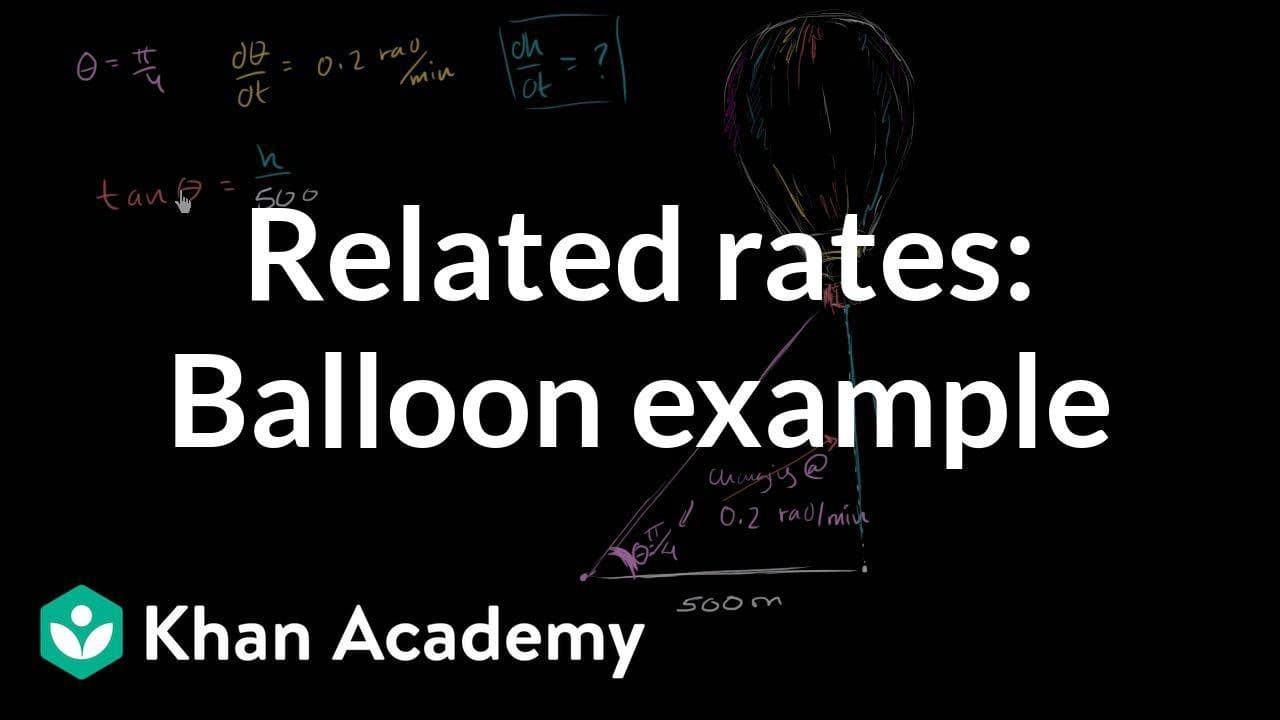
You're watching some type of hot air balloon show, and you're curious about how quickly one hot air balloon in particular is rising. And you have some information at your disposal. You know the spot on the ground that is directly below the hot air balloon. Let's say it took off from that point, it's just been going straight up ever since. And you k... Read More
Key Insights
- 💬 Trigonometry, specifically the tangent function, can be used to relate the angle and the height of the balloon.
- ☠️ Taking the derivative of the tangent function allows us to find the rate at which the height of the balloon is changing.
- ☠️ The relationship between the rate of change of the angle and the rate of change of the height can be determined using the chain rule.
Install to Summarize YouTube Videos and Get Transcripts
Explore YouTube Video Summarizer or Get YouTube Transcript Extractor
Questions & Answers
Q: What information is needed to calculate the rate at which the hot air balloon is rising?
To calculate the rate of ascent, you need to know the distance between the observer and the balloon's launch point, the angle between the ground and the line of sight to the balloon, and the rate at which the angle is changing over time.
Q: How do you relate the angle and the height of the balloon?
By using trigonometry, specifically the tangent function, you can establish a relationship between the angle and the height of the balloon. The tangent of the angle is equal to the height divided by the distance between the observer and the launch point.
Q: What does taking the derivative of the tangent function with respect to time allow us to calculate?
Taking the derivative of the tangent function with respect to time allows us to find the rate of change of the height of the balloon with respect to time, given the rate at which the angle is changing.
Q: What is the rate at which the balloon is ascending, based on the given information?
The rate at which the balloon is rising is determined to be 200 meters per minute.
Summary & Key Takeaways
-
A person is observing a hot air balloon and wants to know how fast it is rising.
-
They know the distance between them and the balloon's launch point, as well as the angle between the ground and the balloon's line of sight.
-
By using the tangent function and taking the derivative, they can find the relationship between the rate of change of the angle and the rate of change of the balloon's height.
-
With the given values, they determine that the balloon is rising at a rate of 200 meters per minute.
Read in Other Languages (beta)
Share This Summary 📚
Summarize YouTube Videos and Get Video Transcripts with 1-Click
Try YouTube Summary with ChatGPT & Claude or YouTube Transcript Generator
Explore More Summaries from Khan Academy 📚



Summarize YouTube Videos and Get Video Transcripts with 1-Click
Try YouTube Summary with ChatGPT & Claude or YouTube Transcript Generator