Bohr Model (6 of 7) Energy Level Derivation and Calculation
TL;DR
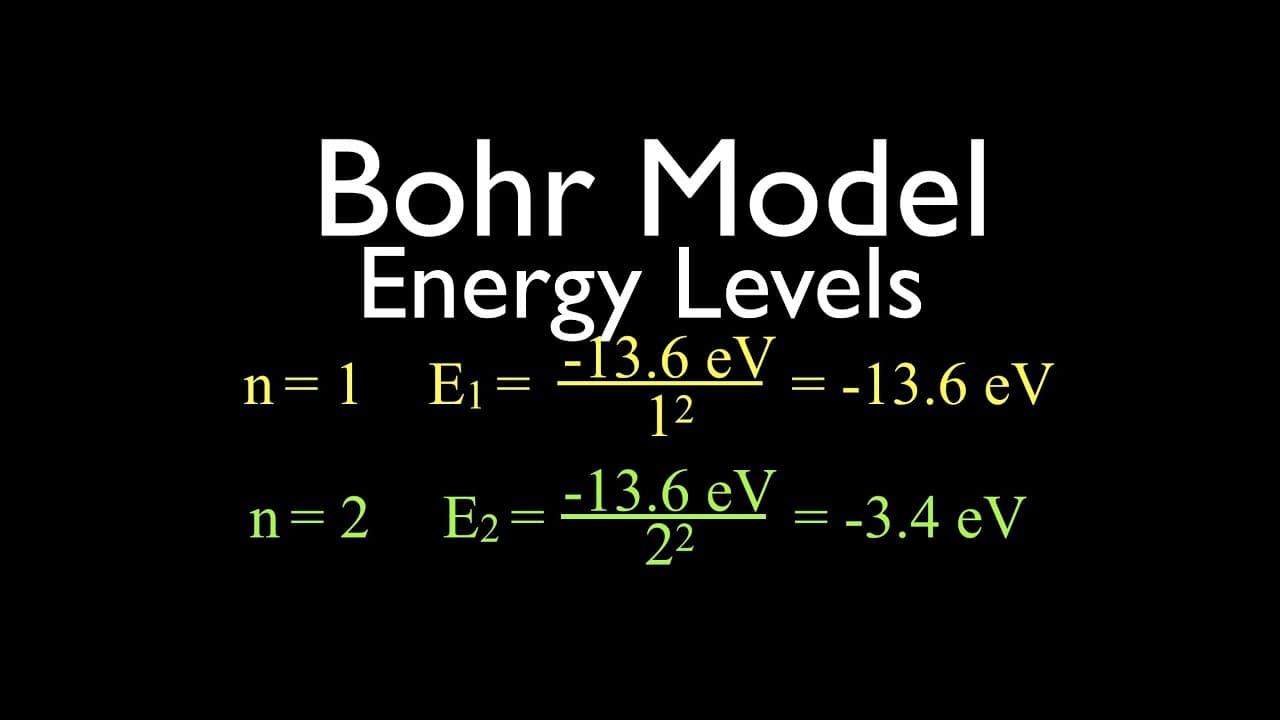
Explaining how to calculate hydrogen atom energy levels using the Bohr model through kinetic and potential energy equations.
Transcript
okay in today's video we're going to go over an explanation a derivation of how we come up with the energy levels in a hydrogen atom using the Bohr model I'm going to do that in a similar manner to how we calculate the Bohr radius in the previous video and you can link to that video the previous video upper right-hand corner of this video if you wa... Read More
Key Insights
- 🫀 Energy levels in a hydrogen atom are derived by combining kinetic and potential energy equations.
- 🖐️ Forces like electric and centripetal forces play crucial roles in determining hydrogen atom energy levels.
- #️⃣ The quantized nature of energy levels in a hydrogen atom relates to whole-number squared values of the principal quantum number.
- 😑 Conversion between joules and electron volts helps express energy levels more conveniently.
- 🎚️ The energy level diagram for hydrogen demonstrates the decreasing energy values for different excited states.
- 🎚️ Bohr's model postulated quantized energy levels to explain the discrete spectrum observed in hydrogen.
- 🫀 The simplified equation for hydrogen atom energy levels incorporates a constant value and the square of the principal quantum number.
Install to Summarize YouTube Videos and Get Transcripts
Explore YouTube Video Summarizer or Get YouTube Transcript Extractor
Questions & Answers
Q: How do we calculate energy levels in a hydrogen atom using the Bohr model?
Energy levels in a hydrogen atom are determined by combining kinetic and potential energy equations derived from the forces between the nucleus and electron, following quantized energy principles.
Q: What forces act on a hydrogen atom according to the Bohr model?
The electric force and centripetal force, balancing each other due to opposite directions but equal magnitudes, guide the electron's motion around the nucleus.
Q: What does the negative sign signify in the potential energy equation for a hydrogen atom?
The negative sign in the potential energy equation indicates a decrease in energy when charges approach each other, with zero potential energy at infinite separation.
Q: How are the energy levels simplified for hydrogen atom states using the principle quantum number?
The energy at each level is represented as -13.6 electron volts divided by the square of the principal quantum number, providing a succinct equation for energy calculations.
Summary & Key Takeaways
-
Derivation of hydrogen atom energy levels by calculating kinetic and potential energy components.
-
Forces acting on a hydrogen atom include electric and centripetal forces.
-
The simplified equation for energy levels relates to the square of the principal quantum number.
Read in Other Languages (beta)
Share This Summary 📚
Summarize YouTube Videos and Get Video Transcripts with 1-Click
Try YouTube Summary with ChatGPT & Claude or YouTube Transcript Generator
Explore More Summaries from Step by Step Science 📚
Summarize YouTube Videos and Get Video Transcripts with 1-Click
Try YouTube Summary with ChatGPT & Claude or YouTube Transcript Generator