Order of operations examples: exponents | Arithmetic operations | 6th grade | Khan Academy
TL;DR
Understanding and applying the order of operations is crucial for solving math expressions correctly.
Transcript
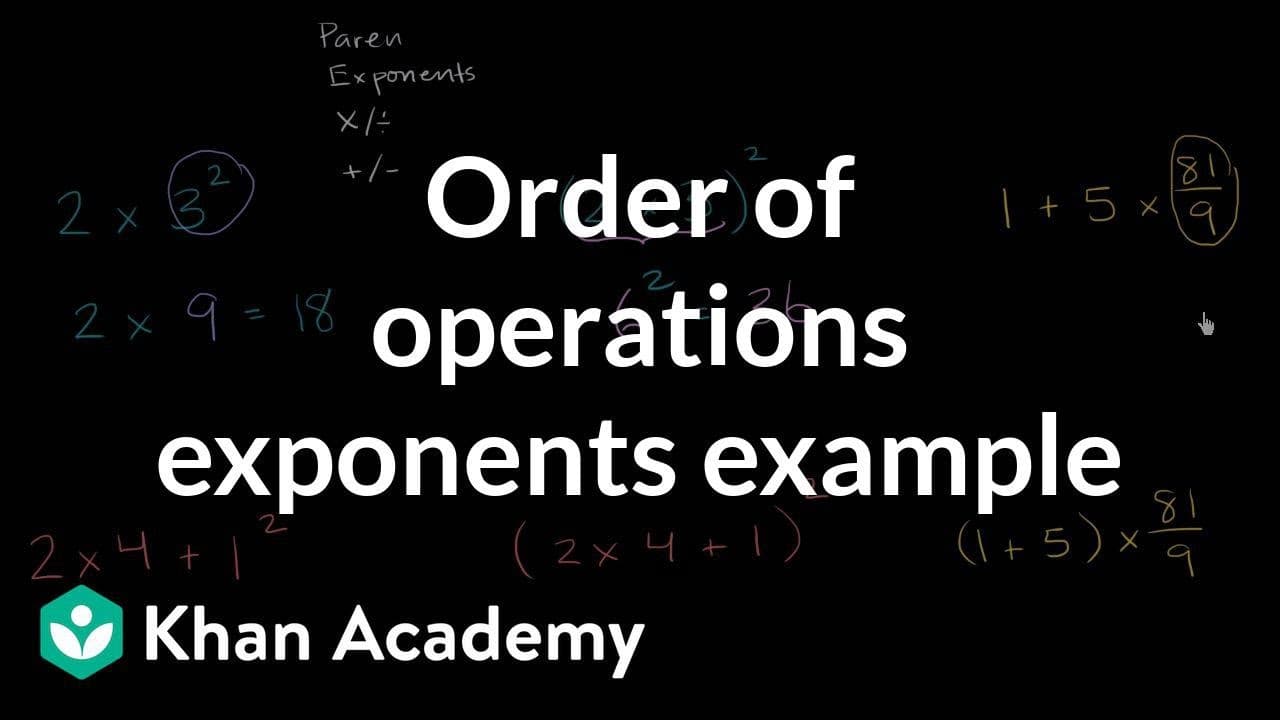
So I have six different expressions here, and what I want you to do is pause this video and try to calculate the value of each of these expressions. I'm assuming you've given a go at it. Now let's work through them. So when we see something like this, we have to remember our order of operations. We have 2 times 3 squared, and we have to remember th... Read More
Key Insights
- 🪈 The order of operations helps ensure consistent and accurate results.
- 🎁 When parentheses are present, prioritize the operations within them before moving on.
- ✖️ Exponents are evaluated before multiplication, division, addition, and subtraction.
- 🗯️ Multiplication and division are performed from left to right, followed by addition and subtraction.
- 👻 Following the order of operations allows for efficient problem-solving in mathematics.
- 🎭 The presence of parentheses can alter the order in which operations should be performed.
- 😑 Be mindful of the sequence of operations to avoid mistakes in solving math expressions.
Install to Summarize YouTube Videos and Get Transcripts
Explore YouTube Video Summarizer or Get YouTube Transcript Extractor
Questions & Answers
Q: What is the order of operations in math expressions?
The order of operations is a set of rules that dictate the sequence in which mathematical operations should be performed. The order is: parentheses, exponents, multiplication and division (from left to right), and addition and subtraction (from left to right).
Q: Why is it important to follow the order of operations?
Following the order of operations ensures that mathematical expressions are solved correctly. Failing to follow the order can lead to incorrect answers. The rules prevent ambiguity and establish a standardized approach to solving expressions.
Q: What happens if parentheses are not present in an expression?
If parentheses are not present, exponents should be evaluated first, followed by multiplication and division from left to right, and finally addition and subtraction from left to right. The absence of parentheses simply implies that no specific grouping is required.
Q: How can the order of operations be applied to simplify expressions step-by-step?
To simplify expressions, identify any parentheses and evaluate the expressions within them first. Then evaluate any exponents. Next, perform multiplication and division in the order they appear from left to right. Finally, perform addition and subtraction in the order they appear from left to right.
Summary & Key Takeaways
-
The video explains the order of operations: parentheses, exponents, multiplication and division, and addition and subtraction.
-
Examples are given to demonstrate how to solve expressions using the correct order of operations.
-
The importance of following the order of operations to arrive at the correct answer is emphasized.
Read in Other Languages (beta)
Share This Summary 📚
Summarize YouTube Videos and Get Video Transcripts with 1-Click
Try YouTube Summary with ChatGPT & Claude or YouTube Transcript Generator
Explore More Summaries from Khan Academy 📚



Summarize YouTube Videos and Get Video Transcripts with 1-Click
Try YouTube Summary with ChatGPT & Claude or YouTube Transcript Generator