Genes, proteins, and cells | Genes, cells, and organisms | High school biology | Khan Academy
TL;DR
Genes contain information about an organism's traits and are passed down from parent to offspring, determining the color and other physical characteristics of an organism.
Transcript
- [Instructor] So when I was younger, around seven or eight years old, I used to have a beta fish named Bob, and he happened to be a blue-colored fish. Now, I've always wondered how he got his color. So for example, were his parents also blue? Does he have any siblings that were blue? So today, let's try to answer in simple terms how Bob gets his b... Read More
Key Insights
- 💁 Genes are passed down from parent to offspring and contain information about an organism's traits.
- 🥺 Alleles are different versions of the same gene, leading to different variations in traits.
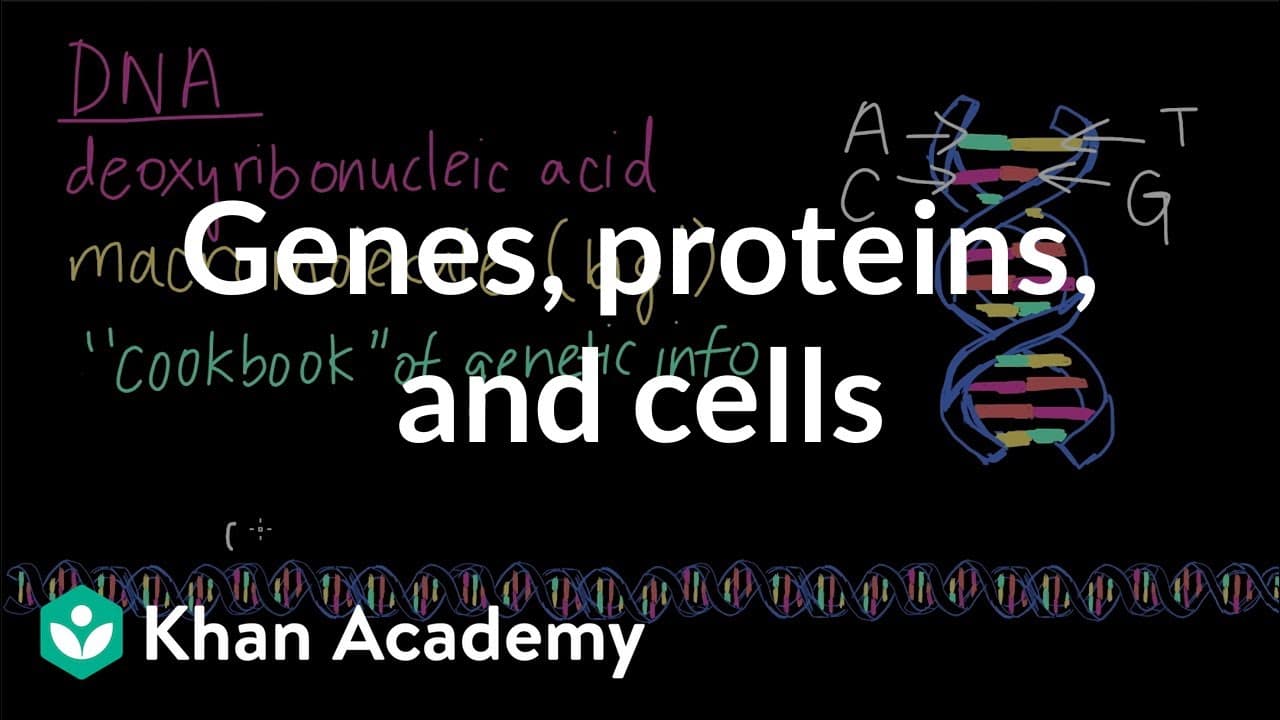
- ❓ Genes are part of the DNA molecule, which consists of nucleotide subunits.
- 🪘 Genes encode proteins, which are made of long sequences of amino acids.
- ❓ Different genes and alleles can result in the production of different proteins, influencing an organism's physical traits.
- 🎭 Cell specialization occurs when different cells perform specific functions, with each cell containing a unique combination of proteins.
- 😑 All cells in an organism contain the same genes and DNA, but their functions differ due to the expression of different subsets of genes.
Install to Summarize YouTube Videos and Get Transcripts
Explore YouTube Video Summarizer or Get YouTube Transcript Extractor
Questions & Answers
Q: How are genes passed down from parent to offspring?
Genes are passed down from parent to offspring through heredity. Each parent contributes half of their genes to their offspring, determining their traits.
Q: What are alleles and how do they influence traits?
Alleles are different versions of the same gene. Different alleles can lead to different variations in traits, such as different colors. For example, an allele may result in a blue-colored fish, while another allele may result in green coloration.
Q: What are genes made of?
Genes are segments of nucleotides within the DNA molecule. DNA is a macromolecule consisting of subunits called nucleotides, represented by the letters A, T, C, and G.
Q: How do genes determine physical traits?
Genes encode proteins, which are made of long sequences of amino acids. They provide instructions on how to create these chains of amino acids, and different genes and alleles can lead to the production of different proteins, ultimately influencing an organism's physical traits.
Summary & Key Takeaways
-
Genes are hereditary units passed down from parent to offspring, containing information about an organism's traits.
-
Different versions of the same gene, known as alleles, can lead to different variations in traits, such as different colors.
-
Genes are segments of nucleotides within the DNA molecule and encode proteins, which are made of long sequences of amino acids.
Read in Other Languages (beta)
Share This Summary 📚
Summarize YouTube Videos and Get Video Transcripts with 1-Click
Try YouTube Summary with ChatGPT & Claude or YouTube Transcript Generator
Explore More Summaries from Khan Academy 📚



Summarize YouTube Videos and Get Video Transcripts with 1-Click
Try YouTube Summary with ChatGPT & Claude or YouTube Transcript Generator