Stanford CS224W: Machine Learning with Graphs | 2021 | Lecture 18 - GNNs in Computational Biology
TL;DR
Graph neural networks have shown great success in leveraging graph representations to learn meaningful patterns in biology and medicine, enabling critical predictions in disease treatment, drug discovery, and more.
Transcript
today i will talk about graph neural networks in computational biology and there has been a tremendous surge in of interest in leveraging graph neural networks and graph representation learning in particular for learning meaningful representations of biology and meaningful representations of data sets and entities when we encounter in biology and m... Read More
Key Insights
- 💊 Biology and medicine can be effectively studied through the lens of networks, as entities like proteins and molecules interact with each other in interconnected networks.
- 🦺 Graph neural networks have achieved success in predicting drug safety, diagnosing diseases, and repurposing drugs due to their ability to capture the topology and structure of biological networks.
- 🤘 Few-shot learning and meta-learning strategies can be employed to transfer knowledge across tasks and improve the accuracy of predictions in scenarios with limited labeled examples.
- 🚨 Experimental validation is crucial to confirm the efficacy of predictions and prioritize potential therapeutic opportunities for emerging diseases like COVID-19.
Install to Summarize YouTube Videos and Get Transcripts
Explore YouTube Video Summarizer or Get YouTube Transcript Extractor
Questions & Answers
Q: Why have graph neural networks seen success in computational biology?
Graph neural networks have been successful in computational biology due to the interconnected nature of biological entities, which can be effectively captured and analyzed through network representations. By leveraging the topology of biological networks, GNNs can learn meaningful representations for various biomedical applications.
Q: How do graph neural networks contribute to drug repurposing for emerging diseases like COVID-19?
Graph neural networks enable the prioritization of existing drugs for repurposing by utilizing their embeddings and comparing them to the embedding of the target disease. By identifying drugs that are close to the disease embedding in the latent space, potential therapeutic opportunities can be identified and experimentally validated.
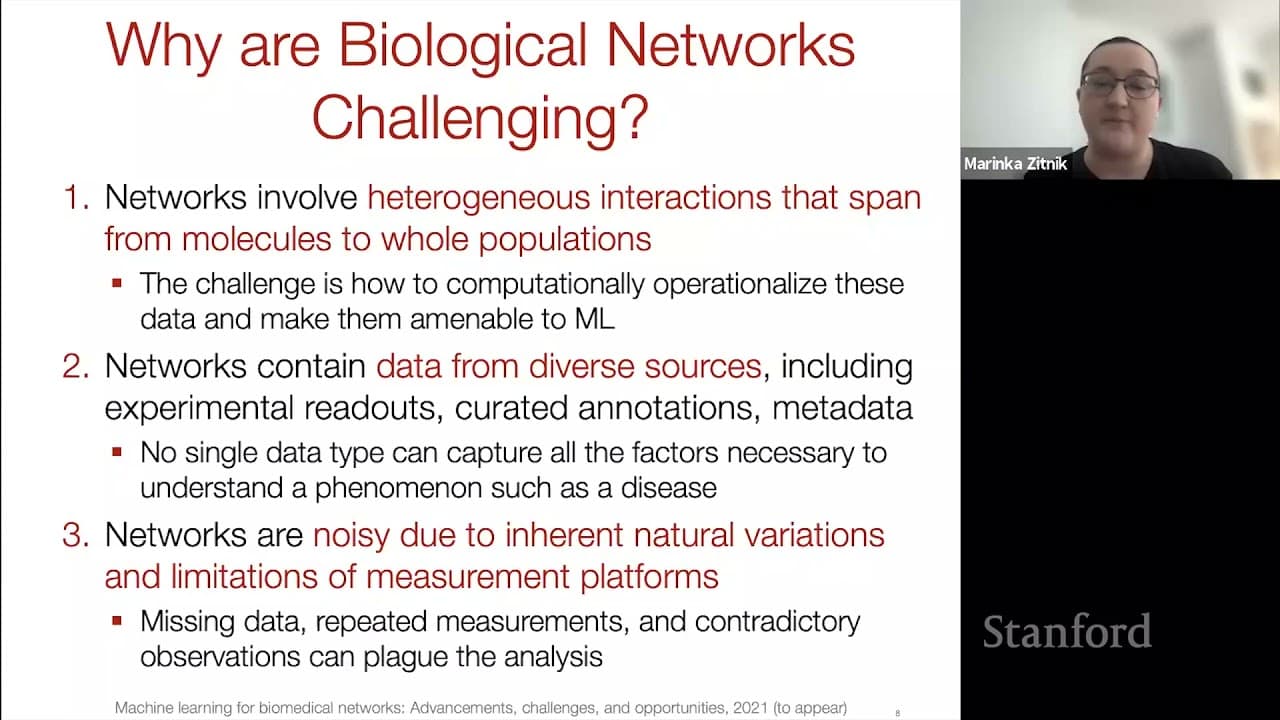
Q: What challenges do biological networks present for computational analysis?
Biological networks involve heterogeneous interactions, diverse data sources, and inherent noise and incompleteness. Computational analysis must address these challenges by operationalizing data, considering diverse data types together, and developing robust methods to handle noise and missing data.
Q: How are subgraph embeddings used in disease diagnosis?
Subgraph embeddings capture local topology and structure in the biological network, providing rich information for disease diagnosis. Subgraph neural networks leverage these embeddings to enable the classification of subgraphs (representing patients' phenotypes) into disease categories, improving diagnostic accuracy.
Summary & Key Takeaways
-
Graph neural networks (GNNs) have gained significant interest in computational biology for learning meaningful representations of biological data sets and entities.
-
Biology is highly interconnected, with proteins and molecules interacting with each other in biological networks, making the study of biology through the lens of networks essential.
-
GNNs have been successfully applied to predict drug safety, diagnose diseases using phenotypes, and repurpose drugs for emerging diseases like COVID-19.
Read in Other Languages (beta)
Share This Summary 📚
Summarize YouTube Videos and Get Video Transcripts with 1-Click
Try YouTube Summary with ChatGPT & Claude or YouTube Transcript Generator
Explore More Summaries from Stanford Online 📚





Summarize YouTube Videos and Get Video Transcripts with 1-Click
Try YouTube Summary with ChatGPT & Claude or YouTube Transcript Generator