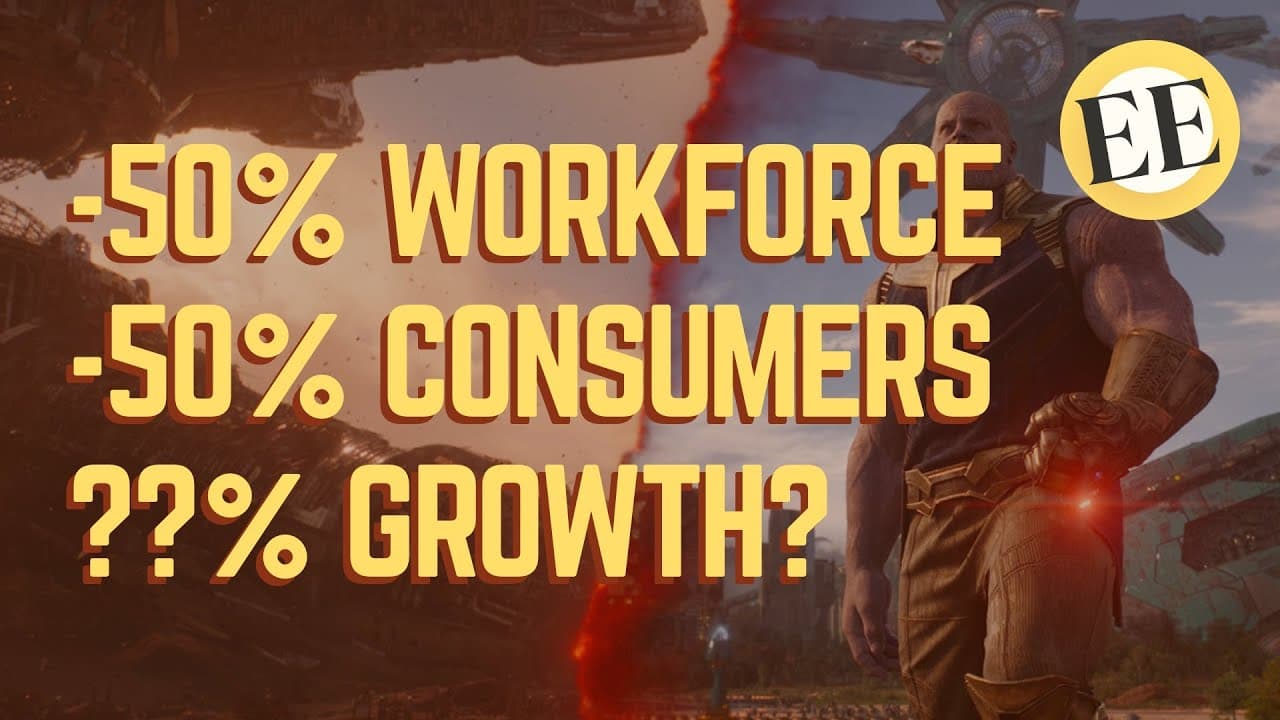
What Would a Thanos Snap do to the Economy?
TL;DR
Analyzes economic effects of Thanos snapping half the population away.
Transcript
So for the three or four people left in the world that haven’t seen avengers, the two most recent films in the series centered around a magical gauntlet that could instantly wipe out exactly half the population of the universe. The villain’s justification was that this was necessary to restore balance to a universe that was overpopulated and p... Read More
Key Insights
- Thanos' snap would initially create chaos but eventually lead to a wealthier existence for survivors due to increased resource availability per person.
- The redistribution of wealth post-snap would likely benefit the already wealthy, further increasing economic inequality.
- Labor scarcity would increase wages for remaining workers, as they would have access to more resources and equipment.
- Despite fewer people, production wouldn't drop by 50% due to increased efficiency and resource availability for remaining workers.
- GDP would drastically fall due to reduced population, but GDP per capita adjusted for purchasing power might increase.
- Long-term innovation would suffer due to fewer people contributing ideas, potentially stalling technological progress.
- Population would eventually rebound, negating the snap's intended long-term effects on resource scarcity.
- Thanos' approach overlooks potential solutions like increasing resources rather than reducing population.
Install to Summarize YouTube Videos and Get Transcripts
Explore YouTube Video Summarizer or Get YouTube Transcript Extractor
Questions & Answers
Q: What would be the immediate economic impact of Thanos' snap?
The immediate economic impact would be chaotic, with survivors dealing with the loss of friends and family. However, they would eventually find themselves with an abundance of resources, such as real estate and goods, leading to increased wealth per person. Labor scarcity would drive up wages as workers become more valuable due to their increased access to resources and equipment.
Q: How would wealth distribution change post-snap?
Wealth distribution would likely become more unequal, as wealth would concentrate among the already wealthy. Inheritance laws and estate taxes would play a role, but overall, the rich would benefit disproportionately from the redistribution of wealth, as they would inherit more assets from deceased family members, further increasing economic inequality.
Q: Would production levels drop by 50% after the snap?
No, production levels wouldn't drop by 50%. While the population would be halved, the remaining workers would have access to more resources and equipment, allowing them to work more efficiently. Production would decrease, but not as drastically, as workers could optimize their efforts, potentially maintaining a significant portion of pre-snap production levels.
Q: What long-term effects would the snap have on innovation?
The long-term effects on innovation would be negative, as the reduced population would mean fewer people contributing ideas and breakthroughs. This could stall technological progress and set humanity back decades. Innovations that drive economic growth and improve quality of life would be less frequent, hindering long-term prosperity.
Q: How would GDP be affected by the snap?
GDP would suffer drastically due to the reduced population, as fewer people would be participating in economic activities. However, GDP per capita, when adjusted for purchasing power parity, might actually increase because the remaining population would have more resources and capital per person, leading to a higher standard of living despite the lower overall GDP.
Q: Would the population eventually rebound after the snap?
Yes, the population would likely rebound over time. As economies become wealthier and barriers to raising children decrease, there would be incentives for families to have more children. Governments and businesses might also encourage population growth to address labor shortages, eventually bringing the population back to pre-snap levels.
Q: What alternative solutions could Thanos have considered?
Instead of halving the population, Thanos could have used his power to increase resources, achieving the same economic outcome without the loss of life. This approach would address resource scarcity without the negative consequences of reduced innovation and population rebound, ultimately providing a more sustainable solution to the central problem of economics.
Q: What is the central economic problem Thanos was trying to solve?
Thanos was attempting to solve the problem of unlimited human desires versus limited resources. By halving the population, he aimed to increase the resources available per person, theoretically leading to a more balanced and prosperous existence. However, this approach overlooks potential solutions like increasing resources and fails to consider long-term consequences.
Summary & Key Takeaways
-
The video explores the hypothetical economic impact of Thanos snapping away half the universe's population. It discusses the immediate chaos followed by potential short-term economic benefits for survivors due to increased resources per person.
-
While survivors might initially enjoy increased wealth and higher wages, the long-term effects could be detrimental due to reduced innovation and technological progress. Wealth inequality would likely increase as wealth concentrates among the already rich.
-
Ultimately, the video suggests that Thanos' solution is flawed due to population rebound and missed opportunities to increase resources rather than decrease population. The analysis highlights the importance of innovation and human capital in economic prosperity.
Read in Other Languages (beta)
Share This Summary 📚
Summarize YouTube Videos and Get Video Transcripts with 1-Click
Try YouTube Summary with ChatGPT & Claude or YouTube Transcript Generator
Explore More Summaries from Economics Explained 📚



Summarize YouTube Videos and Get Video Transcripts with 1-Click
Try YouTube Summary with ChatGPT & Claude or YouTube Transcript Generator