Interpreting points in context of graphs of systems
TL;DR
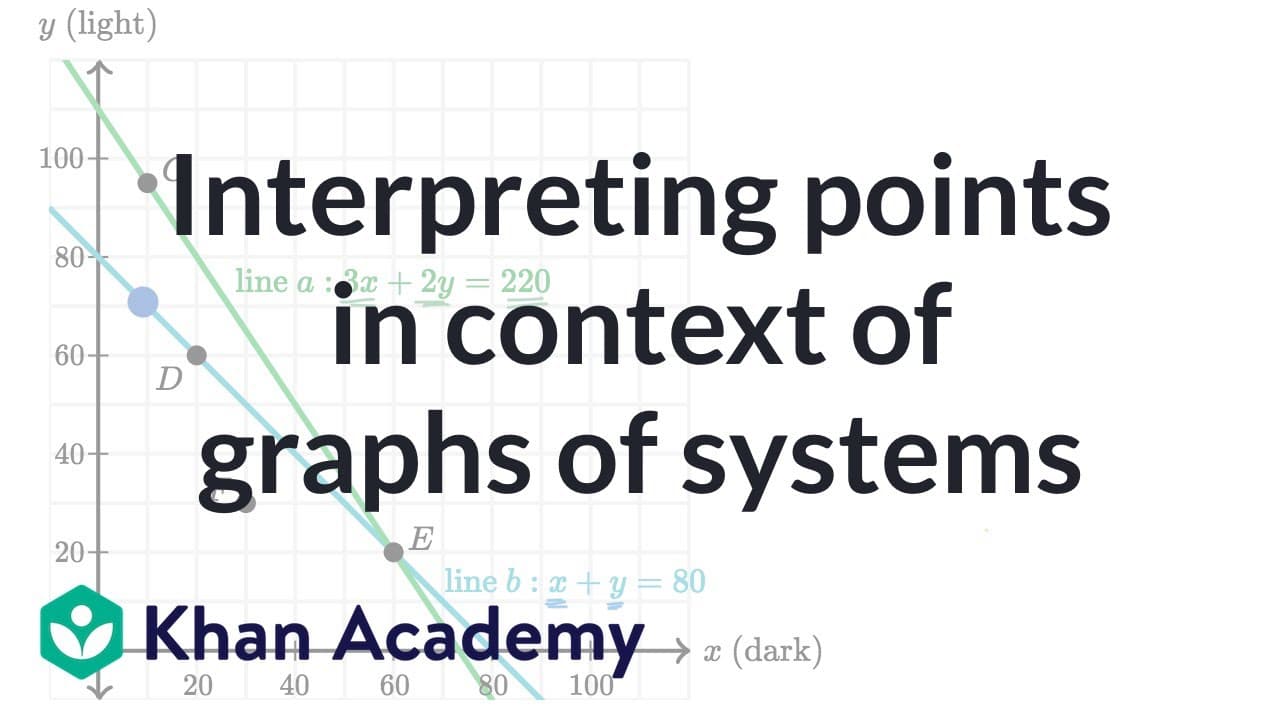
A cafe owner wants to buy a total of 80 kilograms of coffee beans, spending $220. The provided graph represents a system of equations to determine the combination of dark and light roast beans.
Transcript
- [Instructor] We're told that Lauren uses a blend of dark roast beans and light roast beans to make coffee at her cafe. She needs 80 kilograms of beans in total for her next order. Dark roast beans cost $3 per kilogram, light roast beans cost $2 per kilogram, and she wants to spend $220 in total. And they tell us here's a graph that shows a system... Read More
Key Insights
- 🙂 The graph and system of equations help determine the optimal combination of dark and light roast beans for the cafe owner's purchase.
- 🫥 Points on the graph above the blue line indicate that the cafe owner is exceeding the total weight constraint.
- 🫥 Points below the green line suggest that the cafe owner is underspending, while points below both lines indicate a failure to meet both constraints.
Install to Summarize YouTube Videos and Get Transcripts
Explore YouTube Video Summarizer or Get YouTube Transcript Extractor
Questions & Answers
Q: What does the blue line on the graph represent in terms of the cafe owner's purchase constraints?
The blue line represents the constraint that the sum of the kilograms of dark and light roast beans should equal 80, which is the total amount of beans the cafe owner needs.
Q: How is the constraint on spending expressed?
The cafe owner wants to spend $220, and this constraint is represented by the equation 3x + 2y = 220, where x is the kilograms of dark roast beans and y is the kilograms of light roast beans.
Q: What does point C on the graph indicate about the cafe owner's purchase?
Point C represents a situation where the cafe owner is spending exactly $220 but is using more than 80 kilograms of beans. This means the cafe owner is not meeting the constraint on the total weight of the beans.
Q: What does point D on the graph indicate about the cafe owner's purchase?
Point D represents a scenario where the cafe owner is using exactly 80 kilograms of beans but is underspending, as the cost is less than $220. This means the cafe owner is not meeting the spending constraint.
Summary & Key Takeaways
-
The cafe owner needs 80 kilograms of coffee beans and wants to spend $220 in total.
-
Dark roast beans cost $3 per kilogram, while light roast beans cost $2 per kilogram.
-
The graph shows the intersection of two lines representing the constraints on spending and the total weight of the beans.
Read in Other Languages (beta)
Share This Summary 📚
Summarize YouTube Videos and Get Video Transcripts with 1-Click
Try YouTube Summary with ChatGPT & Claude or YouTube Transcript Generator
Explore More Summaries from Khan Academy 📚



Summarize YouTube Videos and Get Video Transcripts with 1-Click
Try YouTube Summary with ChatGPT & Claude or YouTube Transcript Generator