Evaporative cooling | Water, acids, and bases | Biology | Khan Academy
TL;DR
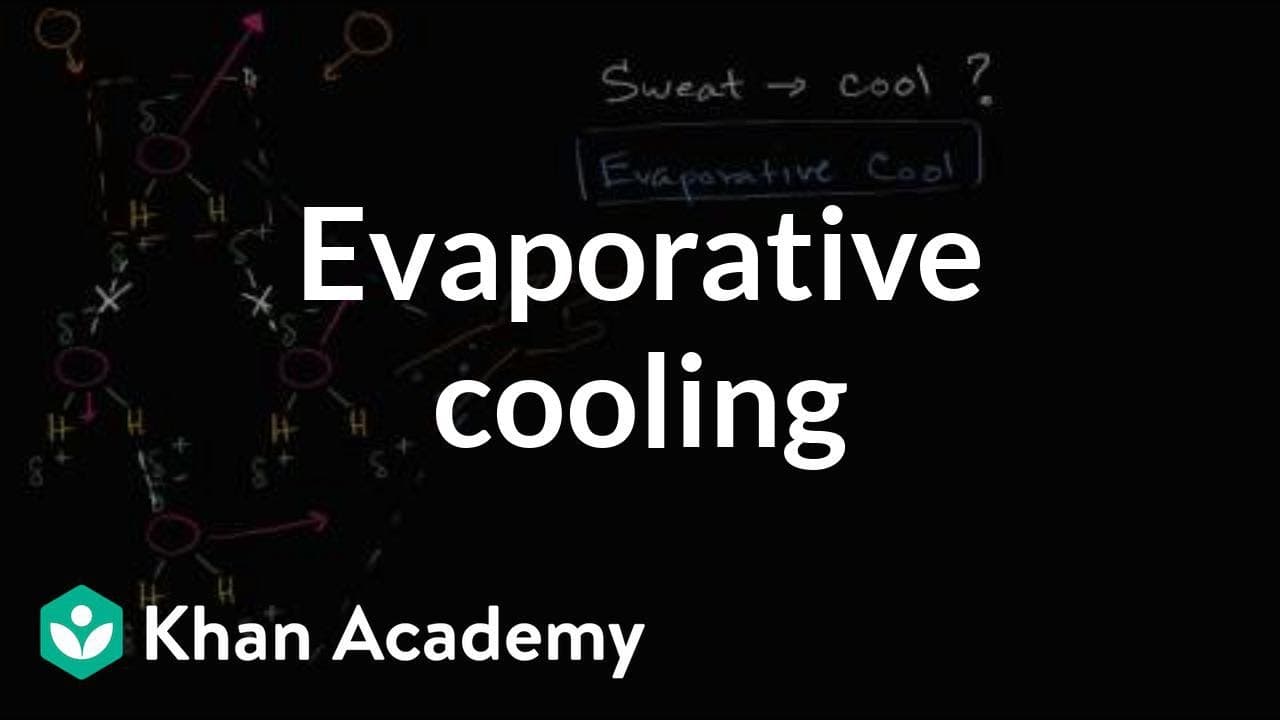
Evaporative cooling is the process by which sweat evaporates from the body, causing a decrease in temperature.
Transcript
- [Voiceover] So if you are like most of us, your body probably sweats when it is warm, when your environment is warm, and you probably realize that it sweats in order to cool itself, in order to keep the body from overheating. But you probably have wondered, "Well, how does this work? "What is actually causing that?" And the simple answer is it's ... Read More
Key Insights
- 😅 Evaporative cooling is the body's natural mechanism to prevent overheating by sweating.
- 💦 The temperature of sweat is determined by the kinetic energy of its water molecules.
- 🥶 Evaporation occurs when high kinetic energy particles break free from hydrogen bonds and become water vapor.
- 🥵 The cooling effect of evaporative cooling is due to the transfer of heat energy from the body to the escaping water molecules.
- 💦 Evaporative cooling causes a decrease in the average kinetic energy and temperature of the remaining water molecules on the skin.
- 😎 The cooling effect of evaporative cooling is essential for regulating body temperature in warm environments.
- 💦 Evaporative cooling is a result of the physical process of water molecules transitioning from a liquid to a gaseous state.
Install to Summarize YouTube Videos and Get Transcripts
Explore YouTube Video Summarizer or Get YouTube Transcript Extractor
Questions & Answers
Q: How does the body cool down through evaporative cooling?
Evaporative cooling occurs when sweat on the surface of the skin evaporates, causing a decrease in temperature. The high kinetic energy particles in sweat escape as water vapor, lowering the average kinetic energy and temperature of the remaining molecules on the skin.
Q: What causes water molecules in sweat to turn into water vapor?
Water molecules in sweat turn into water vapor when they have enough kinetic energy to break free from hydrogen bonds with neighboring molecules and overcome the pressure in the atmosphere. Once they become water vapor, they no longer form hydrogen bonds with other water molecules.
Q: How does evaporative cooling affect the temperature of the body?
Evaporative cooling lowers the temperature of the body by transferring the highest kinetic energy particles in sweat, which carry heat energy, into the vapor phase. As a result, the average kinetic energy and temperature of the remaining molecules in the body decrease.
Q: How does evaporative cooling work on a molecular level?
Evaporative cooling works by allowing the highest kinetic energy water molecules in sweat to escape as water vapor. This process decreases the average kinetic energy of the remaining molecules on the skin, resulting in a decrease in temperature. Body molecules can then transfer their kinetic energy to the remaining water molecules, causing them to increase their temperature.
Summary & Key Takeaways
-
Evaporative cooling is the mechanism by which the body regulates its temperature by sweating and allowing the sweat to evaporate.
-
Sweat consists mainly of water molecules, and their kinetic energy determines the temperature of the sweat.
-
As water molecules with higher kinetic energy break free from hydrogen bonds and become water vapor, the average kinetic energy and temperature of the remaining molecules decrease, leading to a cooling effect on the body.
Read in Other Languages (beta)
Share This Summary 📚
Summarize YouTube Videos and Get Video Transcripts with 1-Click
Try YouTube Summary with ChatGPT & Claude or YouTube Transcript Generator
Explore More Summaries from Khan Academy 📚



Summarize YouTube Videos and Get Video Transcripts with 1-Click
Try YouTube Summary with ChatGPT & Claude or YouTube Transcript Generator