What Is Non-Probability Sampling and Its Types?
TL;DR
Non-probability sampling is a method that lacks equal selection chances for participants, relying on subjective judgments. While it offers advantages like simplicity and accessibility to specific groups, it is limited in generalizability and statistical reliability.
Transcript
hello everybody and welcome to lesson 10 non-proverty sampling in previous lesson 9 we already discussed Proverbs sampling in non-probability sampling as the name implies the selection of a sample elements is not necessarily made with the aim of being statically represented for the Target population because in the non-probat sampling there is no eq... Read More
Key Insights
- 🏪 Non-probability sampling is not based on statistical representation, relying on subjective judgments and convenience.
- ❓ It is simpler and easier to implement than probability sampling methods.
- 👨🔬 Non-probability sampling is useful when access to the target population is limited or when conducting exploratory research.
- 🚱 However, non-probability sampling has limitations such as limited generalizability, sampling bias, and difficulty in statistical inference.
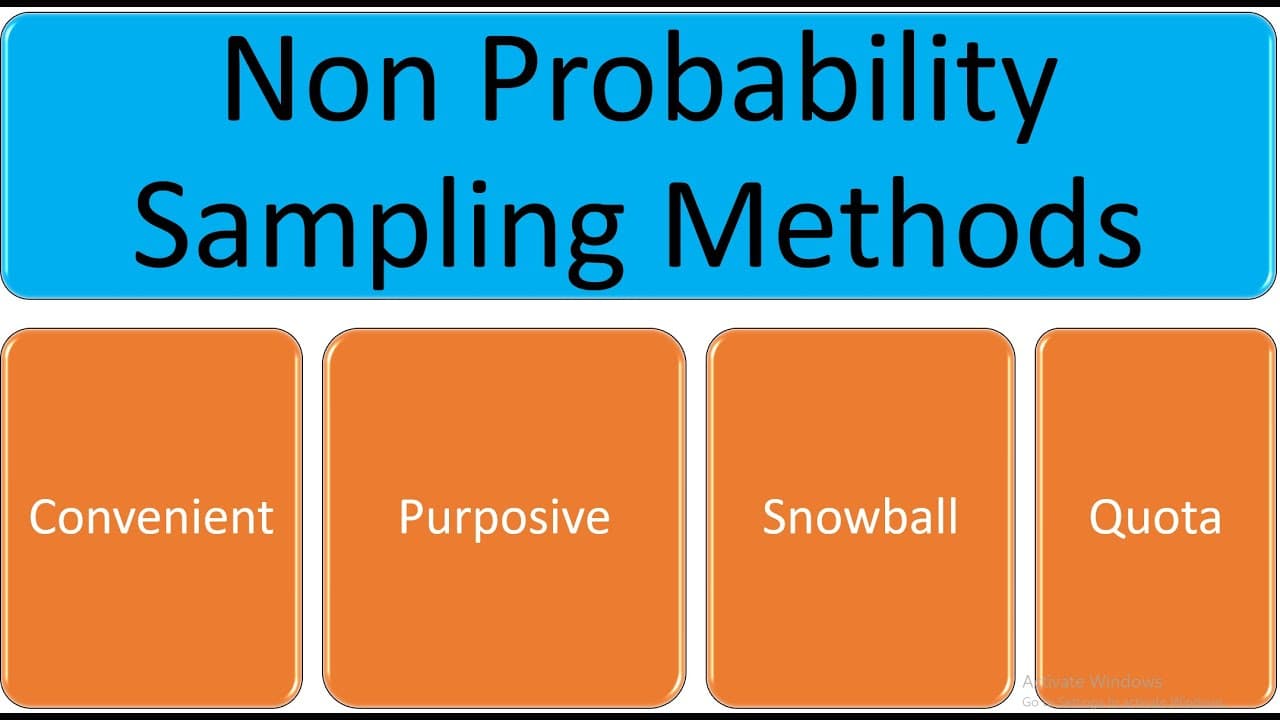
- 🏪 There are different types of non-probability sampling, including convenience sampling, purposive sampling, snowball sampling, and quota sampling.
- 🏪 Convenience sampling involves selecting participants based on convenience or availability, while purposive sampling involves selecting participants based on specific criteria relevant to the research objective.
- 😌 Snowball sampling relies on referrals to recruit additional participants through a network.
- 😫 Quota sampling involves setting predetermined quotas or proportions for different subgroups within a population.
Install to Summarize YouTube Videos and Get Transcripts
Explore YouTube Video Summarizer or Get YouTube Transcript Extractor
Questions & Answers
Q: What is non-probability sampling?
Non-probability sampling is a research sampling technique where elements are selected based on subjective judgments or convenience, lacking equal chances of selection.
Q: Can non-probability sampling be statistically representative?
No, non-probability sampling does not have statistical representation as there is no equal chance of selection for each element, making it difficult to generalize findings to the target population.
Q: What are the advantages of non-probability sampling?
Non-probability sampling offers simplicity, ease of implementation, and accessibility to specific groups or individuals, making it useful in exploratory research or when probability sampling is not feasible.
Q: What are the disadvantages of non-probability sampling?
The disadvantages of non-probability sampling include limited generalizability, sampling bias due to subjective judgment, and difficulty in statistical inference. The results may lack generalizability and representativeness.
Summary & Key Takeaways
-
Non-probability sampling involves selecting a sample without equal chances of selection, relying on subjective judgments and convenience.
-
The advantages of non-probability sampling include simplicity, ease of implementation, and access to specific groups or individuals.
-
However, non-probability sampling has limitations such as limited generalizability, sampling bias, and difficulty in statistical inference.
Read in Other Languages (beta)
Share This Summary 📚
Summarize YouTube Videos and Get Video Transcripts with 1-Click
Try YouTube Summary with ChatGPT & Claude or YouTube Transcript Generator
Explore More Summaries from Solomon Getachew 📚



Summarize YouTube Videos and Get Video Transcripts with 1-Click
Try YouTube Summary with ChatGPT & Claude or YouTube Transcript Generator