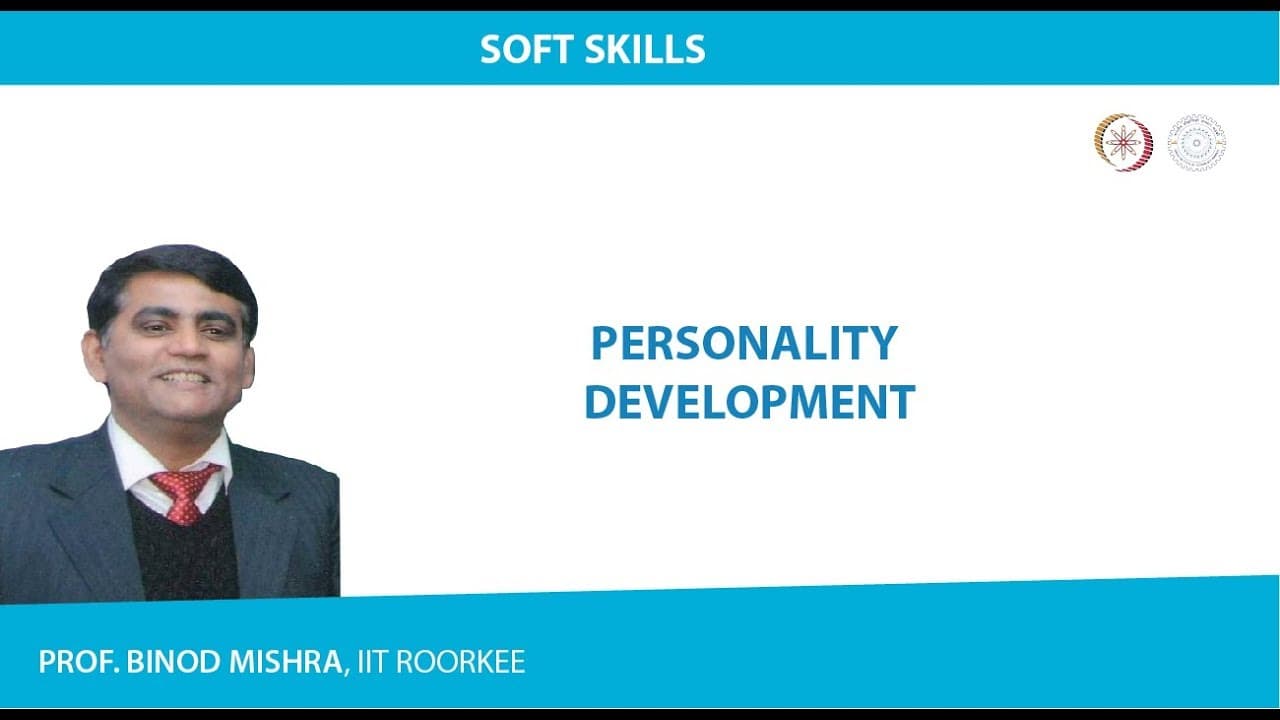
Personality Development
TL;DR
Personality is more than appearance; it's about inner qualities.
Transcript
hello good morning in a series of lectures in softer skills today we are going to talk about personality development and we will see how important each personality in our everyday dealings both at job as well as in our lives sometimes or the other you might have come across the word personality you might have heard it from different people using th... Read More
Key Insights
- Personality is often misunderstood as merely physical appearance or communication skills, but it encompasses deeper emotional and psychological traits.
- The term 'personality' originates from the Latin word 'persona,' meaning mask, highlighting the contrast between outward appearance and inner qualities.
- Personality comprises emotional qualities, attitudes, values, beliefs, communication skills, and behavior, making it an internal characteristic.
- Sigmund Freud's theory of personality includes three systems: id, ego, and superego, each playing a distinct role in decision-making and behavior.
- The id operates on the pleasure principle, seeking immediate gratification without distinguishing right from wrong.
- The ego functions as the executive, mediating between the id's desires and reality, adhering to the reality principle.
- The superego acts as the moral guardian, striving for perfection and imposing moralistic goals over realistic ones.
- Alfred Adler's theory contrasts Freud's by emphasizing social interest over sexual motivation, advocating that humans can change and improve through social interactions.
Install to Summarize YouTube Videos and Get Transcripts
Explore YouTube Video Summarizer or Get YouTube Transcript Extractor
Questions & Answers
Q: What are the common misconceptions about personality?
Many people mistakenly believe that personality is solely about physical appearance, such as good looks or dressing well. However, true personality involves deeper traits like emotional qualities, attitudes, values, beliefs, and behavior. Understanding these internal characteristics is essential for making accurate judgments about an individual's personality.
Q: How does Freud's theory explain personality development?
Freud's theory outlines three systems of personality: id, ego, and superego. The id operates on the pleasure principle, seeking immediate gratification. The ego mediates between the id's desires and reality, adhering to the reality principle. The superego acts as a moral guardian, striving for perfection and imposing moralistic goals over realistic ones, thus shaping an individual's behavior and personality.
Q: What role does the id play in Freud's theory of personality?
In Freud's theory, the id is the reservoir of instinctual desires and operates on the pleasure principle. It seeks immediate gratification without considering right or wrong. The id is present from birth and is driven by basic impulses and desires, which it attempts to satisfy through reflex actions and wish fulfillment, often leading to tension if not managed by the ego.
Q: How does the superego influence behavior according to Freud?
The superego in Freud's theory acts as the moral compass of personality. It represents internalized ideals and standards for judgment. The superego strives for perfection and imposes moralistic goals, often opposing both the id's pleasure-seeking impulses and the ego's realistic considerations. It guides individuals to act in socially acceptable ways, striving for moral and ethical behavior.
Q: What is the significance of Adler's theory in personality development?
Alfred Adler's theory emphasizes the role of social interest and the potential for personal transformation in personality development. Unlike Freud, Adler believed that humans are primarily motivated by social interactions rather than sexual desires. He argued that individuals can change and improve themselves through social engagement and striving for superiority, making his theory relevant in contemporary contexts.
Q: How does Adler's view of personality differ from Freud's?
Adler's view of personality focuses on social interest and the potential for change, contrasting with Freud's emphasis on innate sexual drives. Adler believed that personality is shaped by social interactions and future expectations rather than past experiences. He introduced concepts like fictional finalism, suggesting that individuals are motivated by their goals and aspirations, not just their past.
Q: What is fictional finalism according to Adler?
Fictional finalism, a concept introduced by Adler, refers to the idea that individuals are motivated by future goals and aspirations rather than past experiences. It suggests that people create personal myths or ideals, such as 'honesty is the best policy,' to guide their behavior. These fictions help individuals navigate reality and strive for personal improvement and superiority.
Q: How can understanding personality benefit professional interactions?
Understanding personality can greatly enhance professional interactions by fostering flexibility, persuasion, and diplomacy. Recognizing different personality traits and mindsets allows individuals to adapt their communication and behavior, improving collaboration and conflict resolution. This understanding helps in navigating diverse workplace environments and contributes to personal and professional success by aligning actions with others' expectations and motivations.
Summary & Key Takeaways
-
Personality is often misconceived as physical attributes, but it truly encompasses emotional qualities, attitudes, and beliefs. Understanding these deeper elements is crucial for personal and professional interactions.
-
Freud's theory of personality involves three systems: id, ego, and superego. Each system plays a role in behavior, with the id seeking pleasure, the ego mediating reality, and the superego imposing moral standards.
-
Alfred Adler proposed that personality development focuses on social interest and improvement rather than past experiences. He emphasized the role of social interactions and the potential for personal transformation.
Read in Other Languages (beta)
Share This Summary 📚
Summarize YouTube Videos and Get Video Transcripts with 1-Click
Try YouTube Summary with ChatGPT & Claude or YouTube Transcript Generator
Explore More Summaries from Soft Skills 📚



Summarize YouTube Videos and Get Video Transcripts with 1-Click
Try YouTube Summary with ChatGPT & Claude or YouTube Transcript Generator