How Does Avogadro's Number Relate to the Mole?
TL;DR
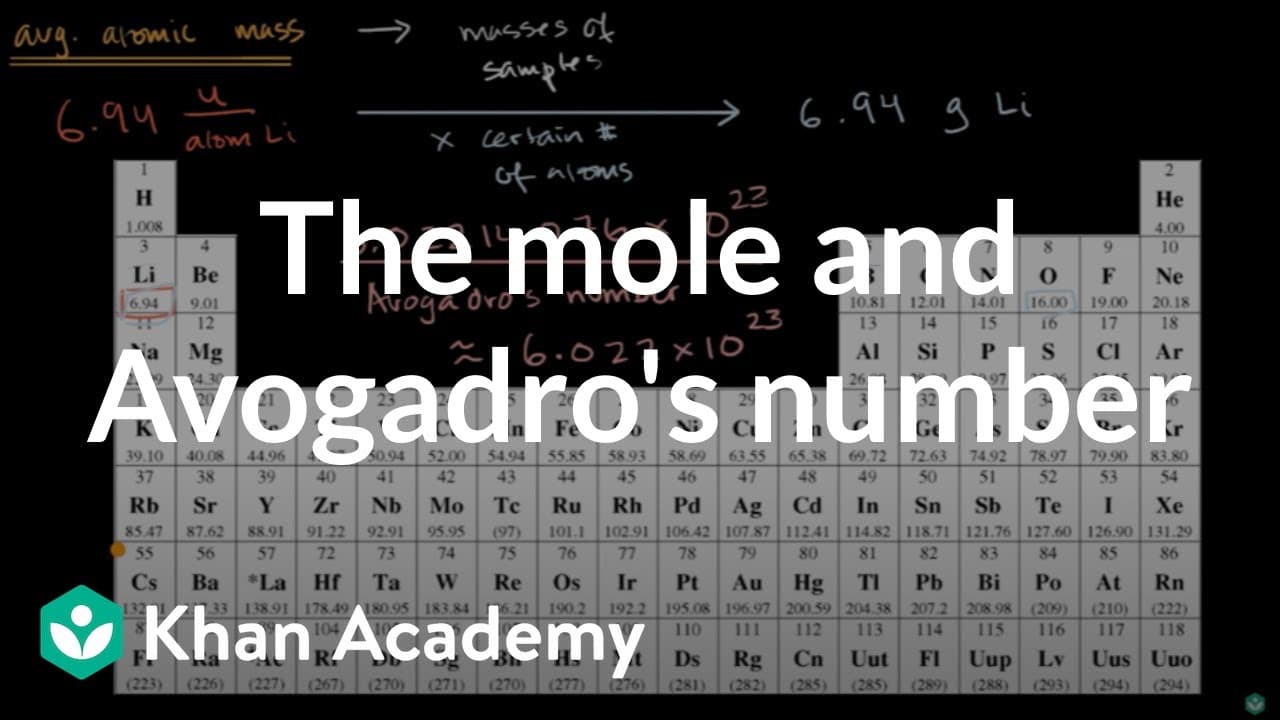
Avogadro's Number, approximately 6.022 x 10²³, connects atomic mass to grams in the lab. A mole represents this specific quantity of atoms, making it easier to transition from atomic scale calculations to practical lab measurements.
Transcript
- [Narrator] In a previous video, we introduced ourselves to the idea of average atomic mass, which we began to realize could be a very useful way of thinking about a mass at an atomic level or at a molecular level. But what we're gonna do in this video is connect it to the masses that we might actually see in a chemistry lab. You're very unlikely ... Read More
Key Insights
- 💆 Average atomic mass can be converted to the mass of a substance in grams using Avogadro's Number.
- ✊ Avogadro's Number, approximately 6.022 times 10 to the 23rd power, is a useful tool in chemistry for mass conversions.
- ✊ The concept of a mole represents a specific amount of substance and is equivalent to 6.022 times 10 to the 23rd power of particles.
- #️⃣ Avogadro's Number and the concept of a mole allow for easy calculations involving mass and the number of atoms or molecules.
- ⚖️ Avogadro's Number is a fundamental constant in chemistry, enabling the connection between atomic scale masses and laboratory scale masses.
- 🫢 Avogadro's Number was named in honor of the Italian chemist Amedeo Avogadro, who made significant contributions to understanding the behavior of gases.
- 🍉 The term "mole" is derived from its relation to the word "molecule" and signifies a specific quantity of a substance.
Install to Summarize YouTube Videos and Get Transcripts
Explore YouTube Video Summarizer or Get YouTube Transcript Extractor
Questions & Answers
Q: How is Avogadro's Number related to the mass of a substance in chemistry?
Avogadro's Number represents the number of atoms needed to have the same mass as the average atomic mass of an element in grams. A sample with this number of atoms will have a mass equal to the element's average atomic mass in grams.
Q: What is the significance of Avogadro's Number?
Avogadro's Number is a fundamental constant in chemistry, allowing for the conversion of masses from atomic scale to laboratory scale. It represents a specific amount of substance and enables calculations involving moles and mass.
Q: What is the definition of a mole in chemistry?
In chemistry, a mole is a unit used to measure the amount of substance. It represents 6.022 times 10 to the 23rd power of that element's atoms, similar to how a dozen represents 12 items.
Q: Who was Avogadro and why is his name associated with a number?
Amedeo Avogadro was an Italian chemist in the early 19th century. Avogadro's Number is named in his honor because he proposed that equal volumes of gases, under the same conditions, contain the same number of particles, known as Avogadro's Law.
Summary & Key Takeaways
-
The video explains how to connect the average atomic mass of an element to the mass of a substance in a chemistry lab.
-
Avogadro's Number, approximately 6.022 times 10 to the 23rd power, represents the number of atoms needed to have the same mass as the average atomic mass of the element in grams.
-
The concept of a mole is introduced, where a mole of an element represents 6.022 times 10 to the 23rd power of that element's atoms.
Read in Other Languages (beta)
Share This Summary 📚
Summarize YouTube Videos and Get Video Transcripts with 1-Click
Try YouTube Summary with ChatGPT & Claude or YouTube Transcript Generator
Explore More Summaries from Khan Academy 📚



Summarize YouTube Videos and Get Video Transcripts with 1-Click
Try YouTube Summary with ChatGPT & Claude or YouTube Transcript Generator