Number System | Units digit | Example - 1 | Aptitude | Part- 11 | Bharath Kumar
TL;DR
This content explains how to find the units place digit in number systems.
Transcript
hi everyone welcome to the session in this session i am going to explaining about the topic number systems in the last session we started the concept of units digit we started the concept of units place digit how to calculate units plus digit of any number now in that also i explained the second one uh two categories one is uh product based and the... Read More
Key Insights
- 💨 The units place digit provides an efficient way to simplify calculations involving powers without needing to compute the entire number.
- 👥 The categorization of digits into three groups helps learners quickly identify their units place properties and apply them in problems.
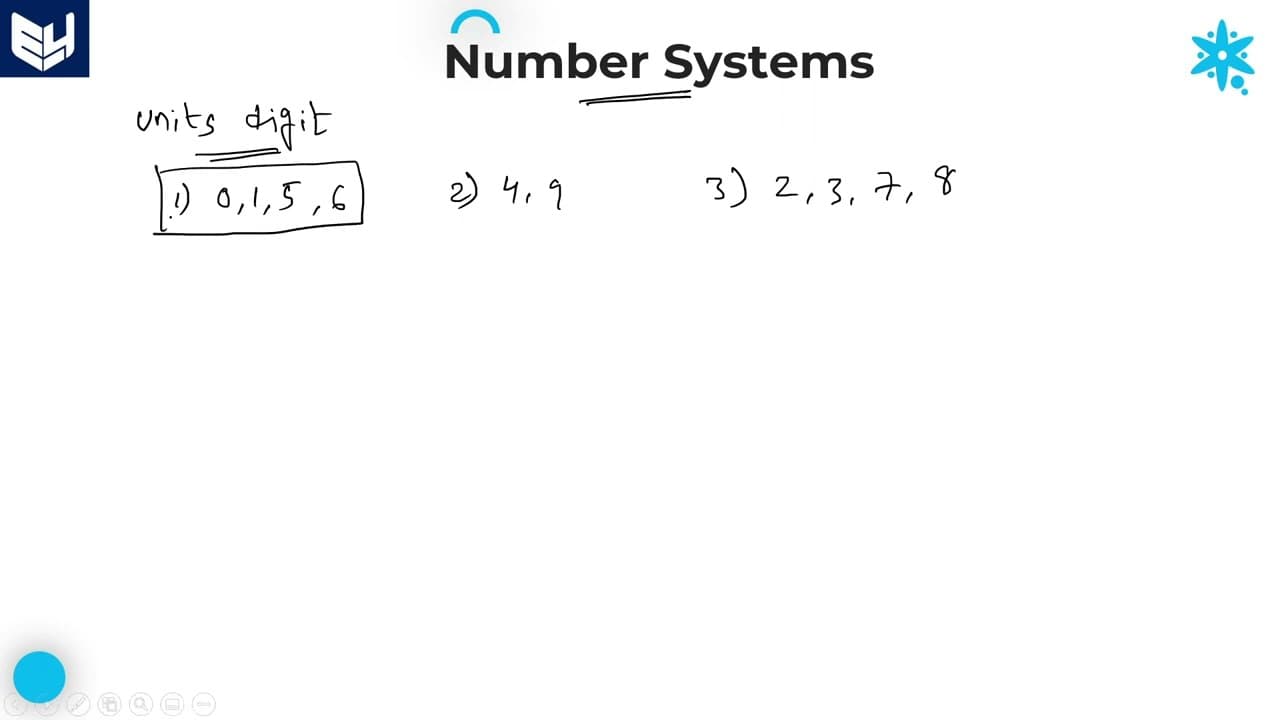
- 💁 Digits 0, 1, 5, and 6 consistently reflect their units place independently of their exponentiated form, making calculations straightforward.
- 🐎 Addition and multiplication of units digits follow simple rules that can significantly speed up problem-solving processes in examinations.
- 📏 The examples demonstrated in the session illustrate practical applications of these rules, highlighting their relevance in solving typical mathematical problems.
- 👻 Familiarity with these categories can enhance numerical agility, allowing for quicker mental calculations and better understanding of number systems.
- 😑 Understanding how to manipulate units place can also provide insights for algebraic expressions, enhancing overall mathematical comprehension.
Install to Summarize YouTube Videos and Get Transcripts
Explore YouTube Video Summarizer or Get YouTube Transcript Extractor
Questions & Answers
Q: What is the importance of knowing the units place digit in arithmetic operations?
Knowing the units place digit is crucial as it simplifies calculations, particularly in powers and large numbers, allowing for quick assessment of the resultant digit without evaluating the whole number.
Q: How are digits categorized in the number system according to the content?
The digits are categorized into three groups based on their units place behavior: the first group contains 0, 1, 5, and 6 which retain their units place irrespective of the power; the second group includes 4 and 9; and the third group includes 2, 3, 7, and 8.
Q: Can you provide an example of calculating the units place digit for a large number?
Certainly! For 230^125, since it ends with 0, the units digit is 0 regardless of the power. Similarly, for 125^621, which ends with 5, the units digit is also 5, demonstrating the reliability of the first category's rule.
Q: How are the units place digits found when performing addition or multiplication?
To find the units place in addition, determine the units digit of each number individually and then add those digits. For multiplication, multiply the units digits of the factors directly, ensuring to only consider the resulting units digit.
Summary & Key Takeaways
-
The session focuses on understanding the concept of units place digits in various calculations involving powers of numbers.
-
It categorizes ten digits into three distinct groups based on their behavior concerning units place calculations: (0, 1, 5, 6), (4, 9), and (2, 3, 7, 8).
-
The content provides examples and methods to calculate units place digits in addition, subtraction, and multiplication, emphasizing simplicity and clarity.
Read in Other Languages (beta)
Share This Summary 📚
Summarize YouTube Videos and Get Video Transcripts with 1-Click
Try YouTube Summary with ChatGPT & Claude or YouTube Transcript Generator
Explore More Summaries from Education 4u 📚

Summarize YouTube Videos and Get Video Transcripts with 1-Click
Try YouTube Summary with ChatGPT & Claude or YouTube Transcript Generator