What Are Regular Expressions and How Do They Work?
TL;DR
Regular expressions are patterns used to describe regular languages accepted by finite automata. They enable the representation of complex patterns through simple expressions and utilize operations like union, intersection, and Kleene closure to construct and manipulate these languages. Key symbols like the Kleene star signify zero or more occurrences, while the plus indicates one or more.
Transcript
hi students welcome back now let's see what is a regular expression so what do you mean by regular expression so in the theory of competitions you can came across these regular expressions what it means the language accepted by finite automata the language whatever the language you're taking that language accepted by a finite automata can easily de... Read More
Key Insights
- 😑 Regular expressions are essential for defining and processing regular languages, directly correlating to finite automata.
- 🤩 The Kleene star and Kleene plus represent critical quantifiers for matching patterns within strings.
- 😑 Union and intersection operations facilitate the combination and filtering of regular languages to create more complex expressions.
- 😑 Regular expressions provide a compact and powerful framework for text processing tasks, enhancing productivity in programming.
- 😑 Recognizing the significance of regular expressions is fundamental for developers working with data validation and search functionalities in applications.
- 💦 Understanding these concepts is crucial for anyone intending to work in fields involving automata theory, compiler design, and text processing.
- 😑 The simplicity of regular expressions allows for their application in a variety of programming languages, empowering developers to solve complex string issues efficiently.
Install to Summarize YouTube Videos and Get Transcripts
Explore YouTube Video Summarizer or Get YouTube Transcript Extractor
Questions & Answers
Q: What are regular expressions and why are they important?
Regular expressions are sequences of characters defining search patterns, primarily used in programming to match text within strings. They are crucial when working with search operations, data validation, and string manipulations in programming languages, making text processing more efficient and precise.
Q: How is the Kleene star operation defined in regular expressions?
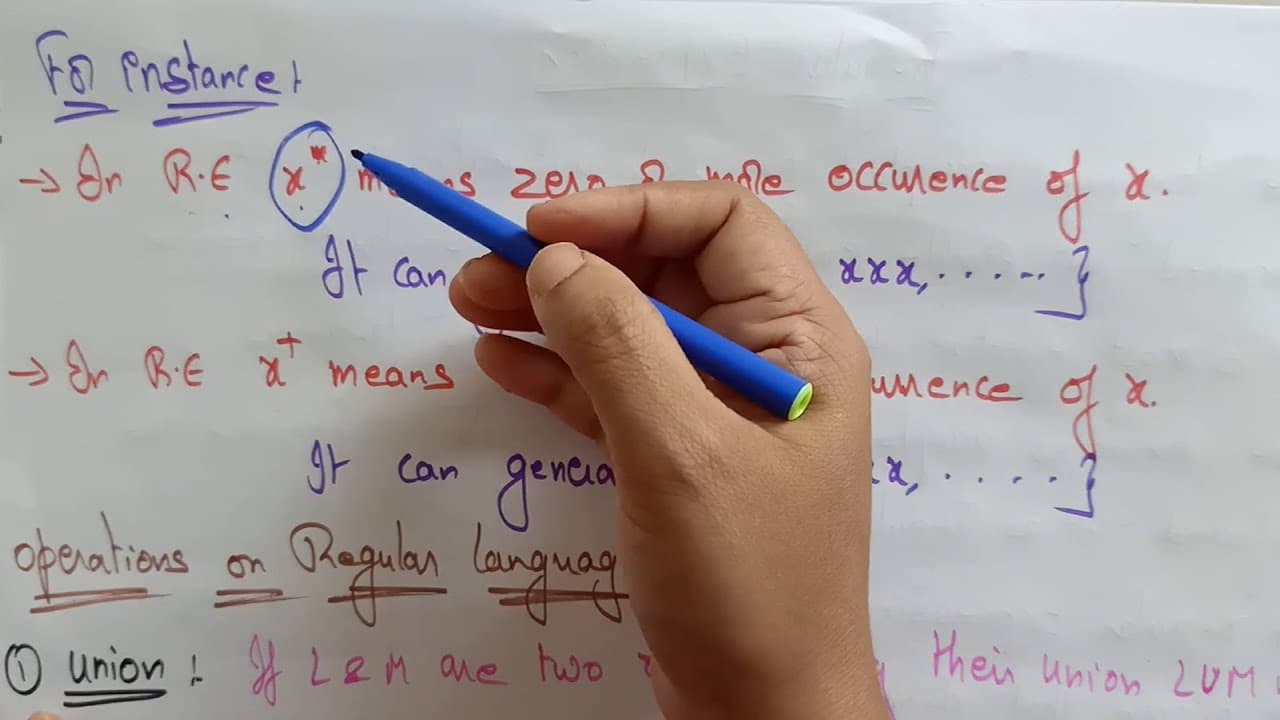
The Kleene star operation, represented as "X*", signifies that the character or pattern "X" can occur zero or more times in a string. This means a string generated could be empty, have one occurrence of "X", or multiple occurrences, enabling flexible matching criteria for patterns in text processing.
Q: Can you explain the difference between Kleene star and plus in regular expressions?
The Kleene star ("X*") allows for zero or more occurrences of "X", meaning the pattern can be absent altogether. In contrast, the plus sign ("X+") denotes one or more occurrences of "X", which requires at least one instance of the pattern to match, thus enforcing stricter matching rules.
Q: What is the union operation in regular languages?
The union operation combines two regular languages, L and M, represented as L ∪ M, allowing for strings that are either in language L or language M. This operation expands the capabilities of pattern matching, enabling recognition of strings fitting either of the two specified conditions.
Q: How does the intersection operation work in regular expressions?
The intersection operation identifies common strings in two regular languages, L and M, represented as L ∩ M. This operation narrows down the results to strings that belong to both languages, functioning similarly to mathematical intersections but within the framework of string patterns.
Q: What is meant by clean closure in regular expressions?
Clean closure, denoted as "L*", denotes a regular language set that encompasses all possible strings formed from language L through zero or more repetitions of its strings. It allows for the generation of complex patterns while maintaining simplicity and flexibility in language representation.
Summary & Key Takeaways
-
Regular expressions are a way to represent languages accepted by finite automata, utilizing simple expressions to describe complex patterns.
-
The operations of union, intersection, and Kleene closure are fundamental in constructing and understanding regular languages and their corresponding regular expressions.
-
Key concepts like "star" and "plus" denote quantifiers, with "star" allowing zero or more occurrences, while "plus" requires at least one occurrence of a pattern.
Read in Other Languages (beta)
Share This Summary 📚
Summarize YouTube Videos and Get Video Transcripts with 1-Click
Try YouTube Summary with ChatGPT & Claude or YouTube Transcript Generator