Uniform Electric Field (5 of 9) Work Done by an Electric Field
TL;DR
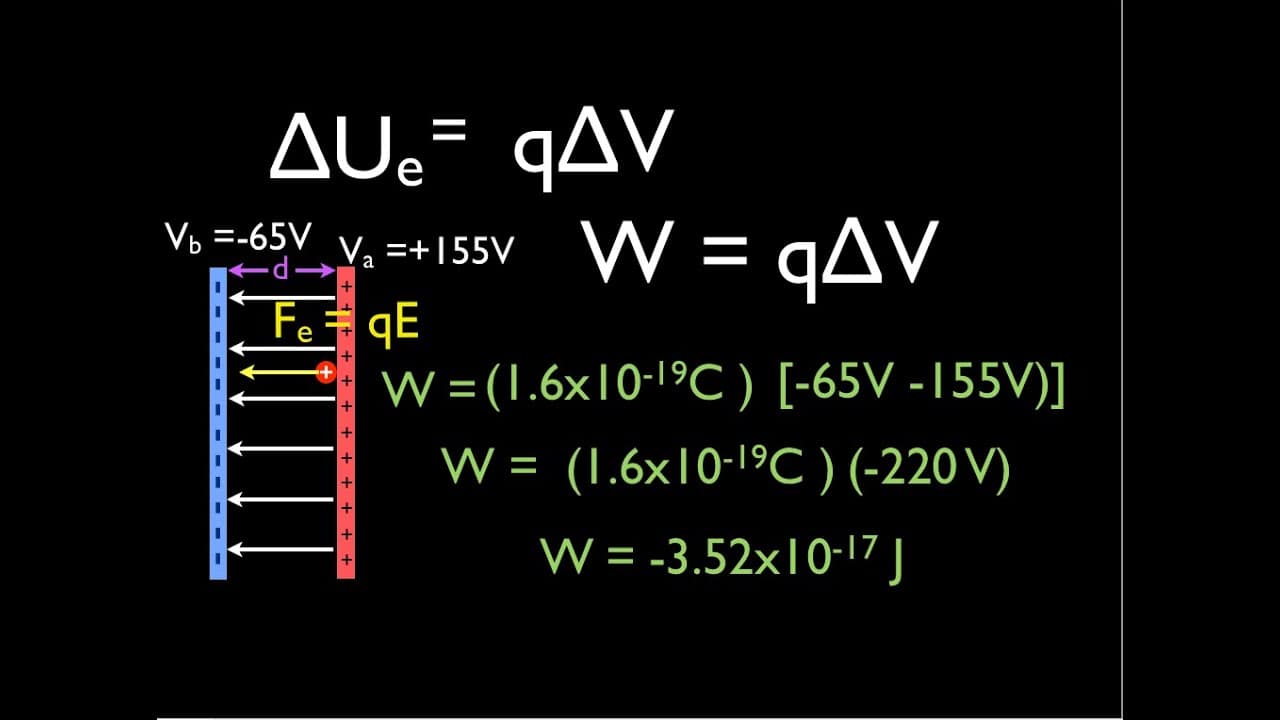
Calculating work done by an electric field on a proton moving through potential difference.
Transcript
okay in today's video we are going to do a problem involving potential difference and we are going to calculate the amount of work done by an electric field on a proton when it moves that charge that proton through a difference in potential or through a potential difference this is the problem how much work does the field do when it moves a proton ... Read More
Key Insights
- 💦 Work in an electric field is calculated by multiplying charge and potential difference.
- 💦 Potential energy, work, and kinetic energy are interrelated in the context of moving charges.
- 💦 Understanding the concept of electric potential energy aids in calculating work.
- 🈂️ Conservation of energy applies to the movement of charges through potential differences.
- 💦 Negative potential difference implies work against the natural movement of charges.
- 🔌 Electric charges experience repulsion towards like charges in an electric field.
- 🈂️ The relationship between potential energy and kinetic energy governs charge movement.
Install to Summarize YouTube Videos and Get Transcripts
Explore YouTube Video Summarizer or Get YouTube Transcript Extractor
Questions & Answers
Q: How is work calculated in an electric field when moving a positive charge through potential difference?
Work is calculated by multiplying the amount of charge and the potential difference through which the charge is moved, as per the equation derived from electric potential energy.
Q: What relationship exists between potential energy, work, and kinetic energy in an electric field?
The potential energy at the start equals the work done on the charge, which equals the kinetic energy gained by the charge as it moves through the field.
Q: What does the negative potential difference signify in the context of moving a positive charge?
A negative potential difference signifies that work is being done against the natural movement of the charge due to the repulsion between like charges.
Q: How does the concept of conservation of energy apply to the movement of charges through a potential difference?
The total energy (potential, kinetic, and work) remains constant as a charge moves through a potential difference due to the conservation of energy principle.
Summary & Key Takeaways
-
Explaining how work is calculated in an electric field when moving a proton through a potential difference.
-
Relating potential energy, work, and kinetic energy in the context of electric charges.
-
Demonstrating the calculation of work using charge and potential difference values.
Read in Other Languages (beta)
Share This Summary 📚
Summarize YouTube Videos and Get Video Transcripts with 1-Click
Try YouTube Summary with ChatGPT & Claude or YouTube Transcript Generator
Explore More Summaries from Step by Step Science 📚
Summarize YouTube Videos and Get Video Transcripts with 1-Click
Try YouTube Summary with ChatGPT & Claude or YouTube Transcript Generator