What Are Decision and Classification Trees?
TL;DR
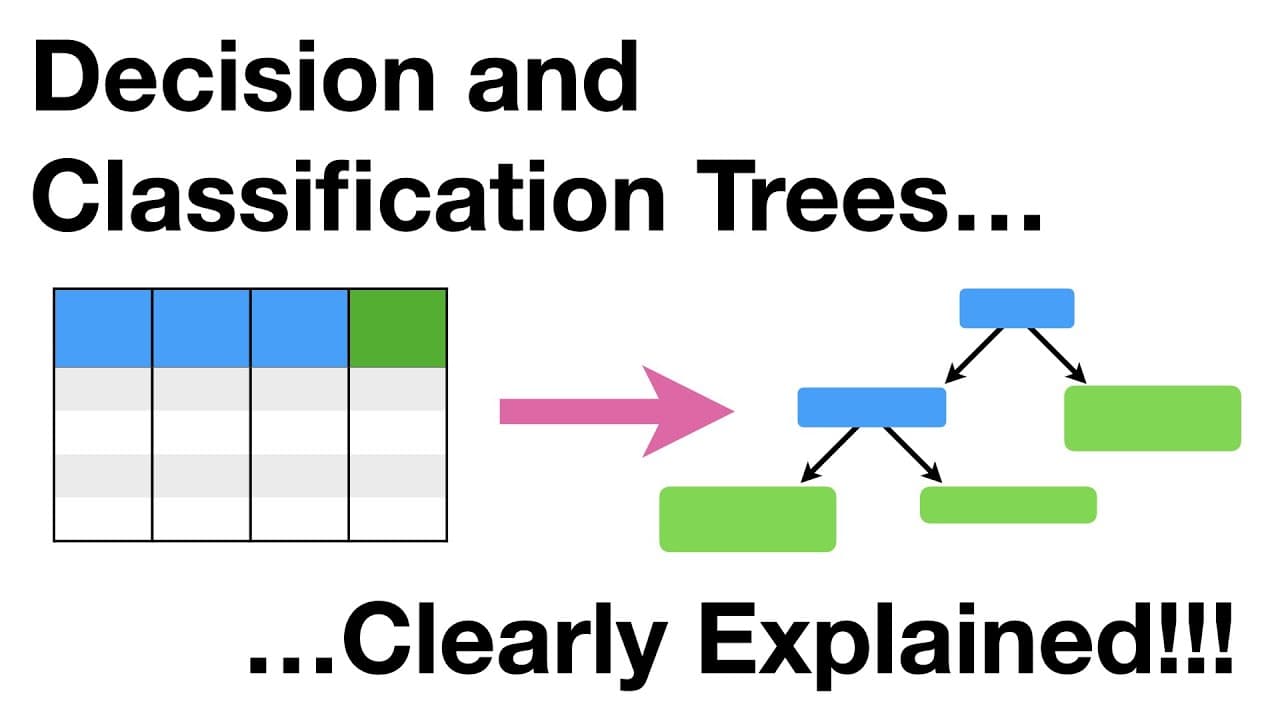
Decision trees are models that make decisions based on true or false statements, while classification trees specifically categorize data points. To build a classification tree, start with raw data, select a question for the root, calculate impurity values for potential splits, and choose the split that minimizes impurity. This process helps classify outcomes effectively.
Transcript
i like decision trees how about you stat quest hello i'm josh darmer and welcome to statquest today we're going to talk about decision and classification trees and they're going to be clearly explained here is a simple decision tree if a person wants to learn about decision trees then they should watch this stat quest in contrast if a person does n... Read More
Key Insights
- 🌲 Decision trees make statements and decisions based on true or false statements.
- 🌲 Classification trees classify things into categories, while regression trees predict numeric values.
- 📲 The top of a decision tree is called the root, branches have arrows pointing to and away from them, and leaves have arrows pointing to them.
- 🌲 Genie impurity is a popular method to quantify the impurity of leaves in a decision tree.
- 😘 Building a decision tree involves choosing a question, calculating impurity values, making splits based on the lowest impurity, and assigning output values to leaves.
- 🌲 Overfitting is a concern in decision trees, and pruning or setting limits on tree growth can help address this issue.
- 😵 Cross-validation is used to determine the best parameters for building decision trees.
Install to Summarize YouTube Videos and Get Transcripts
Explore YouTube Video Summarizer or Get YouTube Transcript Extractor
Questions & Answers
Q: What is the difference between a decision tree and a classification tree?
A decision tree can either classify things into categories or predict numeric values, whereas a classification tree specifically focuses on classifying things into categories.
Q: Can decision trees handle different types of data?
Yes, decision trees can handle different types of data, such as mixing numeric data with yes/no data, and using different numeric thresholds for the same data.
Q: How do you interpret the arrows in a decision tree?
In most cases, it is assumed that if a statement is true, you go to the left, and if a statement is false, you go to the right. So, true and false labels may or may not be present.
Q: What are the impure leaves in a decision tree?
Impure leaves are those that contain a mixture of people or instances that belong to different categories. In contrast, pure leaves contain instances belonging to only one category.
Key Insights:
- Decision trees make statements and decisions based on true or false statements.
- Classification trees classify things into categories, while regression trees predict numeric values.
- The top of a decision tree is called the root, branches have arrows pointing to and away from them, and leaves have arrows pointing to them.
- Genie impurity is a popular method to quantify the impurity of leaves in a decision tree.
- Building a decision tree involves choosing a question, calculating impurity values, making splits based on the lowest impurity, and assigning output values to leaves.
- Overfitting is a concern in decision trees, and pruning or setting limits on tree growth can help address this issue.
- Cross-validation is used to determine the best parameters for building decision trees.
- Supporting StatQuest by subscribing, contributing to Patreon, or purchasing merchandise helps to continue the production of these educational videos.
Summary & Key Takeaways
-
Decision trees make statements and make decisions based on true or false statements, either classifying things into categories or predicting numeric values.
-
Classification trees are easy to work with, starting at the top and working down until you can't go any further.
-
To build a tree, you start with raw data, choose a question to ask at the top, calculate impurity values for each leaf, and make splits based on the lowest impurity.
Read in Other Languages (beta)
Share This Summary 📚
Summarize YouTube Videos and Get Video Transcripts with 1-Click
Try YouTube Summary with ChatGPT & Claude or YouTube Transcript Generator
Explore More Summaries from StatQuest with Josh Starmer 📚
Summarize YouTube Videos and Get Video Transcripts with 1-Click
Try YouTube Summary with ChatGPT & Claude or YouTube Transcript Generator