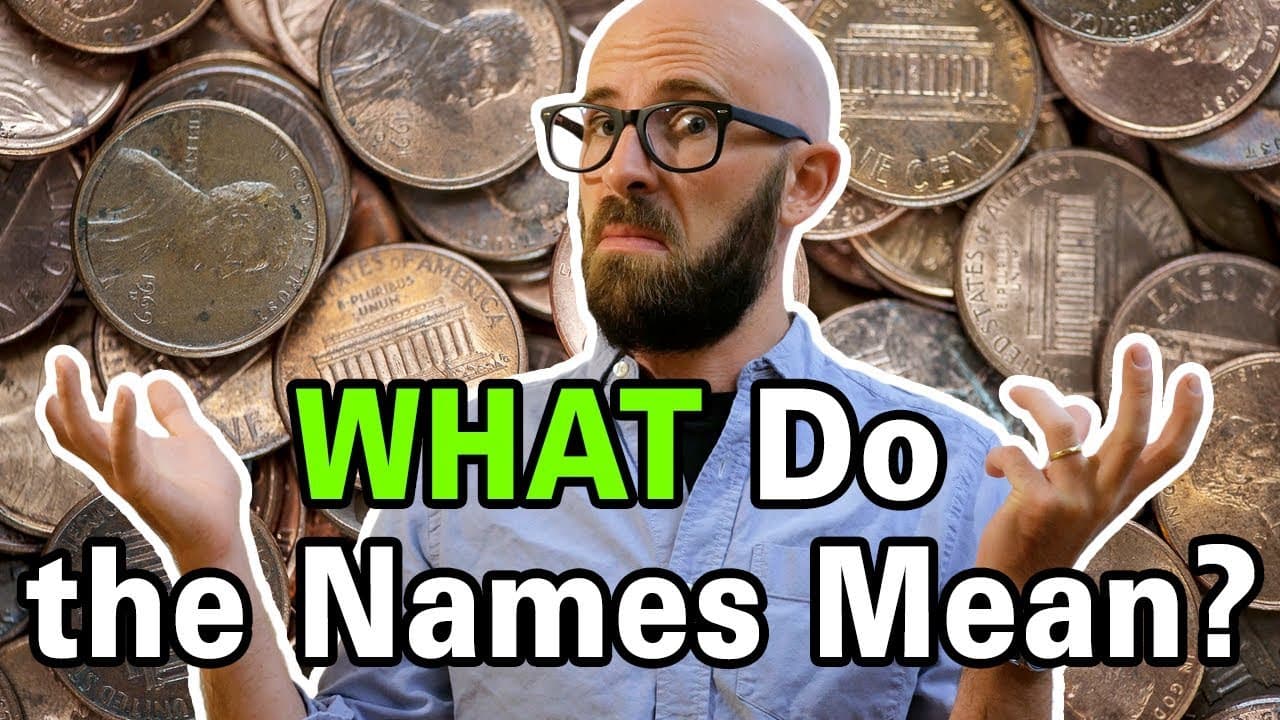
How Did Pennies, Nickels, Dimes, Quarters, and Dollars Get Their Names?
TL;DR
U.S. currency names and their origins are traced back to historical influences, such as the Coinage Act of 1792 and the Spanish dollar.
Transcript
Leigh H. asks: Why do we call pennies, nickels, and dimes those names? Prior to the United States minting their own coins, it relied on foreign currency. However, that all changed with the passing of the Coinage Act of 1792, which provided the framework for regulating money produced in the United States, as well as established the United States Min... Read More
Key Insights
- 🏸 The Coinage Act of 1792 and subsequent legislation established the foundation for minting U.S. currency.
- 🏤 The names of U.S. coins were often borrowed from British and European currency.
- 🥺 The Spanish dollar influenced the choice of denominations, leading to the naming of the dime and quarter.
- 😒 The term "buck" originated from the use of deerskins as a medium of exchange.
- ⌛ U.S. currency designs evolved over time, reflecting historical events and commemorating significant figures.
- 🤘 The ridged circumferences of the dime and quarter were introduced to prevent illicit manipulation of precious metal coins.
- 😫 George Washington's refusal to have his portrait on U.S. currency set the precedent for not featuring living presidents.
Install to Summarize YouTube Videos and Get Transcripts
Explore YouTube Video Summarizer or Get YouTube Transcript Extractor
Questions & Answers
Q: When and how did the United States Mint begin producing coins?
The United States Mint started producing coins four years before the construction of a Mint building, with the first circulated dime minted in 1796.
Q: What influenced the choice of a 1/4 denomination for the U.S. quarter?
The decision to use a 1/4 denomination for the U.S. quarter was influenced by the Spanish dollar, which was widely circulated and valued at 8 reales, matching the material and weight of the U.S. dollar.
Q: Why did the term "buck" become synonymous with the U.S. dollar?
The term "buck" originally referred to deerskins, which were used as a medium of exchange before the introduction of the U.S. dollar. As the U.S. dollar gained popularity, "buck" became a slang term for the dollar.
Q: What did the original U.S. penny depict, and when was it changed?
The original U.S. penny featured the symbol of liberty as a woman with flowing hair. In 1909, the design was replaced with the bust of Abraham Lincoln to commemorate his 100th birthday.
Summary & Key Takeaways
-
The Coinage Act of 1792 established the framework for regulating U.S. money and the creation of the United States Mint.
-
The copper cent and half cent were among the first U.S. coins, borrowing the name "penny" from the British currency.
-
The term "nickel" replaced "half dime" after the introduction of a new five-cent coin made of copper and nickel alloy.
-
The dime derived its name from the French term "disme," meaning one-tenth, signifying its value as one-tenth of a dollar.
-
The quarter's naming reflects its worth as a quarter of a dollar, partly influenced by the Spanish dollar widely circulated in the U.S.
Read in Other Languages (beta)
Share This Summary 📚
Summarize YouTube Videos and Get Video Transcripts with 1-Click
Try YouTube Summary with ChatGPT & Claude or YouTube Transcript Generator
Explore More Summaries from Today I Found Out 📚






Summarize YouTube Videos and Get Video Transcripts with 1-Click
Try YouTube Summary with ChatGPT & Claude or YouTube Transcript Generator