Comparing fractions with the same denominator | Math | 3rd grade | Khan Academy
TL;DR
This content explains how to compare fractions visually and numerically, using examples of dividing pizzas and equal pieces.
Transcript
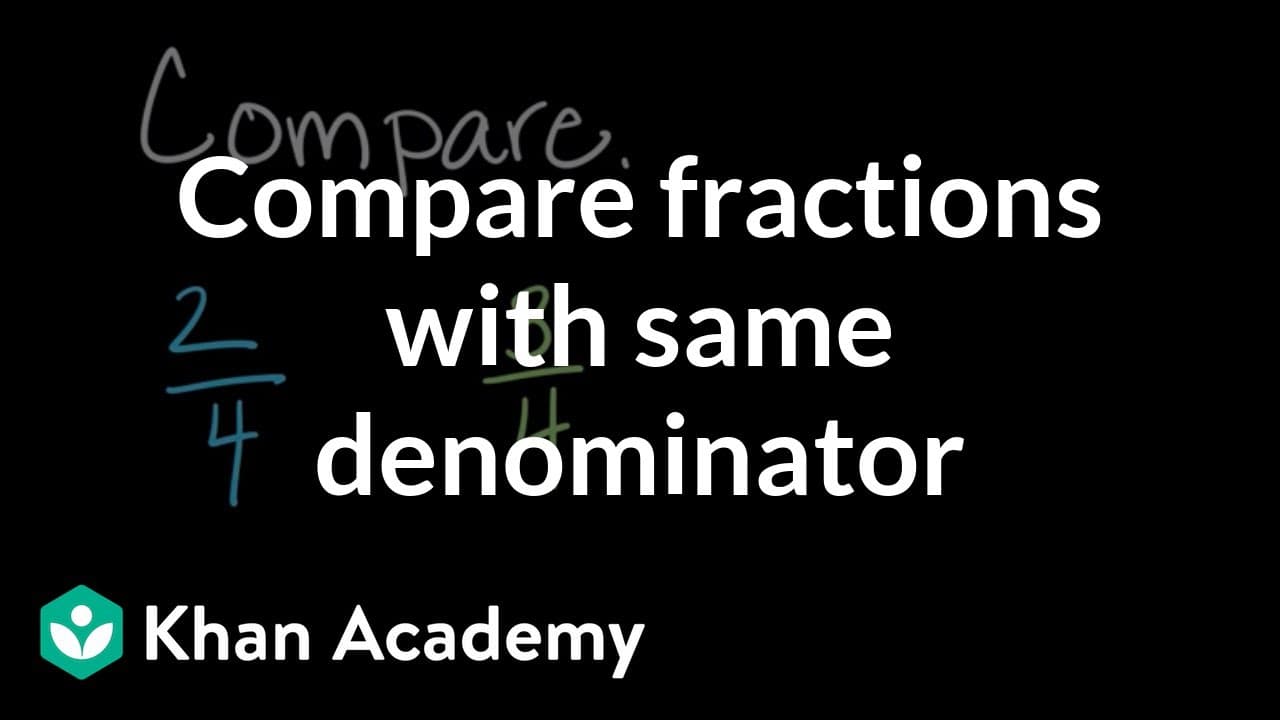
- [Voiceover] Let's compare 2/4 and 3/4. First let's think about what these fractions mean. 2/4 means we have some whole, and we've split it into four equal size pieces, and we get two of those pieces. Maybe we can think about pizza for an example. We split a pizza into four equal size pieces, and we ate two of them. 3/4 means that same whole, that... Read More
Key Insights
- 🥳 Fractions can be compared visually by dividing a whole into equal parts and observing the number of parts each fraction represents.
- 🤬 The less than symbol (<) indicates a smaller fraction, while the greater than symbol (>) indicates a larger fraction.
- ❓ Numerical comparisons involve comparing the numerators of fractions with the same denominator.
- 🥳 Understanding the concept of fractions representing equal parts is crucial in accurately comparing fractions.
- 🍕 Real-life examples like pizza slices can help in visualizing and comprehending fraction comparison.
- 🈸 Numerical understanding of fractions is important for various mathematical applications.
- ❓ Fractions can be compared using both visual and numerical methods, depending on the situation.
Install to Summarize YouTube Videos and Get Transcripts
Explore YouTube Video Summarizer or Get YouTube Transcript Extractor
Questions & Answers
Q: How can we compare fractions visually?
Visual comparisons involve dividing a whole into equal pieces and comparing the number of those pieces each fraction represents. This can be done using shapes like pizzas or drawing lines to represent the pieces.
Q: What does the less than symbol (<) indicate in fraction comparison?
The less than symbol shows that the fraction on the left side is smaller or takes up less space than the fraction on the right side. In terms of numerators and denominators, it means the numerator of the left fraction is smaller than the numerator of the right fraction.
Q: How can we compare fractions numerically?
Numerical comparisons involve comparing the numerators of fractions with the same denominator. The fraction with the larger numerator is greater, while the fraction with the smaller numerator is lesser. The denominator remains the same in these comparisons.
Q: Can fraction comparison be done without drawing pictures?
Yes, fraction comparison can be done without visual representations. By understanding that fractions with larger numerators represent more pieces of the same size, one can determine which fraction is greater. It is important to have a clear understanding of how fractions represent equal parts.
Summary & Key Takeaways
-
Fractions are described using everyday examples like pizza slices.
-
Visual representations help determine the size of fractions.
-
Numerical comparisons are made by checking the number of equal pieces.
Read in Other Languages (beta)
Share This Summary 📚
Summarize YouTube Videos and Get Video Transcripts with 1-Click
Try YouTube Summary with ChatGPT & Claude or YouTube Transcript Generator
Explore More Summaries from Khan Academy 📚



Summarize YouTube Videos and Get Video Transcripts with 1-Click
Try YouTube Summary with ChatGPT & Claude or YouTube Transcript Generator