What Are Common Greek Alphabet Symbols in Science?
TL;DR
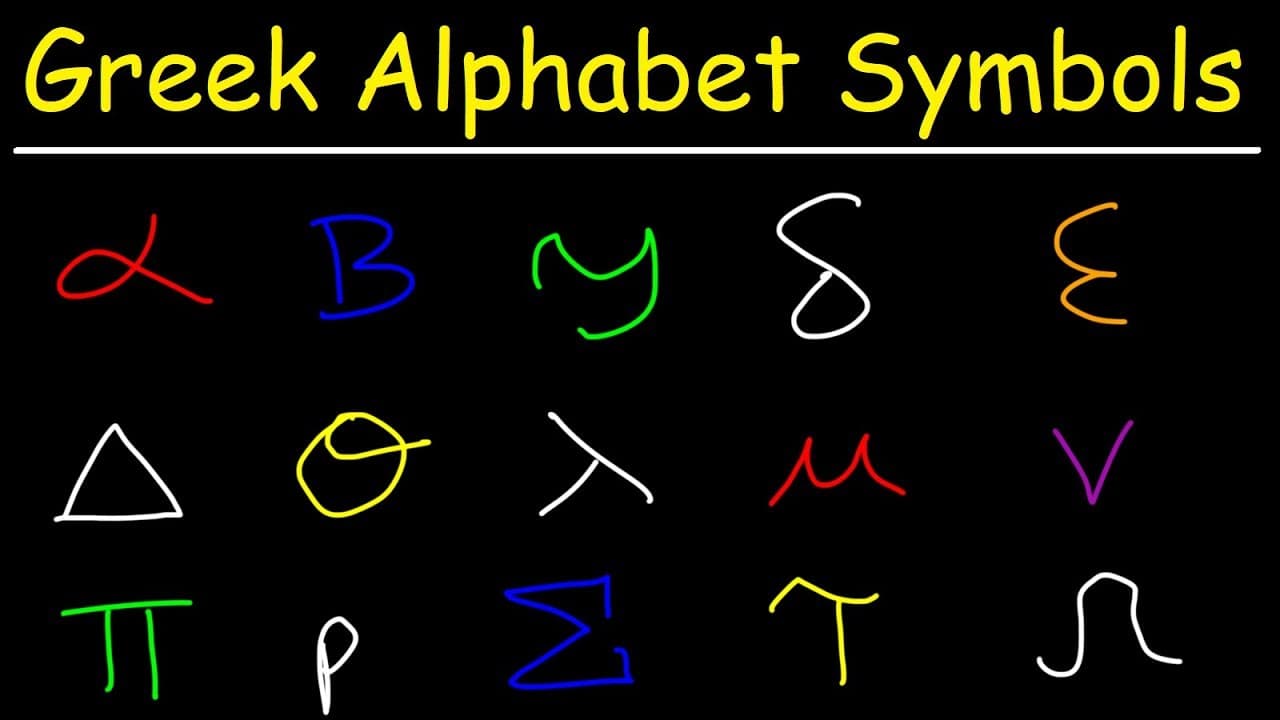
Common Greek alphabet symbols in math, chemistry, and physics include alpha for angular acceleration, beta for angles, gamma, and delta for change. Other symbols like epsilon, lambda, mu, and pi represent various scientific constants or values, with sigma denoting summation and omega relating to angular frequency. Understanding these symbols is essential for navigating these subjects effectively.
Transcript
in this video we're going to talk about certain greek alphabet symbols that you might see in a typical math course or in chemistry or physics so the first one is the symbol alpha in physics this symbol typically represents angular acceleration sometimes you'll see alpha used as an angle particularly in trig the next symbol is a beta which can also ... Read More
Key Insights
- 🤬 Greek alphabet symbols are commonly used in math, chemistry, and physics courses.
- 📐 Alpha represents angular acceleration and can also be an angle in trigonometry.
- 💱 Delta symbolizes change, while epsilon represents the dielectric constant.
- 🤬 Pi is a well-known symbol for the mathematical constant, and sigma represents both angles and summation.
Install to Summarize YouTube Videos and Get Transcripts
Explore YouTube Video Summarizer or Get YouTube Transcript Extractor
Questions & Answers
Q: What does the symbol alpha represent in physics?
In physics, the symbol alpha typically represents angular acceleration. It can also be used to represent an angle in trigonometry.
Q: What is the significance of the symbol delta?
The symbol delta can be represented in two forms: lowercase and triangle. In calculus, it is used to represent change, such as delta x for change in x or delta y for change in y.
Q: What does the symbol epsilon represent in physics?
In physics, epsilon represents the dielectric constant within a capacitor.
Q: Where is the symbol pi commonly encountered?
The symbol pi is typically encountered in math and geometry. It represents the mathematical constant pi, which is approximately equal to 3.14159.
Q: What does the symbol sigma represent in math?
The lowercase sigma is used to represent an angle, similar to theta. The uppercase sigma represents summation or sum, where a series of values are added together.
Q: How is the symbol omega used in electrical circuits?
The symbol omega corresponds to angular frequency. It is also used as the unit of resistance, measured in ohms, when dealing with electrical circuits.
Summary & Key Takeaways
-
The video provides an overview of Greek alphabet symbols used in math, chemistry, and physics.
-
It explains the meanings and applications of symbols such as alpha, beta, gamma, delta, epsilon, a, theta, kappa, lambda, mu, nu, pi, rho, sigma, tau, phi, and omega.
-
The symbols are used to represent quantities like angular acceleration, angles, change, dielectric constant, impedance, wavelength, units, frequency, resistivity, summation, time constant, and resistance.
Read in Other Languages (beta)
Share This Summary 📚
Summarize YouTube Videos and Get Video Transcripts with 1-Click
Try YouTube Summary with ChatGPT & Claude or YouTube Transcript Generator
Explore More Summaries from The Organic Chemistry Tutor 📚




Summarize YouTube Videos and Get Video Transcripts with 1-Click
Try YouTube Summary with ChatGPT & Claude or YouTube Transcript Generator