Rewrite in terms of their cofunctions
TL;DR
This video explains the concept of cofunctions in trigonometry and how they can be used to find equivalent angles.
Transcript
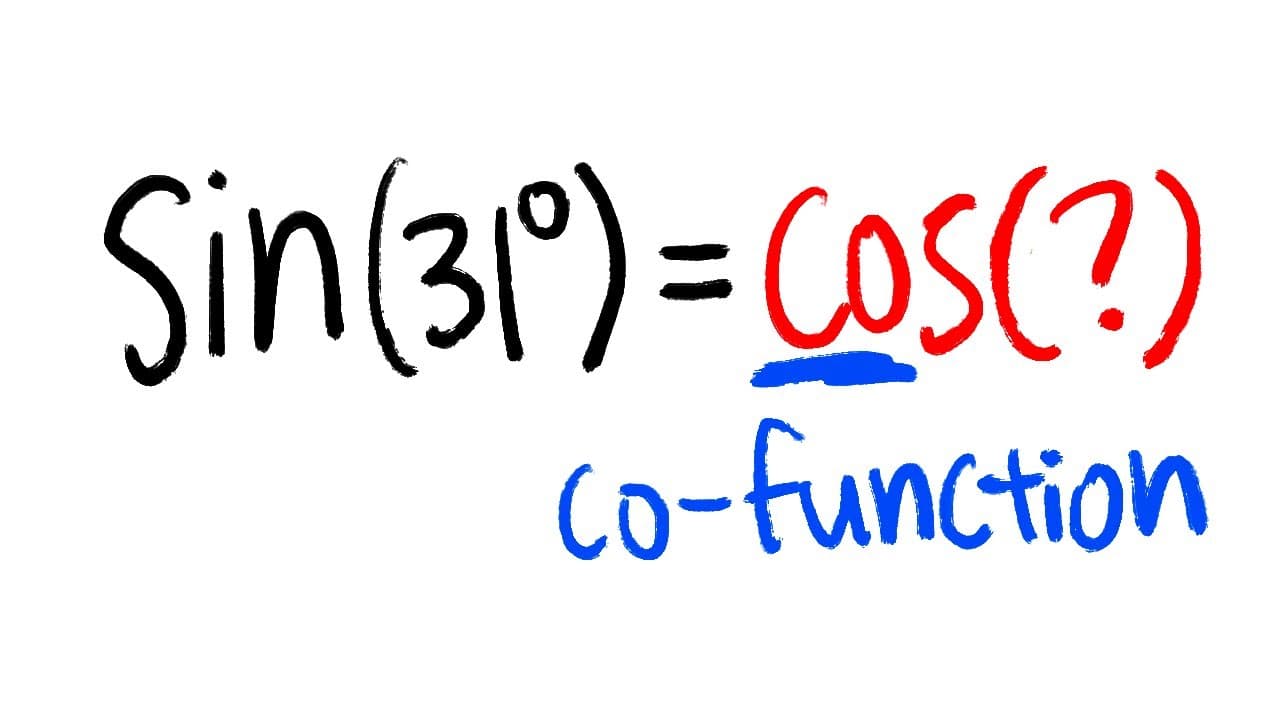
okay welcome to be right the followings in terms of their core functions and that's the key the first one here we have stying of 31 degrees and of course we have sign right here its cofunction it's of course cosine and remember for the cofunction it means that the two inning goes they had to be added to 90 degrees because when we have two angles ad... Read More
Key Insights
- 🔺 Cofunctions in trigonometry involve finding equivalent angles using the complementary angle concept.
- 👨💼 The sine and cosine, tangent and cotangent, and secant and cosecant are cofunction pairs.
- 🍹 The sum of complementary angles is always 90 degrees.
Install to Summarize YouTube Videos and Get Transcripts
Explore YouTube Video Summarizer or Get YouTube Transcript Extractor
Questions & Answers
Q: What is the concept of cofunctions in trigonometry?
Cofunctions in trigonometry refer to the relationship between a trigonometric function and its corresponding function of the complementary angle. They allow us to find equivalent angles.
Q: How are complementary angles related to cofunctions?
Complementary angles add up to 90 degrees. Cofunctions state that the sine and cosine, tangent and cotangent, and secant and cosecant of complementary angles are equal.
Q: How do we find the cofunction of an angle?
To find the cofunction of an angle, subtract the given angle from 90 degrees. This will give you the equivalent angle for the cofunction.
Q: Can you provide an example of using cofunctions to find equivalent angles?
Sure! Let's say we have an angle of 31 degrees. To find the sine of 31 degrees, we subtract it from 90 degrees to get 59 degrees. Therefore, the sine of 31 degrees is equivalent to the cosine of 59 degrees.
Summary & Key Takeaways
-
The video explains that the cofunction of an angle is the trigonometric function of the complementary angle (90 degrees minus the given angle).
-
For example, the sine of 31 degrees is equal to the cosine of 59 degrees because they are complementary angles.
-
Similarly, the cotangent of 54 degrees is equal to the tangent of 36 degrees, and the secant of (75 degrees minus theta) is equal to the cosecant of theta plus 15 degrees.
Read in Other Languages (beta)
Share This Summary 📚
Summarize YouTube Videos and Get Video Transcripts with 1-Click
Try YouTube Summary with ChatGPT & Claude or YouTube Transcript Generator
Explore More Summaries from blackpenredpen 📚


Summarize YouTube Videos and Get Video Transcripts with 1-Click
Try YouTube Summary with ChatGPT & Claude or YouTube Transcript Generator