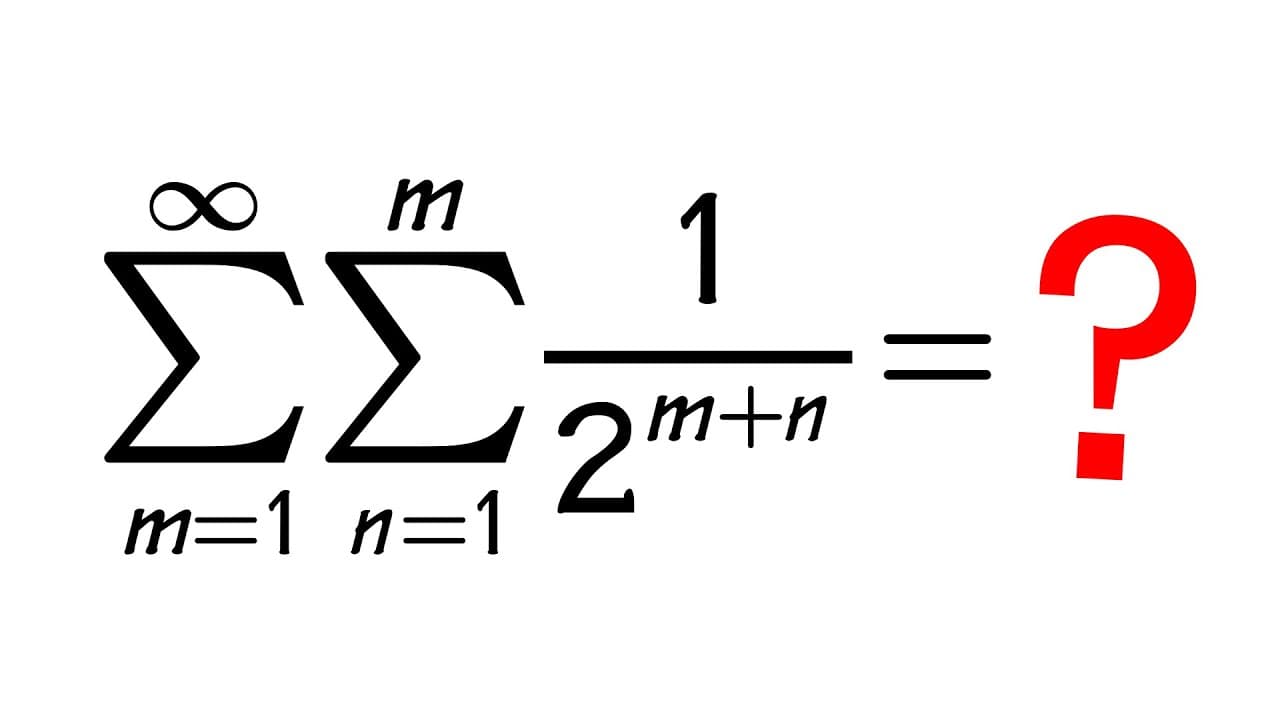
Changing Order of a Double Summation
TL;DR
The video explains how to change the order of a double summation and provides an example calculation, resulting in the answer of 2/3.
Transcript
let me take a start the answer to this right here yes okay let's do some math for fun you have this double summation for you guys and whenever we have a double summation be sure we do this part first and then that one so first we have the sum as n goes from 1 to N and then we have 1 over 2 to the M plus n power do whatever you want right here and t... Read More
Key Insights
- 🪈 Changing the order of a double summation involves rearranging the limits and variables.
- ❓ The formula for an infinite geometric series can be used to simplify calculations within a summation.
- 😑 Working out the limits before dealing with the expression inside the summation ensures accurate results.
- 💝 The concept of derangements can be applied to calculate the number of possible gift distributions in certain scenarios.
Install to Summarize YouTube Videos and Get Transcripts
Explore YouTube Video Summarizer or Get YouTube Transcript Extractor
Questions & Answers
Q: How do you change the order of a double summation?
To change the order of a double summation, you need to carefully rearrange the limits and variables. In this example, the outer summation goes from 1 to M, and the inner summation goes from 1 to infinity. By rearranging the limits, the summation becomes M goes from 1 to infinity and N goes from 1 to M.
Q: What is the formula for an infinite geometric series?
The formula for an infinite geometric series is a/(1 - r), where a is the first term and r is the common ratio. In this case, the first term is 1/(2 to the nth power) and the common ratio is 1/2. So the formula becomes 1/(2 to the nth power)/(1 - 1/2) = 2/(2 to the nth power - 1).
Q: Why is it important to work out the limits before dealing with the expression inside the summation?
Working out the limits first is important because the expression inside the summation evaluates differently depending on the values of M and N. By evaluating the limits first, you can simplify the expression and ensure that the calculation is done correctly.
Q: How can you determine the number of possible ways to distribute gifts in the given scenario?
In the scenario with people exchanging gifts, if T leaves with B's gift, you need to find the number of possible ways to distribute the rest of the gifts among the remaining people. This can be solved using the concept of derangements, which calculates the number of permutations where no item remains in its original position.
Summary & Key Takeaways
-
The video demonstrates how to change the order of a double summation, using the example of a sum with a power of 1/2.
-
By rearranging the order of the summation and using the concept of geometric series, the calculation is simplified.
-
The result is 2/3, and the video encourages viewers to try the calculation themselves and provides further exercises related to this topic.
Read in Other Languages (beta)
Share This Summary 📚
Summarize YouTube Videos and Get Video Transcripts with 1-Click
Try YouTube Summary with ChatGPT & Claude or YouTube Transcript Generator
Explore More Summaries from blackpenredpen 📚
Summarize YouTube Videos and Get Video Transcripts with 1-Click
Try YouTube Summary with ChatGPT & Claude or YouTube Transcript Generator