Constructing a unit normal vector to a curve | Multivariable Calculus | Khan Academy
TL;DR
Learn how to construct a unit normal vector on a curve using vector algebra techniques.
Transcript
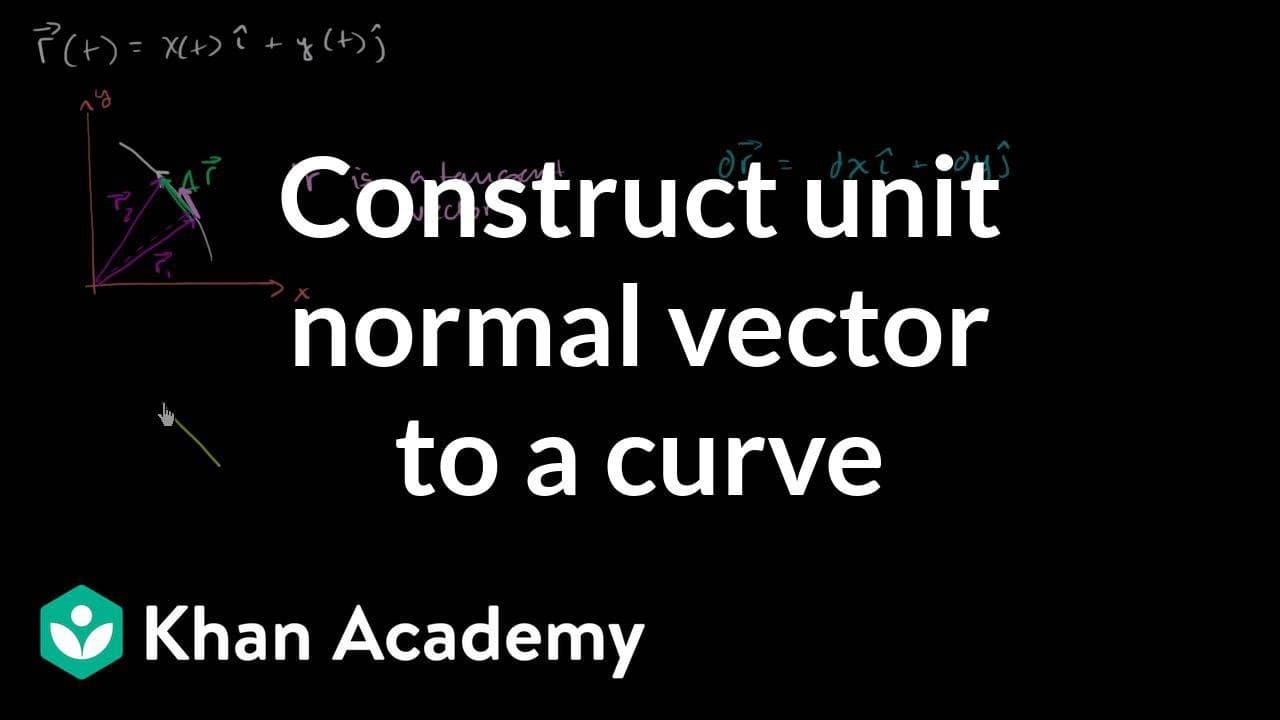
- [Voiceover] So let's say that we've got the curve R defined, so this is our curve R. It's X of T times I plus Y T times J, it's a curve in two dimensions on the XY plane. And let's graph it, just graph it in kind of a a generalized form. So that's our Y-axis. This is our X-axis. Our curve R might look something like this. It might look something,... Read More
Key Insights
- 🧘 A tangent vector can be approximated by taking the difference between two position vectors along a curve.
- ❣️ The normal vector is constructed by taking the negative reciprocal of the slope of the tangent vector and swapping the x and y components.
- 🟨 The magnitude of the normal vector is equal to the square root of the sum of the squares of the x and y components of the position vector.
- 🗂️ Normalizing the normal vector involves dividing it by its magnitude, resulting in a unit vector with a length of 1.
- 😥 The unit normal vector represents the direction perpendicular to the curve at any point.
- 👷 The construction of a unit normal vector is a fundamental concept in vector algebra and has various applications in mathematics and physics.
Install to Summarize YouTube Videos and Get Transcripts
Explore YouTube Video Summarizer or Get YouTube Transcript Extractor
Questions & Answers
Q: What is the purpose of constructing a unit normal vector on a curve?
The unit normal vector is used to determine the direction perpendicular to a curve at any given point. It is useful in various applications, such as calculating the curvature of the curve or determining normal forces in physics.
Q: How do you approximate the tangent vector using position vectors?
To approximate the tangent vector, you can take the difference between two position vectors at slightly different points along the curve. As the difference in points becomes smaller, the slope of the tangent line approaches the slope of the curve at that point.
Q: How is the normal vector constructed from the tangent vector?
The normal vector is constructed by taking the negative reciprocal of the slope of the tangent vector and swapping the x and y components. This ensures that the normal vector is perpendicular to the tangent vector.
Q: Why is it important to normalize the normal vector?
Normalizing the normal vector means dividing it by its magnitude, which makes it a unit vector with a length of 1. This is useful for consistent calculations as it simplifies further vector operations.
Summary & Key Takeaways
-
The video discusses the construction of a unit normal vector on a curve in two-dimensional space using vector algebra.
-
It explains the concept of a tangent vector and how to approximate it using the difference between two position vectors.
-
The video demonstrates how to break down the tangent vector into its horizontal and vertical components to construct the normal vector.
-
The final step involves normalizing the normal vector by dividing it by the magnitude of the position vector.
Read in Other Languages (beta)
Share This Summary 📚
Summarize YouTube Videos and Get Video Transcripts with 1-Click
Try YouTube Summary with ChatGPT & Claude or YouTube Transcript Generator
Explore More Summaries from Khan Academy 📚



Summarize YouTube Videos and Get Video Transcripts with 1-Click
Try YouTube Summary with ChatGPT & Claude or YouTube Transcript Generator