This AI Creates Virtual Fingers! 🤝
TL;DR
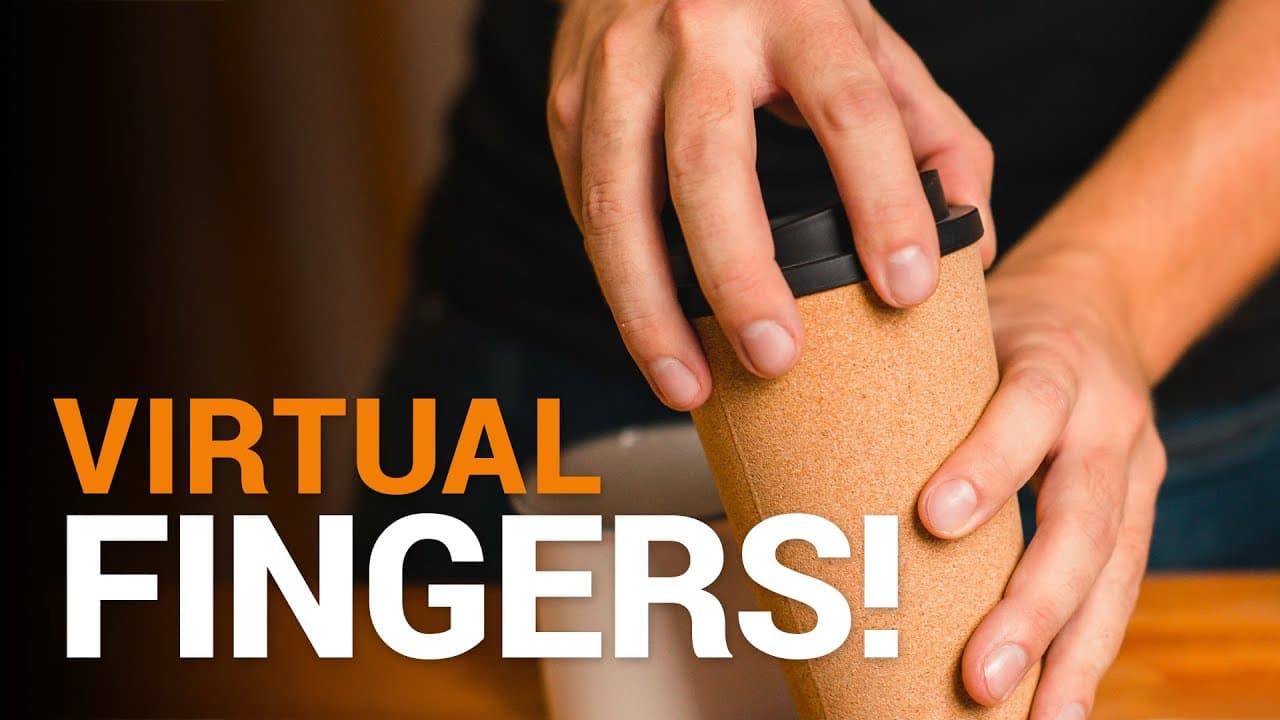
Researchers have developed a virtual reality system that can manipulate objects using only wrist sensors, creating realistic finger movements through AI synthesis.
Transcript
Dear Fellow Scholars, this is Two Minute Papers with Dr. Károly Zsolnai-Fehér. Today we are going to see how we can use our hands, but not our fingers to mingle with objects in virtual worlds. The promise of virtual reality, VR is indeed truly incredible. If one day it comes to fruition, doctors could be trained to perform surgery in a virtual envi... Read More
Key Insights
- 👾 Virtual reality has numerous potential applications in fields like medicine, space exploration, and telepresence.
- 🤗 Previous techniques for hand tracking in virtual reality have had limitations in object manipulation.
- 🖐️ The new technique utilizes wrist sensors and AI synthesis to create realistic finger movements without finger sensors.
- 🖐️ The system can manipulate objects of different sizes and shapes and can adapt its finger movements accordingly.
- 🚂 It can generalize its knowledge to manipulate objects it has not been trained on.
- 😚 The system operates in close to real time, enabling interactive experiences.
- 🤗 However, it may still struggle with small features on objects or inaccurate hand pose readings, requiring further improvements.
Install to Summarize YouTube Videos and Get Transcripts
Explore YouTube Video Summarizer or Get YouTube Transcript Extractor
Questions & Answers
Q: How does the virtual reality system manipulate objects without finger sensors?
The system reads information from only the wrist and the objects in the hand, synthesizing finger movements automatically through AI. There are no sensors on the fingers themselves.
Q: Can the virtual reality system manipulate different objects with varying sizes and shapes?
Yes, the AI can synthesize appropriate finger movements based on the geometry of the object, even when the scale changes. It can handle different objects, such as teapots, and adapt its movements accordingly.
Q: Does the virtual reality system only work on objects it has been trained on?
No, the system can manipulate objects it has not seen before. For example, it can use a teapot's handle and hold it from the bottom, even if their appearances differ. The system can generalize its knowledge to new objects.
Q: How fast does the virtual reality system operate?
The system runs in close to real time, allowing for interactive experiences. There is a slight delay, but further advancements can address this issue in future iterations.
Summary & Key Takeaways
-
Virtual reality technology has the potential to revolutionize fields such as medicine, space exploration, and telepresence applications.
-
Previous work has used learning-based algorithms to track hand orientations, but struggled with challenging hand-hand interactions and limitations in object manipulation.
-
The new technique utilizes wrist sensors and AI synthesis to create realistic finger movements, allowing users to interact with virtual objects.
Read in Other Languages (beta)
Share This Summary 📚
Summarize YouTube Videos and Get Video Transcripts with 1-Click
Try YouTube Summary with ChatGPT & Claude or YouTube Transcript Generator
Explore More Summaries from Two Minute Papers 📚




Summarize YouTube Videos and Get Video Transcripts with 1-Click
Try YouTube Summary with ChatGPT & Claude or YouTube Transcript Generator