Binary, Decimal and Hexadecimal Number Systems
TL;DR
Learn how to count in base 10 (decimal), base 2 (binary), and base 16 (hexadecimal) number systems.
Transcript
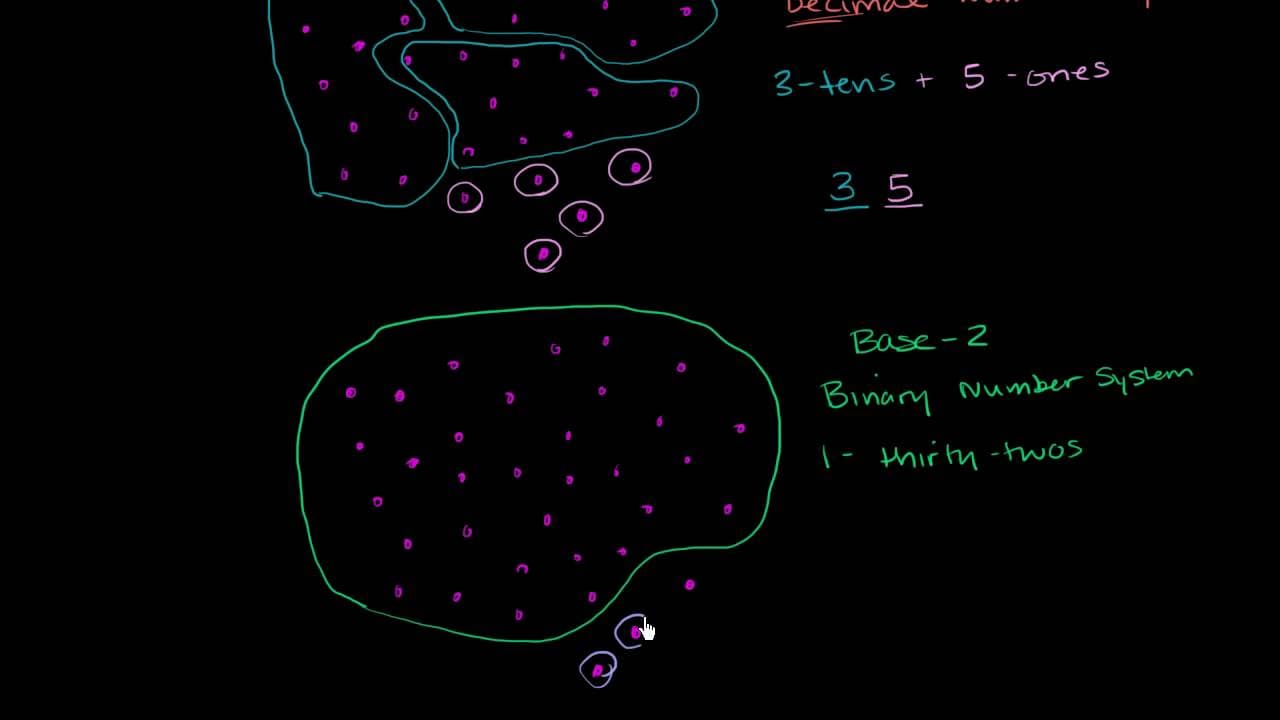
I've created a cluster of things right here and then I copy and pasted another cluster and I have a couple of these off canvas and what I want to do is represent the number of things we have in each of these clusters in different bases and eat in different number systems so first we're going to do it in base in base ten sometimes called a decimal n... Read More
Key Insights
- 👻 Different number systems, such as base 10, 2, and 16, allow for diverse ways of representing quantities.
- #️⃣ Each number system has its own base and set of digits to represent numbers.
- 👥 Grouping objects in different systems helps in efficiently representing quantities.
- ⚾ Understanding number systems beyond base 10 expands our mathematical and computational capabilities.
- #️⃣ The largest power of the base number is used for grouping in each number system.
- #️⃣ Place values play a crucial role in representing the total number of objects in each number system.
- ⚾ Base 2 (binary) has only two digits (0 and 1), while base 16 (hexadecimal) has sixteen digits, including additional symbols.
Install to Summarize YouTube Videos and Get Transcripts
Explore YouTube Video Summarizer or Get YouTube Transcript Extractor
Questions & Answers
Q: What is the purpose of counting the objects in different number systems?
Counting in different number systems helps us understand the concept of base and expands our understanding of number representation beyond decimal system.
Q: Why is the largest power of the base number used to group the objects?
Using the largest power of the base number allows us to have the fewest number of groups and simplify the representation of the total objects.
Q: How are the objects grouped and represented in base 10?
The objects are grouped in groups of ten, and the total is represented using the digits in the tens and ones places.
Q: How are the objects grouped and represented in base 2?
The objects are grouped in powers of two, and the total is represented using the digits in the twos and ones places. Each digit in base 2 is either 0 or 1.
Q: What are the additional digits used in base 16?
In base 16, the additional digits used are A, B, C, D, E, and F to represent the numbers 10, 11, 12, 13, 14, and 15 respectively.
Q: How are the objects grouped and represented in base 16?
The objects are grouped in groups of sixteen, and the total is represented using the digits in the sixteens and ones places. The additional digits are used when necessary.
Summary & Key Takeaways
-
The content explains how to represent a group of objects in different number systems (base 10, base 2, and base 16).
-
It demonstrates counting and grouping objects in each number system, starting with the largest power of the base number.
-
The content explains how to represent the total number of objects in each number system using place values.
Read in Other Languages (beta)
Share This Summary 📚
Summarize YouTube Videos and Get Video Transcripts with 1-Click
Try YouTube Summary with ChatGPT & Claude or YouTube Transcript Generator
Explore More Summaries from Khan Academy 📚



Summarize YouTube Videos and Get Video Transcripts with 1-Click
Try YouTube Summary with ChatGPT & Claude or YouTube Transcript Generator