Introduction to vertical angles | Angles and intersecting lines | Geometry | Khan Academy
TL;DR
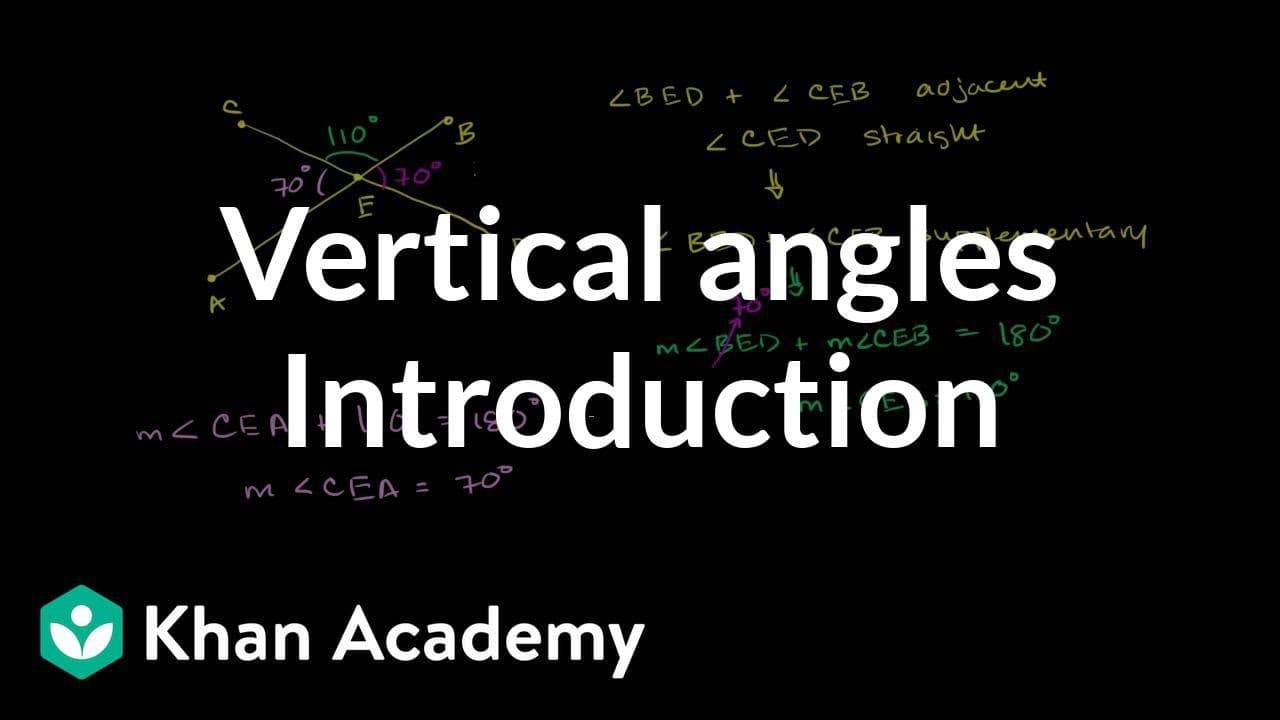
This video explains how to find the measures of various angles formed by intersecting line segments.
Transcript
Let's say I have two intersecting line segments. So let's call that segment AB. And then I have segment CD. So that is C and that is D. And they intersect right over here at point E. And let's say we know, we're given, that this angle right over here, that the measure of angle-- That B is kind of, I don't know why I wrote it so far away. So let me ... Read More
Key Insights
- 🫥 Adjacent angles formed by intersecting lines are supplementary (their measures add up to 180 degrees).
- 🔺 Vertical angles, also known as opposite angles, are always congruent.
- 🔺 Knowing the measure of one angle allows us to find the measures of adjacent and vertical angles.
Install to Summarize YouTube Videos and Get Transcripts
Explore YouTube Video Summarizer or Get YouTube Transcript Extractor
Questions & Answers
Q: How can we find the measure of angle CEB?
Angle CEB can be found by knowing that angle BED is 70 degrees and the two angles form a straight angle. Subtracting 70 from 180 gives us the measure of angle CEB as 110 degrees.
Q: How can we find the measure of angle CEA?
Angle CEA can be found using the same logic as before. Since angle CEB and angle CEA are adjacent and form a straight angle, their measures must add up to 180 degrees. Subtracting 110 from 180 gives us the measure of angle CEA as 70 degrees.
Q: Are the angles opposite to each other at intersecting lines always equal?
Yes, the angles opposite to each other at intersecting lines are always equal. These angles are called vertical angles. In the given diagram, angle BED and angle CEA are vertical angles.
Q: How can we find the measure of angle AED?
To find the measure of angle AED, we can use the fact that angles CEA and AED are supplementary because they form a straight angle. Subtracting 70 from 180 gives us the measure of angle AED as 110 degrees.
Summary & Key Takeaways
-
The video teaches how to find the measures of angles in a diagram with intersecting line segments.
-
It demonstrates how to use the fact that adjacent angles are supplementary and that vertical angles are congruent to solve for angle measures.
-
The video concludes by introducing the concept of vertical angles and hinting at their equality, which will be proven in the next video.
Read in Other Languages (beta)
Share This Summary 📚
Summarize YouTube Videos and Get Video Transcripts with 1-Click
Try YouTube Summary with ChatGPT & Claude or YouTube Transcript Generator
Explore More Summaries from Khan Academy 📚



Summarize YouTube Videos and Get Video Transcripts with 1-Click
Try YouTube Summary with ChatGPT & Claude or YouTube Transcript Generator