Stanford Seminar - ML Explainability Part 3 I Post hoc Explanation Methods
TL;DR
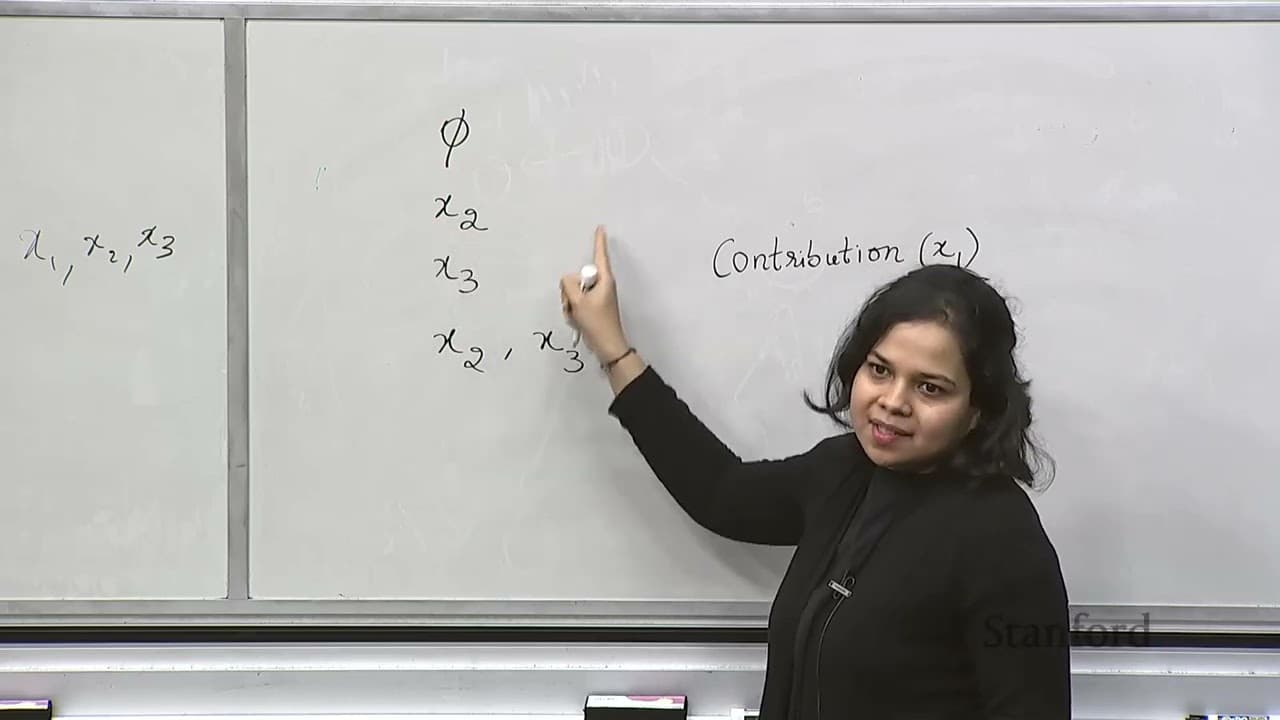
Post-hoc explanation methods provide interpretable descriptions of complex models' behavior to end users, ensuring faithfulness and interpretability. These methods can be divided into local explanations, which explain individual predictions, and global explanations, which describe the complete behavior of the model.
Transcript
all right let's get started okay okay so part two of our discussion so now we're going to focus on post hoc explanation methods right so let's think about explanations a bit more because unlike what we have been talking about so far uh there is no longer a model that is trying to be inherently interpretable here or produce things that can be interp... Read More
Key Insights
- 🫢 Post-hoc explanation methods bridge the gap between complex models and end users by providing interpretable descriptions of model behavior.
- 😃 Local explanations help understand individual predictions, while global explanations shed light on bigger picture biases and behavior.
- 🍁 Various methods, such as feature importances and saliency maps, can be used to generate local explanations.
- 👤 Counterfactual explanations guide users on how to change features to achieve desired model outcomes.
- ⚾ Representation-based approaches leverage intermediate model representations to understand the model's reliance on semantically meaningful concepts.
- ❓ Model distillation techniques approximate complex model predictions using simpler interpretable models.
- 📏 Rule-based methods, such as decision trees and rule sets, provide intuitive global explanations by mimicking complex model predictions.
Install to Summarize YouTube Videos and Get Transcripts
Explore YouTube Video Summarizer or Get YouTube Transcript Extractor
Questions & Answers
Q: What are the key properties of explanations in the post-hoc setting?
Explanations in the post-hoc setting should faithfully describe the behavior of the classifier and be interpretable to the end user.
Q: How do local explanations differ from global explanations?
Local explanations explain individual predictions, uncover biases, and help assess predictions in a local neighborhood. Global explanations provide an overview of the model's behavior, helping uncover big picture biases.
Q: What are some popular methods for generating local explanations?
Feature importances, saliency maps, and prototypes are commonly used methods for generating local explanations.
Q: How can counterfactual explanations be used in practice?
Counterfactual explanations can provide insights into how to change features and by how much to flip a model's prediction, facilitating model improvement and decision-making.
Summary & Key Takeaways
-
Post-hoc explanation methods focus on providing interpretable descriptions of complex models' behavior to end users.
-
Local explanations aim to explain individual predictions, while global explanations provide a bird's eye view of the model's behavior.
-
Local explanation methods include feature importances, saliency maps, and prototypes, while global explanation methods involve representative local explanations and representation-based approaches.
Read in Other Languages (beta)
Share This Summary 📚
Summarize YouTube Videos and Get Video Transcripts with 1-Click
Try YouTube Summary with ChatGPT & Claude or YouTube Transcript Generator
Explore More Summaries from Stanford Online 📚

Summarize YouTube Videos and Get Video Transcripts with 1-Click
Try YouTube Summary with ChatGPT & Claude or YouTube Transcript Generator